

For as long as humanity has existed, the sun has been our one constant.
It’s the engine of all life, the warm light on our face, the silent, massive anchor of our cosmic home. It feels permanent. It feels eternal.
But it’s not.
Our sun is a star. And like every star in the sky, it has a finite lifespan. It was born in a cloud of dust, it’s currently living its long “middle age,” and one day, it will die. This simple, cosmic fact leads straight to one of the most profound questions we can ask: What is the sun’s final destiny?
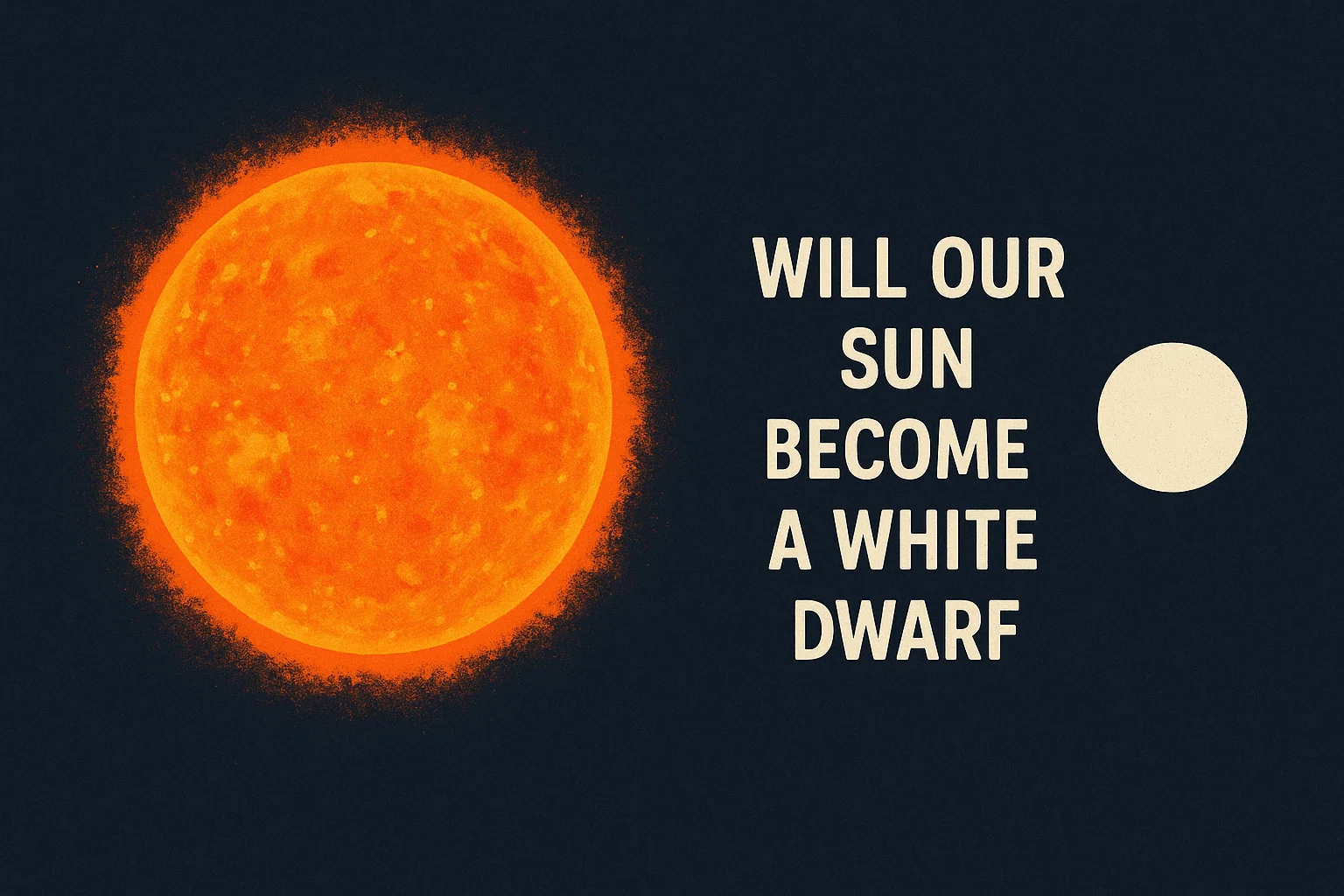
For most of us, the question is much more specific: will our sun become a white dwarf?
The short answer is a resounding, definitive yes.
But that simple “yes” hides one of the most violent, beautiful, and utterly mind-boggling transformations in the entire universe. The journey from the star we know and love today to its final, tiny ember is a story of unimaginable scale, time, and power. It’s not just the sun’s story.
It’s the final chapter of our entire solar system. Let’s trace that journey.
More in Celestial Objects Category
Why Are Neutron Stars So Dense
Key Takeaways
- Yes, It Will: The answer to “will our sun become a white dwarf?” is definitive. Our sun’s mass is in the perfect “Goldilocks” range to end its life as a white dwarf, not a black hole.
- The Timeline: Don’t panic. The sun is only about 4.6 billion years old, roughly halfway through its 10-billion-year main-sequence lifespan. The “end” won’t even begin for another 4.5 to 5 billion years.
- The Red Giant Phase: Before it becomes a white dwarf, the sun will swell into a “red giant.” It will become a monstrous, bloated version of itself, expanding to engulf Mercury, Venus, and almost certainly Earth.
- Planetary Nebula: After the red giant phase, the sun will shed its outer layers. This process will create a stunning, intricate, and glowing cloud of gas called a planetary nebula.
- The Final Ember: The white dwarf is the hot, incredibly dense core left behind after the planetary nebula cloud dissipates. This core will be about the size of Earth but will contain roughly 60% of the sun’s original mass.
- The Long Cool-Down: This white dwarf will no longer produce new heat. It’s a dead ember. It will simply spend trillions of years slowly cooling down until it becomes a cold, invisible “black dwarf.”
First Off, Is Our Sun Even Special?
It’s easy to think of our sun as one-of-a-kind. It’s our star, after all. It’s the star of the show.
But in the grand cosmic zoo, our sun is comfortably, almost boringly, average. It’s a G-type main-sequence star, or “yellow dwarf” (though it’s technically white, our atmosphere just filters the light to make it look yellow). It’s a reliable, middle-of-the-road kind of star.
And this “average” status is actually the single most important clue to its future.
A star’s entire life—from its fiery birth in a nebula to its dramatic death—is dictated by one single factor: its mass. How much “stuff” did it start with?
That initial mass sets all the rules. It determines how hot the star burns, how long it lives, and, most critically, how it dies. In the universe, there are really only two main death-paths for stars: the high-mass path and the low-mass path.
Our sun is firmly, and thankfully, in the low-mass category.
How Do the Fates of Stars Differ?
Think of it this way: the real titans of the galaxy, the blue-white superstars more than eight to ten times the mass of our sun, are the rockstars of the cosmos. They live fast, burn unbelievably bright, and die young.
They burn through their entire fuel supply in a cosmic flash—a few million years, tops. When their fuel runs out, they don’t go gently. They die in a supernova, one of the most violent events in the universe. A supernova explosion is so powerful it can forge all the heavy elements (like the gold in your jewelry) and briefly outshine its entire host galaxy.
What’s left behind is just as extreme: either a spinning, hyper-dense neutron star or, if the star was a true monster, a black hole.
Our sun is just not in that weight class. It’s a lightweight.
Stars like our sun, and in fact, about 97% of all stars in the Milky Way, take the low-mass path. They are the marathon runners, not the sprinters. They live long, stable lives for billions of years and then die with a majestic, (relatively) gentle sigh.
This “gentle sigh” is the process that leads directly to a white dwarf.
What’s Powering the Sun Right Now?
To understand how the sun dies, we first have to understand what’s keeping it alive. What makes it shine?
The answer is nuclear fusion. And the scale of it is hard to grasp.
Deep in the sun’s core, the pressure is an almost imaginary 250 billion times Earth’s atmospheric pressure. The temperature is a blistering 27 million degrees Fahrenheit. Under these insane conditions, something incredible happens. Hydrogen atoms, the sun’s primary fuel, are stripped of their electrons and are moving so fast they can’t avoid each other. They are slammed together with such force that they fuse.
In this specific reaction, called the proton-proton chain, four hydrogen atoms are fused, through a few steps, into one helium atom.
This process, however, isn’t a perfect 1-to-1 swap. The resulting helium atom has just a tiny bit less mass than the four hydrogen atoms that went into it.
That “lost” mass isn’t truly lost. It’s converted directly into a pure, titanic burst of energy. This is the E=mc² that Einstein made famous. This energy, in the form of gamma rays, is the sun’s heartbeat.
But here’s a wild thought: that burst of light doesn’t just fly straight out. The sun’s interior is so dense that the photon of light has to “random walk” its way out, bouncing off atoms, getting absorbed, and re-emitted, over and over. This journey can take, on average, over 100,000 years.
The light hitting your face right now was created in the sun’s core before human civilization even began.
What Is This “Main Sequence” I Keep Hearing About?
This stable, hydrogen-fusing state is what astronomers call the “main sequence.” Our sun has been on the main sequence for 4.6 billion years and will stay there for another 5 billion or so.
It’s a star’s long, stable, boring adulthood.
And “boring” is the best thing it could possibly be for us. During this phase, the sun is in a state of perfect balance, an elegant tug-of-war that has lasted for billions of years.
- Fusion (Outward Push): The nuclear furnace in the core is constantly releasing energy, trying to blow the star apart.
- Gravity (Inward Pull): The star’s own colossal mass is constantly trying to crush it all down into a single point.
This stalemate, called hydrostatic equilibrium, is what keeps our sun a stable, reliable sphere of light. It’s this very stability that allowed life to evolve on Earth over billions of years.
The entire story of a star’s death, from red giant to white dwarf, is simply the story of what happens when this delicate balance is finally, catastrophically broken.
And it will be broken.
When Does the ‘End of Days’ for Our Sun Begin?
The sun’s engine runs on hydrogen. But its fuel tank isn’t infinite.
In about 5 billion years, the hydrogen in the very center of the core—the part that’s hot and dense enough to fuse—will be exhausted. It will all have been turned into helium “ash.”
The fire in the very center of the sun will stop.
And that’s when everything changes.
With the outward push of fusion gone, the tug-of-war is over. Gravity wins. Instantly. The core, now made of inert helium, will begin to collapse under its own crushing weight. This collapse is the trigger for the sun’s dramatic death.
You might think this would make the sun smaller. But here comes the first great paradox of stellar death: the collapse of the core makes the rest of the star swell to a monstrous size.
What’s the Very First Sign the Sun Is Changing?
As that helium core collapses, the pressure and temperature in the layers just outside the core skyrocket. It gets so hot, in fact, that it ignites the unused hydrogen in a shell around the dead core.
This is called hydrogen shell burning.
This new fire is unbelievably intense. It’s far hotter and more ferocious than the gentle core-burning the sun did in its youth. This new, supercharged engine, burning closer to the surface, produces a massive new blast of energy.
This immense outward pressure shoves the sun’s outer layers—the ones that aren’t fusing—further and further out.
The sun will begin to swell. And swell. And swell.
Its surface will expand, and as it gets further and further away from the hot, new engine, it will cool down. A cooler star shines redder.
The sun will become a red giant.
What Will the Red Giant Phase Actually Look Like from Earth?
This phase won’t be subtle. It will be the end of the solar system as we know it.
The sun will swell over millions of years, growing larger, and larger, and larger. Its new, bloated size will be terrifying. It will expand past the orbit of Mercury, vaporizing the planet instantly. It will swell further, its red, wispy atmosphere consuming Venus.
Then, it will reach Earth.
How Big Will the Sun Actually Get?
Astronomers are fairly certain the red giant sun will expand to a radius of about 1 Astronomical Unit (AU).
What’s 1 AU? It is the exact, current distance between the sun and the Earth.
So, yes. The sun will swallow us.
The visible “surface” of the sun will be at our current location. Earth, if it’s not pushed into a slightly wider orbit by the sun’s changing mass, will be engulfed by the star’s fiery, thin outer atmosphere.
What Happens to Earth?
It’s hard to overstate the end. It’s not just “it gets hot.” It’s a step-by-step planetary execution.
Long, long before the sun’s surface actually reaches us, the heat will be unimaginable. The sun’s “luminosity,” or its total energy output, will increase by a factor of a thousand or more.
This new, intense radiation will be a blowtorch aimed at our world.
First, the oceans will boil. All of them. The entire planet will be enveloped in a thick, scalding steam atmosphere. Eventually, that steam will be blasted off into space by the solar wind, leaving the planet dry.
The continents will be next. The surface of the Earth will become a single, global desert of scorched rock, hot enough to melt lead, then copper, then iron. Our planet will be reduced to a charred, lifeless, molten slag-ball.
Then, the sun’s edge will arrive.
Our planet, or what’s left of it, will be vaporized. It will spiral inward, broken apart by tidal forces and incinerated, its atoms becoming just another part of the sun’s-material. A final, tiny contribution to the star that once gave it life.
Even if Earth were to somehow survive by being pushed into a wider orbit, it wouldn’t matter. It would be a sterile, baked cinder. The “habitable zone,” the cozy region where liquid water can exist, will have moved out past Mars, out to the orbit of Jupiter and Saturn.
Perhaps, for a brief, fleeting moment, Saturn’s icy moons like Titan and Enceladus could melt, forming temporary, fleeting oceans on their surfaces.
The Sun’s “Mid-Life Crisis”: What Happens After It’s a Red Giant?
This red giant phase, powered by that hydrogen shell, lasts for about a billion years. All this time, the “dead” helium core at the center has been collapsing, getting hotter and denser.
Eventually, the temperature in that collapsing core hits a new magic number: 100 million degrees.
At this temperature, a new fusion reaction ignites. Helium, the “ash” from the first fire, becomes the fuel for a new fire. The helium atoms, in what’s called the triple-alpha process, begin to fuse into carbon and oxygen.
Here’s the kicker: in a star like our sun, this core is so dense that it’s in a quantum state (degenerate). When the helium does ignite, it doesn’t ignite gradually. It ignites all at once, in a runaway reaction that lasts mere minutes.
This new ignition is an incredibly sudden and violent event called the helium flash. An unimaginable amount of energy is released inside the core, a nuclear detonation that would be invisible from the outside.
So, the Sun Shrinks Again?
For a little while, yes. The new, stable helium-burning engine in the core creates a new, powerful outward push, re-establishing a temporary balance. This new energy source actually forces the sun to shrink back down from its bloated red giant size.
It becomes smaller, hotter, and more stable.
It gets a temporary new lease on life, a second, brief “adulthood,” steadily fusing helium into carbon and oxygen in its core. But this phase is short-lived. It only lasts for about 100 million years. Why so fast? Because helium fusion, as a fuel, is far less efficient than hydrogen.
The sun burns through its entire helium supply in a cosmic heartbeat.
What Happens When the Helium Runs Out?
You guessed it. The same story, one last time. But with more violence.
The helium in the core is exhausted, leaving behind a new “dead” core made of carbon and oxygen. This new core begins to collapse.
Gravity wins. Again.
This final collapse ignites two shells around the core: an inner shell of fusing helium and an outer shell of fusing hydrogen. This is the sun’s last, desperate gasp.
This “double-shell burning” phase makes the sun swell up again, becoming even larger and far more unstable than the first time. This is the “Asymptotic Giant Branch” (AGB) phase. The sun is now a truly monstrous, pulsating, and unstable star.
How Does the Sun Finally… Disappear?
During this final, unstable AGB phase, the sun’s “engine” is sputtering. These two burning shells are not stable. They flicker, flare, and send “thermal pulses” or “hiccups” of energy shuddering through the star.
These pulses are so powerful that they literally “puff” the sun’s outer layers off into space.
Remember, the sun is now so enormous that its surface gravity is incredibly weak. Those outer layers are hanging on by a thread. Each thermal pulse acts like a cosmic gust of wind, pushing more and more of the sun’s atmosphere—its hydrogen and helium envelope—away from the core.
A massive, slow-motion wind of stellar material begins to flow out into the solar system. Over a few thousand years, the sun effectively evaporates, shedding as much as 40% of its total mass.
What Is a “Planetary Nebula”?
This beautiful, expanding, intricate cloud of ejected gas is what we call a planetary nebula.
The name is a complete misnomer, a confusing holdover from 18th-century astronomers who thought these glowing, round clouds looked like planets (like Uranus) through their small telescopes. They have absolutely nothing to do with planets.
They are, quite simply, the beautiful, intricate shrouds of dying stars.
As this cloud of gas expands, something amazing happens. The part of the sun that is left behind—the collapsed, dead core of carbon and oxygen—is finally revealed. And it is spectacularly, blindingly hot.
This exposed core, no longer hidden, unleashes a torrent of high-energy ultraviolet radiation. This radiation slams into the expanding gas cloud that was once the sun’s outer layers, causing it to ionize and glow like a giant, cosmic neon sign.
This is the stunning beauty we see in telescope images like the Ring Nebula or the Helix Nebula. They aren’t simple bubbles; their complex, butterfly, or hourglass shapes are likely sculpted by the dying star’s rotation, magnetic fields, and any companion planets.
But they are fleeting. They only glow for about 10,000 years before the gas cloud expands and diffuses so much that it just fades into the blackness of interstellar space, recycling the sun’s elements for the next generation of stars.
So, Will Our Sun Become a White Dwarf? The Big Reveal.
Yes. That small, searingly hot, naked core left behind at the center of the planetary nebula?
That is the white dwarf.
It’s the end of the line. It’s the carbon-oxygen core that just wasn’t massive or hot enough to ignite a new fusion reaction. For carbon to fuse (into heavier elements like magnesium and neon), you need temperatures over 600 million degrees. Our sun’s core will never get that hot.
The fusion stops. For good.
What Is a White Dwarf, Really?
A white dwarf is one of the strangest, most extreme objects in the universe. It is the corpse of a star, but it’s a corpse with some very weird properties.
Our sun’s core, which will contain about 60% of the sun’s original mass (about 0.6 solar masses), will have collapsed down to a sphere roughly the size of the Earth.
Stop and think about that. More than half the mass of the sun, an object you could fit 1.3 million Earths into, crammed into a ball the size of our planet.
The density is staggering. A single teaspoon of white dwarf material would weigh about 15 tons on Earth. A sugar cube of it would weigh as much as a school bus. Gravity on its “surface” would be over 100,000 times stronger than what you feel right now.
Why Doesn’t This Core Collapse Into a Black Hole?
With all that mass in such a small space, why doesn’t gravity just win the final battle and crush it into a singularity?
This is where quantum mechanics steps in with one last, bizarre trick. The core is saved by something called electron degeneracy pressure.
In a normal gas, particles are zipping around with lots of space. But in a white dwarf, the matter is packed so tightly that the electrons are forced into their lowest possible energy states. Think of it like a game of musical chairs where all the chairs are on the floor. The rules of quantum physics (specifically, the Pauli Exclusion Principle) state that no two electrons can occupy the same state (or “chair”) in the same place.
The electrons, in short, resist being crushed any further. They’re out of room. They push back.
This “degeneracy pressure” is not a thermal pressure, like in a normal star. It’s a purely quantum-mechanical force. And it is strong enough to halt the crush of gravity, forever.
This pressure is the only thing holding the white dwarf up. It’s also the reason there’s a mass limit. If a star’s core is more than 1.4 times the mass of our sun (a number known as the Chandrasekhar Limit), this electron pressure will fail. Gravity will win, and the star will collapse, triggering a supernova.
But our sun’s core will be well below that limit. It is destined to be a white dwarf. And we are very, very certain of this. Our observations of other stars in all these life stages confirm this model.
What Will This “White Dwarf Sun” Be Like?
So, the sun will be gone. Our planet will be gone. In its place will be a tiny, glowing-hot stellar ember. What will the solar system be like?
The remaining planets—Mars (if it survives, now a scorched rock), Jupiter, Saturn, Uranus, and Neptune—will all still be there. They will be orbiting this new, tiny, Earth-sized star. But their orbits will be wider now, since the sun “lost” so much mass when it puffed away its outer layers.
The solar system will be a dark, silent, and frozen place.
Will It Still Be Bright?
The white dwarf will be incredibly hot when it’s born, with a surface temperature of over 100,000 degrees Celsius, far, far hotter than the sun is today.
But it will also be tiny. The size of a planet.
Because its surface area is so small, its total luminosity will be very low. It will shine with a brilliant, blue-white light, but it’s just a pinpoint, not a life-giving sun. From the vantage point of a frozen Jupiter, the white dwarf sun would be just a single, extraordinarily bright star in the sky, not a disk. It would provide practically no heat.
The solar system will be plunged into a permanent, deep-freeze. This tiny, cooling corpse will be the only tombstone for the star that once anchored a vibrant, living system.
And Then… The Real End?
A white dwarf is a stable object. It’s held up by electron degeneracy pressure, a quantum-mechanical certainty that doesn’t fade. So, does it just… stay there forever, a hot ember in the dark?
Pretty much.
The white dwarf is dead. It has no internal source of heat. It is not generating any new energy. It’s just a hyper-dense, super-hot “space rock” that will spend the rest of eternity radiating its leftover heat into the cold of space.
And that process is impossibly slow.
What’s a “Black Dwarf”?
The universe is currently about 13.8 billion years old. That sounds like a long time.
But astronomers calculate that it will take a white dwarf trillions of years to radiate all its heat away and cool down to the background temperature of the universe (just a few degrees above absolute zero).
The universe is not nearly old enough for this to have happened yet. Not even once, anywhere. There are no black dwarfs.
Not yet.
But, theoretically, this is the final stage. A white dwarf that has finally cooled completely, a cold, dark, invisible sphere of degenerate matter floating in the dark.
This theoretical object is called a black dwarf.
It’s the true, final death of a star like our sun. A cold, dead crystal of carbon and oxygen, the size of a planet, orbiting the dark ruins of its former solar system, in a universe so ancient and dark it may be unrecognizable.
It’s a quiet, cold, and lonely end.
It’s written in the laws of physics, dictated by the sun’s very mass. It is the inevitable, distant, and spectacular fate that awaits our solar system. In billions of years, our sun will swell into a destroyer, then shed its layers to create a breathtaking celestial flower, before finally settling down for an eternal rest as a tiny, dense, and slowly fading diamond in the dark.
FAQ – Will Our Sun Become a White Dwarf
What is the timeline for the sun’s transformation into a white dwarf?
The sun will begin its final transformation into a white dwarf in about 4.5 to 5 billion years, after it goes through phases like becoming a red giant and shedding its outer layers.
What happens during the red giant phase of the sun?
During the red giant phase, the sun will swell dramatically, expanding past the orbit of Mercury, Venus, and possibly Earth, engulfing or vaporizing these planets in the process.
What exactly is a white dwarf, and how does it form?
A white dwarf is the dense, hot core of a star that remains after the star has shed its outer layers, forming planetary nebulae; it is stabilized by electron degeneracy pressure and does not undergo further fusion.
Can the white dwarf eventually cool down and become a black dwarf?
Yes, over trillions of years, a white dwarf will gradually cool and emit less heat until it becomes a black dwarf, which is a hypothetical, cold, dark remnant of the star.