

You’re standing in your backyard on a freezing Tuesday night. The sky is clear, the air is crisp, and you tilt your head back to look at Orion. You see that bright, bluish-white star at the hunter’s foot? That’s Rigel. It looks peaceful, doesn’t it? It sits there like a diamond, steady and unmoving. But that calmness is a total lie.
If you could zoom in on Rigel, you wouldn’t see a peaceful star. You would see a violent, screaming monster tearing itself apart.
We tend to think of stars as eternal. To us, they are. They outlast our empires, our species, and even our planet’s geology. But in the grand casino of the cosmos, some stars play it safe, and others go all in on the first hand. Blue giants are the high rollers. They live fast, shine with a brilliance that defies logic, and die young in spectacular explosions.
I’ve always been obsessed with this paradox. You’d assume that a massive star—one that holds way more fuel than our Sun—would burn longer. It’s like a car with a bigger gas tank, right? Wrong. It turns out, the laws of physics don’t care about our intuition.
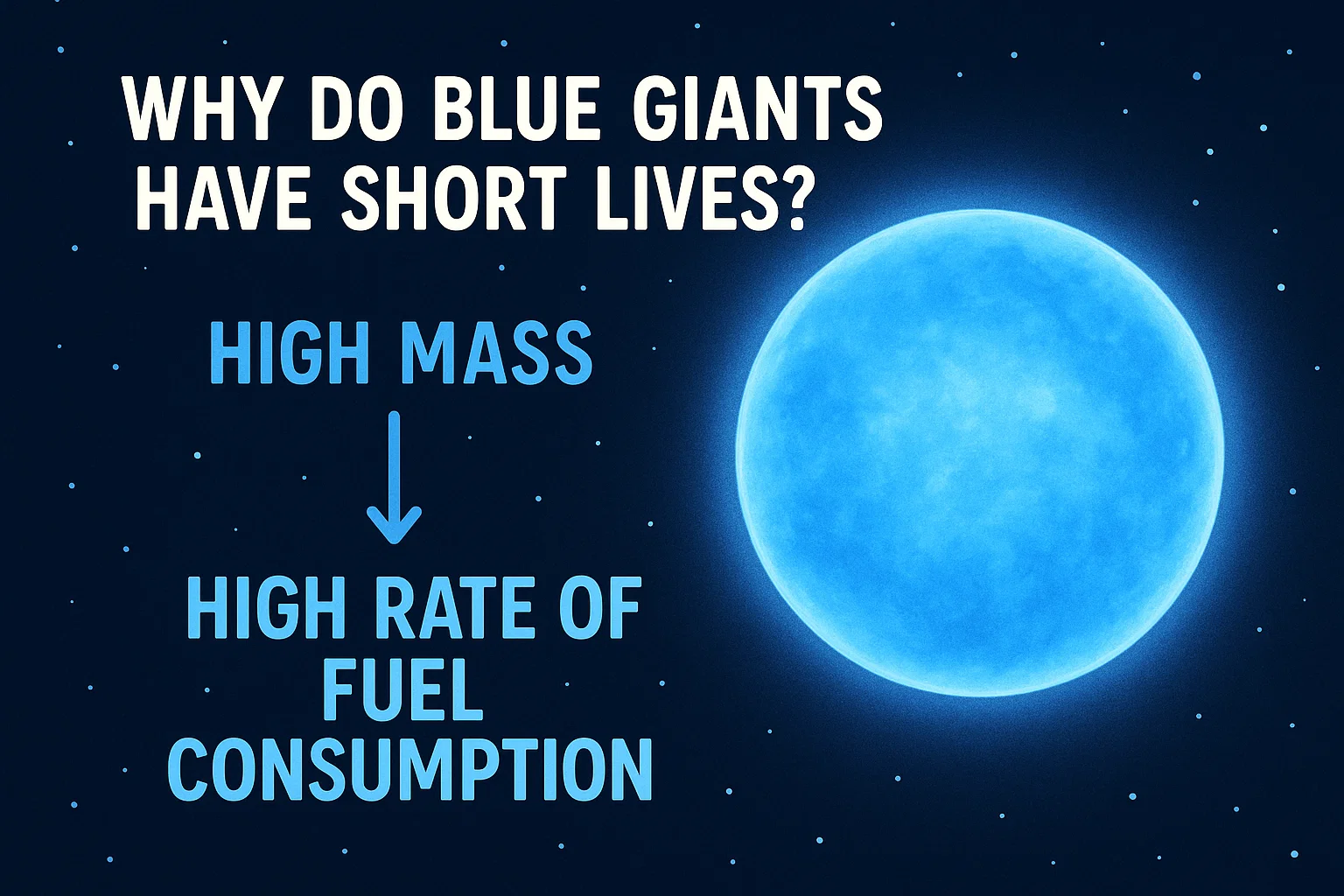
So, why do blue giants have short lives? The simple answer is that they are terrible at budgeting. They burn through their energy reserves at a rate that borders on insanity. But the real story involves a deep dive into nuclear physics, gravity, and the inevitable tragedy of being too powerful for your own good.
More in Celestial Objects Category
Difference Between Meteoroid Meteor Meteorite
What Is Left After a Supernova
Key Takeaways
- Mass is a Double-Edged Sword: The more mass a star has, the harder gravity squeezes the core, forcing it to burn fuel exponentially faster.
- The CNO Cycle: Blue giants use a catalytic fusion process that acts like a turbocharger, incinerating hydrogen supplies in a blink of cosmic time.
- Hydrostatic Equilibrium: These stars are locked in a desperate tug-of-war between gravity and outward pressure; stopping the burn means instant collapse.
- Inefficient Mixing: Unlike smaller stars, blue giants don’t circulate their fuel well, meaning they often die with plenty of unburnt hydrogen left in their outer layers.
- Violent Exits: Their short lives almost always end in Type II supernovae, scattering the elements that make up our bodies across the universe.
What Exactly Makes a Star a “Blue Giant”?
Let’s get our definitions straight before we start dissecting these beasts. When astronomers talk about blue giants, they aren’t just talking about big stars. They are talking about the O and B class stars on the Hertzsprung-Russell diagram (a fancy chart scientists use to sort stars).
These things are massive. We are talking 10, 20, even 50 times the mass of our Sun. But mass is just the starting point. The surface temperature of our Sun is a respectful 10,000 degrees Fahrenheit (5,500 Celsius). A blue giant? You’re looking at temperatures soaring above 50,000 degrees Fahrenheit (28,000 Celsius).
That heat is why they look blue. Physics dictates that hotter objects emit light with shorter wavelengths. Red is “cool” in stellar terms (though still hot enough to incinerate you), yellow is midway, and blue is the extreme.
So, you have a star that is incredibly heavy and unbelievably hot. This combination sets the stage for a very quick demise.
Is Having More Fuel Actually a Bad Thing?
Here is where the logic trips people up. A blue giant starts its life with a massive reservoir of hydrogen. If our Sun has a tank spanning 10 gallons, a blue giant has a tanker truck holding 1,000 gallons.
You look at that and think, “Great, that star is going to run forever.”
But you have to look at the engine.
Our Sun drives a sensible sedan. It sips gas. It’s efficient. A blue giant drives a rocket ship that is actively exploding. The relationship between a star’s mass and its brightness (luminosity) isn’t a 1-to-1 ratio. It’s closer to a power of 3.5.
This means if you double the mass of a star, you don’t just double its brightness. You increase it by a factor of roughly 11. If you have a star 10 times as massive as the Sun, it isn’t 10 times brighter. It’s about 3,000 times brighter.
To produce that much light and heat, the star has to chew through its fuel supply at a ferocious pace. It doesn’t matter that the tank is huge because the consumption rate is astronomical. This disproportionate burn rate is the fundamental reason why blue giants have short lives. They are rich in resources but spend them like there is no tomorrow—because for them, there isn’t.
How Does Gravity Act as the Villain in This Story?
I like to view stars as battlegrounds. A star is never truly stable; it’s in a constant state of crisis management.
On one side, you have gravity. Gravity wants to crush everything toward the center. It wants to turn the star into a tiny, dense point. Since blue giants are so massive, the gravitational force crushing down on the core is terrifying.
On the other side, you have thermal pressure. This is the energy created by nuclear fusion pushing outward. It holds the ceiling up.
In a small star like a red dwarf, gravity is weak. The star doesn’t need to work very hard to keep the ceiling from collapsing. It can fuse hydrogen slowly and chill out for trillions of years.
In a blue giant, gravity is a 50-ton weight sitting on the star’s chest. To keep from being crushed, the core has to push back with insane power. The only way to generate that kind of pressure is to fuse hydrogen atoms frantically. The star can’t take a break. If it slows down its fusion rate by even a fraction, gravity wins, and the star collapses. It is forced to burn fast just to exist.
What Is the CNO Cycle and Why Is It So Wasteful?
We need to get a little technical for a second, but stay with me. This is the mechanism that kills these stars.
Our Sun uses something called the Proton-Proton chain to fuse hydrogen. It’s a slow, methodical process. It involves smashing protons together and waiting for nature to take its course. It works great at lower temperatures.
Blue giants are too hot for that. Their cores are millions of degrees hotter than the Sun’s. At these temperatures, they switch to a different fusion method called the CNO Cycle (Carbon-Nitrogen-Oxygen).
In this process, carbon atoms act as a catalyst. They grab a hydrogen proton, undergo a series of transformations involving nitrogen and oxygen, and spit out a helium atom, releasing energy. Then the carbon goes back to grab another proton.
Here is the kicker: The CNO cycle is incredibly sensitive to temperature. If you raise the core temperature by just a little bit, the energy production skyrockets. Because blue giants are under such heavy gravitational pressure, their cores are scorching. This engages the CNO cycle at full throttle. It’s like pouring gasoline on a campfire. The hydrogen doesn’t just burn; it vanishes.
Just How Short Are We Talking?
When astronomers say “short,” they warp our sense of time. To a geologist, a million years is a decent amount of time. To an astronomer, it’s a blink.
Let’s look at the numbers:
- Red Dwarfs: Live for 1 trillion+ years. (Longer than the current age of the universe).
- The Sun: Lives for about 10 billion years. (We are halfway through).
- Blue Giants: Live for 10 million to 100 million years.
That’s it.
Think about the dinosaurs. They died out 65 million years ago. If a blue giant was born the day the asteroid hit Earth, it might already be dead by now. In the timeline of the cosmos, these stars are camera flashes. They pop into existence, light up the galaxy, and vanish before anyone gets a good look.
This extreme brevity explains why they are relatively rare. You have to catch them in the act.
Why Don’t They Just Cool Down and Last Longer?
It’s a fair question. If burning fast kills you, why not slow down?
The star doesn’t have a choice. Remember the gravity issue? The star creates its own trap. It gathers mass to form, but that mass creates the gravity that demands high pressure.
If a blue giant tried to cool down—if the fusion rate dropped—the outward pressure would vanish. Gravity would instantly slam the outer layers inward. This compression would heat the core back up, reigniting the fusion even harder than before.
The star is locked in a feedback loop. It must remain hot to support its own weight. It’s the equivalent of having to sprint at full speed just to stay upright. You can’t jog. You can’t walk. You sprint until you collapse.
The Convection Problem: Leaving Fuel on the Table
There is another tragic design flaw in blue giants. They die with a full tank of gas.
Red dwarfs are fully convective. Imagine a pot of boiling soup where the stuff at the bottom mixes with the stuff at the top. Red dwarfs cycle their hydrogen. They can use almost 100% of their fuel supply because fresh hydrogen from the surface eventually cycles down to the core to be burned.
Blue giants don’t do this. Their interiors are stratified, like a layer cake. The core is separate from the radiative zone, which is separate from the surface.
The fusion only happens in the core. The star burns through the hydrogen in the center effectively, but it can’t reach the massive reserves of hydrogen floating in the outer layers. It’s like driving a car that dies when the main line is empty, even though you have 50 gallons in the back seat that you can’t access. This inefficiency cuts their potential lifespan significantly.
What Happens When the Hydrogen Runs Out?
This is where the “short life” transitions into a “violent death.”
For a blue giant, running out of hydrogen isn’t a gentle fade into the night. It’s a crisis. The moment fusion stops, gravity—which has been waiting for millions of years—slams the core shut.
The core shrinks. The pressure spikes. The temperature goes through the roof. Suddenly, the star starts fusing helium into carbon. It swells up into a Red Supergiant (like Betelgeuse is right now).
But helium runs out fast. So it fuses carbon. Then neon. Then oxygen. Then silicon.
Each stage is shorter than the last. It might burn hydrogen for 10 million years. Helium for 1 million. Carbon for a thousand years. By the time it gets to silicon, it burns through that fuel in literally days.
The Iron Dead End
The end of the road is iron.
Fusing elements lighter than iron creates energy. It releases heat. That heat fights gravity. But fusing iron is different. Iron is the most stable element in the universe. Fusing iron doesn’t create energy; it consumes it.
The instant the core creates iron, the engine stalls. The outward pressure drops to zero.
In a fraction of a second, the core collapses from something the size of Earth to something the size of Manhattan. It collapses at 25% the speed of light. The outer layers of the star rush in, hit this super-dense core, and bounce off.
Boom.
You get a Type II Supernova. For a few weeks, that single star shines brighter than the entire galaxy that houses it.
Why Should We Care About These Short-Lived Stars?
It sounds like a waste, doesn’t it? A star gathers all that material just to blow it up a few million years later.
But this is why you are here.
Why do blue giants have short lives? To create you.
The Big Bang only created hydrogen, helium, and a pinch of lithium. That’s it. You can’t build a human out of gas. You need carbon, oxygen, nitrogen, iron, calcium, and phosphorus.
Those heavy elements are only created in one place: the pressure cookers inside massive stars. When a blue giant dies and explodes, it blasts those elements out into the universe.
That cloud of debris mixes with other gas clouds. Eventually, gravity pulls that enriched cloud together to form a new star (like our Sun) and planets (like Earth). The iron in your blood came from the death of a blue giant. The calcium in your teeth was forged in the core of a star that lived fast and died young. Their short lives are the price paid for the complexity of the universe.
Can We See Them in the Night Sky?
Yes, and they are some of the most famous stars you know.
I mentioned Rigel in Orion. That’s a classic blue supergiant. Then there is Spica in the constellation Virgo. These stars are incredibly far away, yet we can see them with the naked eye because they are so luminous.
If you put a red dwarf where Rigel is (about 860 light-years away), you would need a powerful telescope to see it. But Rigel acts like a lighthouse.
Observing them is a race against time. We see them in open clusters, usually surrounded by the wispy gas of the nebula that birthed them. They don’t have time to wander off. Our Sun has circled the galaxy about 20 times. A blue giant often doesn’t even finish half an orbit before it detonates.
The Role of Stellar Winds
There is one more factor that shortens their lifespan. These stars are literally blowing themselves away.
The light coming off a blue giant is so intense that it carries physical momentum. It pushes gas away from the surface. We call this “stellar wind.”
But this isn’t a gentle breeze. A massive star can lose a mass equivalent to the Earth every single year just through wind. Some stars, known as Wolf-Rayet stars (which are often evolved blue giants), have shed their entire outer envelopes, exposing their searing hot cores to space.
Imagine trying to keep a fire going while someone is actively shoveling the wood out of the fireplace. That’s what a blue giant deals with. It burns fuel inside and loses fuel outside simultaneously.
Do Binary Companions Make It Worse?
To make matters more complicated, most blue giants have a partner. Massive stars love company. They often form in binary pairs.
Sometimes, these stars get too close. They start swapping gas. One star might strip the outer layers off the other. This “vampire” behavior can alter the lifespan of both stars.
If a blue giant steals mass from its neighbor, it gets heavier. As we know, more mass equals more gravity, which equals a faster burn rate. So, by “eating” its neighbor, the star actually rushes toward its own death even faster. It’s a gluttonous path to destruction.
A Recap on the Physics of Short Lives
Let’s boil this down. You want to know why do blue giants have short lives?
- The Mass-Luminosity Relation: Energy output scales wildly with mass. A little more mass means a LOT more burning.
- The CNO Turbocharger: Their core temperatures unlock a fusion method that devours hydrogen.
- The Gravity Trap: They cannot cool down or slow down without collapsing.
- Inefficiency: They fail to mix their fuel, wasting vast amounts of potential energy.
It is a perfect storm of physics designed to create the brightest lights and the quickest deaths.
Conclusion: A Beautiful Catastrophe
I look at the night sky differently now that I understand what is happening up there. When you see a reddish star, you are seeing a star that is conserving its energy, playing the long game. But when you see that piercing blue point of light, you are witnessing a cosmic tragedy in real-time.
Blue giants are the rock stars of the universe. They don’t plan for retirement. They don’t save for a rainy day. They take everything they have—all that mass, all that potential—and they ignite it all at once.
They die so we can live. And honestly? That makes their short, violent lives the most meaningful ones in the sky. So tonight, go outside, find Orion, and give a little nod to Rigel. It’s working hard up there.
FAQ – Why Do Blue Giants Have Short Lives
What defines a ‘blue giant’ star, and how is it classified?
A blue giant is classified as an O or B type star on the Hertzsprung-Russell diagram, characterized by its high mass—typically 10 to 50 times that of the Sun—and extremely high surface temperatures exceeding 50,000 degrees Fahrenheit, giving it a blue appearance.
Why do blue giants have shorter lifespans despite their large fuel reserves?
Blue giants have short lifespans because they burn through their fuel at an extremely rapid rate due to their high mass and core temperatures, making the fuel consumption proportional to their luminosity raised to a high power, which accelerates their life cycle.
How does gravity influence the short lives of blue giants?
Gravity exerts immense force on blue giants because of their high mass, requiring the star to sustain rapid nuclear fusion to create enough outward pressure to counteract collapse; if fusion slows, gravity causes the star to collapse, forcing it to burn fuel faster in a relentless cycle.
What role does the CNO cycle play in the rapid death of blue giants?
The CNO cycle is a fusion process that becomes dominant in hotter, more massive stars like blue giants, and it is highly sensitive to temperature; it causes the star to consume hydrogen at an explosive rate, significantly shortening its lifespan.
Why do blue giants often die in supernova explosions?
Blue giants die in supernova explosions because once they exhaust their nuclear fuel, the core collapses into a dense form, fusing heavier elements up to iron, after which the collapse triggers a supernova as the outer layers rush inward and then explode outward, scattering elements into space.