

You think the Sun is hot? Think again. The Sun is barely lukewarm compared to the absolute beasts lurking in the deep dark of our galaxy. I’m talking about stars that live fast, die young, and scream into the void with winds so powerful they literally tear the star apart. I’m talking about Wolf-Rayet stars.
If you have ever wondered why are Wolf-Rayet stars so hot, you aren’t alone. It’s one of the questions that puzzled astronomers for decades until we figured out the mechanism. The short answer? They are cosmic exhibitionists. They have stripped off their clothes—their cool outer layers—to flash their superheated cores to the entire universe.
But there is so much more to it than that. These stars are the heavy metal rockers of the cosmos. They are rare, they are violent, and they are essential to our existence. Let’s dive into the inferno.
More in Celestial Objects Category
What Happens If You Fall Into a Black Hole
Key Takeaways
- Exposed Engines: These stars are hot because they’ve blown away their cooler hydrogen “skin,” revealing the nuclear furnace beneath.
- Violent Winds: They generate hurricane-force stellar winds moving at millions of miles per hour.
- Cosmic Rarities: You won’t find many; there are only a few hundred known in the Milky Way.
- Element Factories: They are responsible for pumping massive amounts of carbon, nitrogen, and oxygen into space.
- Explosive Endings: Almost every Wolf-Rayet star is destined to die as a supernova or collapse into a black hole.
What On Earth (Or Space) Is a Wolf-Rayet Star?
Imagine a star twenty, fifty, or maybe even a hundred times heavier than the Sun. Now, imagine that star having a nervous breakdown. That is essentially a Wolf-Rayet (WR) star.
These aren’t your garden-variety stars. Most stars, like our Sun, sit comfortably on the “main sequence.” They burn hydrogen into helium, mind their own business, and stay stable for billions of years. Wolf-Rayet stars have no patience for that. They are massive O-type stars that have run out of chill.
They have entered the final stages of their lives. They burn fuel at a rate that defies logic. If the Sun is a Prius sipping gas, a Wolf-Rayet star is a dragster dumping the entire fuel tank into the engine at once.
How Did We Even Find These Things?
Back in 1867, two French astronomers, Charles Wolf and Georges Rayet, were staring through a telescope at the Paris Observatory. They were using a spectrometer to break starlight into rainbows (spectra) to see what the stars were made of.
Usually, stars show dark lines in their rainbows. These are absorption lines—cool gas absorbing light. But Wolf and Rayet saw something weird. These three stars in the constellation Cygnus showed bright lines. The gas wasn’t absorbing light; it was glowing. It was emitting light.
This was a huge deal. It meant the gas was incredibly hot and moving incredibly fast. It took decades to figure out, but they had discovered a star that was literally blowing itself apart.
Why Are Wolf-Rayet Stars So Hot Compared to the Sun?
Here is the main event. Why the heat? To understand why are Wolf-Rayet stars so hot, you have to understand how a star is built.
A normal star is like a house in winter. The fireplace (the core) is super hot—millions of degrees. But you have walls, insulation, and siding (the radiative and convective zones and the hydrogen envelope) that keep that heat inside. By the time the heat reaches the outside of the house (the photosphere), it’s a manageable temperature.
The Sun’s surface is about 5,500°C (10,000°F). Hot, sure. But safe.
Wolf-Rayet stars decided they hate the house. They blew the roof off. They tore down the walls.
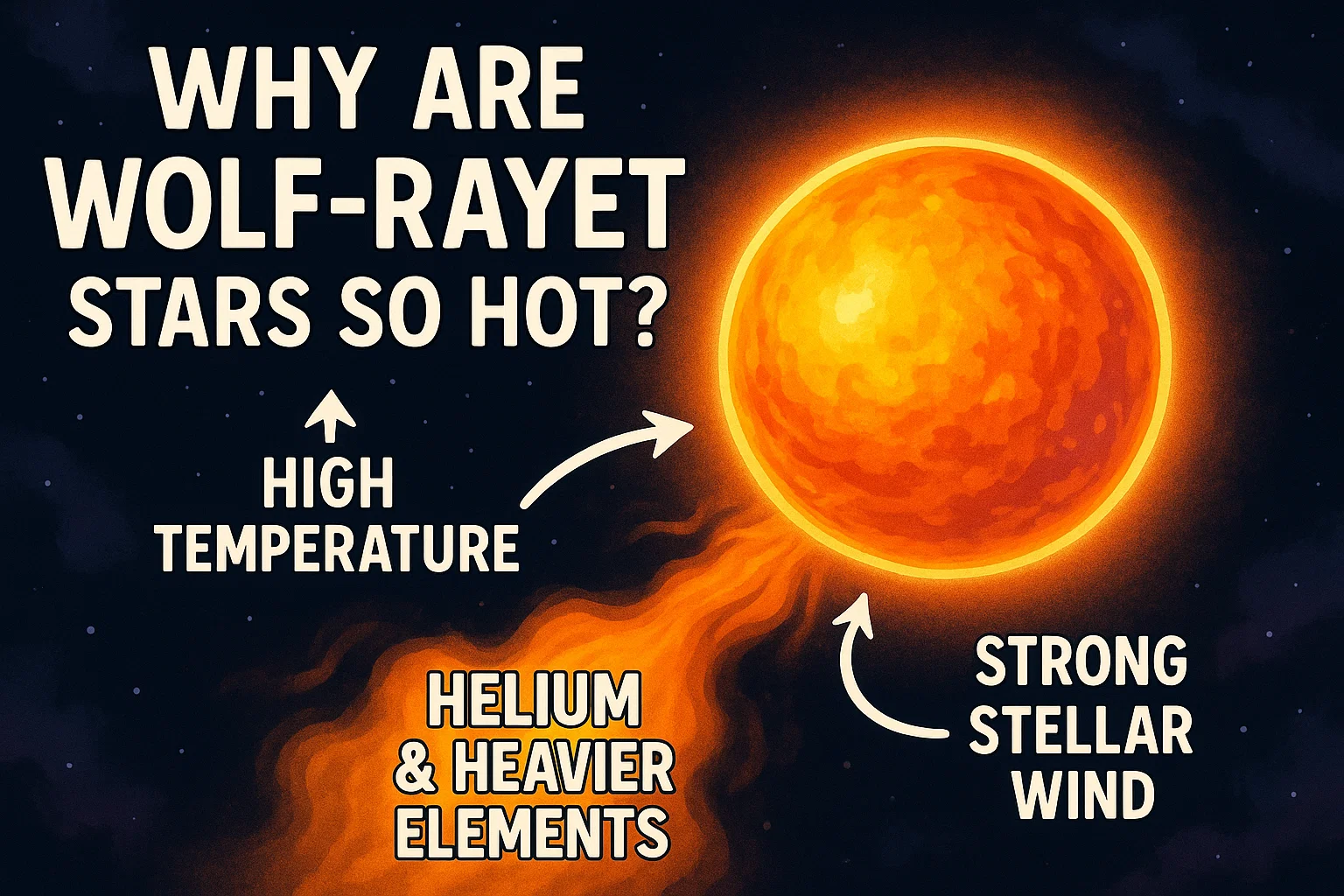
Through intense stellar winds, a Wolf-Rayet star sheds its outer hydrogen layer. This layer is the “insulation.” Once that layer is gone, you are looking directly at the fusion reactor. You aren’t seeing a cool surface anymore; you are staring at the helium core where the magic happens.
That is the secret. They are hot because they are naked.
Just How Hot Are We Talking?
We are talking temperatures that melt the mind. The “coolest” Wolf-Rayet stars sit around 30,000°C. The hot ones? They can exceed 200,000°C.
To put that in perspective:
- Sun: 5,500°C
- Welding Arc: 6,000°C
- Lightning Bolt: 30,000°C
- Wolf-Rayet Star: 200,000°C
If our Sun were this hot, Earth would be toast. Literally. The oceans would boil instantly, the atmosphere would strip away, and the rocks would melt. Thankfully, these monsters are far away.
What Drives the Winds That Strip the Star?
I mentioned the star “blows its roof off.” But how? Gravity on a massive star is immense. It takes a lot of force to kick gas off the surface.
The answer is light.
It sounds crazy, but light has momentum. If you stand outside on a sunny day, you don’t feel the sunlight pushing you back. But if you stood on the surface of a Wolf-Rayet star, the light is so intense—millions of times brighter than the Sun—that it physically shoves atoms into space.
Can Light Really Push Matter?
Absolutely. It’s called radiation pressure. In these stars, the core is producing so many photons that they slam into heavy elements like iron in the atmosphere. It’s like a fire hose hitting a pile of sand. The water (light) hits the sand (gas) and blasts it away.
This creates the “stellar wind.” But don’t think of a gentle breeze. The winds on a Wolf-Rayet star clock in at 2,000 to 3,000 kilometers per second. That is about 6 million miles per hour.
This wind is what carries the outer layer away. Over a few hundred thousand years, the star loses huge chunks of its mass—sometimes equal to 10 or 20 times the mass of our entire Sun. It’s a diet plan on a galactic scale.
How Do We Classify These Hot Messes?
Astronomers like to put things in boxes. Since these stars are stripping layers, we see different elements depending on how deep they have peeled. We classify them by which element is screaming the loudest in the spectrum.
The WN Stars (Nitrogen Rich)
This is the first stage. The star has peeled off the hydrogen and exposed the layer where hydrogen fused into helium. This process (the CNO cycle) leaves behind a lot of nitrogen. So, if we see a lot of nitrogen, we call it a WN star. It’s hot, but it’s just getting started.
The WC Stars (Carbon Rich)
Now things are getting serious. The star has blown away the nitrogen layer too. Now we are looking at the layer where helium is fusing into carbon. These stars are rich in carbon and oxygen. They are hotter, smaller, and closer to death.
The WO Stars (Oxygen Rich)
These are the rarest of the rare. The star has stripped down to its very bones. We are seeing deep layers rich in oxygen. These stars are incredibly hot and are basically moments away (cosmically speaking) from exploding.
Where Do Heavy Elements Come From?
You have carbon in your DNA. You have oxygen in your lungs. Where did it come from? It wasn’t the Big Bang. The Big Bang only made hydrogen and helium.
Every other element was cooked inside a star.
This is why I love Wolf-Rayet stars. They are the galaxy’s ultimate crop dusters. Because they have such violent winds, they don’t just make these elements and hoard them. They spray them out into the universe.
When you see a Wolf-Rayet star, you are seeing a chemical factory venting its exhaust. That exhaust creates the dust clouds that eventually form new stars, new planets, and yes, people. We are literally made of Wolf-Rayet exhaust.
Why Are They So Rare?
If you look up tonight, you won’t see one. Not with your naked eye (unless you are in the southern hemisphere looking at Gamma Velorum, and even that looks like a normal dot).
They are rare because they don’t last.
A star like the Sun lives for 10 billion years. A massive O-type star lives for maybe 10 million. But the Wolf-Rayet phase? It’s a blink. It lasts maybe 500,000 years.
In the timeline of the universe, that is nothing. It’s like seeing a mayfly. You have to be looking at exactly the right time to catch a massive star in this specific phase of dying. That is why we only know of about 500 or so in our galaxy.
Are They Dangerous to Us?
Let’s talk about the elephant in the room. Or rather, the pinwheel in the sky.
There is a star called WR 104. It’s a Wolf-Rayet star about 8,000 light-years away. It’s famous because it looks like a spiral pinwheel. This spiral is caused by dust forming where the wind of the WR star crashes into the wind of a companion star.
The scary part is that we are looking right down the barrel of the spiral.
The Gamma-Ray Burst Threat
When Wolf-Rayet stars die, they don’t just explode; some of them might produce Gamma-Ray Bursts (GRBs). These are the most powerful explosions since the Big Bang. A focused beam of radiation that vaporizes anything in its path.
If WR 104 sends a GRB right at us, it could strip our ozone layer.
But before you start digging a bunker, relax. The chances are tiny.
- We don’t know if WR 104 will make a GRB.
- The beam has to be perfectly aligned.
- It’s 8,000 light-years away.
It’s a fun campfire story for astronomers, but not a reason to lose sleep.
What Is the “Binary” Twist?
For a long time, we thought WR stars stripped themselves just by their own light pressure. But recently, the story got a plot twist.
It turns out, a lot of massive stars have partners. Binary systems. If two stars orbit close enough, gravity gets messy. The companion star can act like a vampire, sucking the outer hydrogen layer off the massive star.
This “stripping” accelerates the process. It creates a Wolf-Rayet star faster than if the star did it alone. This might explain why are Wolf-Rayet stars so hot even when they don’t seem massive enough to drive such huge winds on their own—they had help getting naked.
How Will James Webb Help Us?
The James Webb Space Telescope (JWST) is a game-changer. Wolf-Rayet stars are often shrouded in their own dust—the very dust they created. Visible light gets blocked.
But JWST sees in infrared. Infrared cuts through dust like a knife.
We are now getting images of Wolf-Rayet stars with detail we never dreamed of. We can see the structure of the winds, the shockwaves, and the complex dance of binary partners. We are learning exactly how much mass they lose and how that mass triggers new star formation nearby.
Check out this incredible imagery from the Webb Telescope to see what infrared reveals.
The Connection to Black Holes
Here is the grand finale. What happens when the party ends?
The star runs out of fuel. Gravity wins. The core collapses.
Most Wolf-Rayet stars are heavy enough that they don’t stop collapsing at a neutron star. They go all the way. They punch a hole in the fabric of spacetime. They become black holes.
In fact, astronomers observing gravitational waves (ripples in space) have detected colliding black holes that are unusually heavy. The leading theory? These black holes were born from Wolf-Rayet stars.
By studying these hot stars today, we are studying the parents of the black holes that will collide billions of years from now.
Can You See One Yourself?
If you have a small telescope, you can hunt for the “Crescent Nebula” (NGC 6888) in the constellation Cygnus.
The nebula looks like a glowing brain floating in space. In the absolute center, you will see a faint star. That is WR 136.
That star is blowing a wind that is smashing into gas it shed earlier in its life. The “brain” you see is the shockwave. It’s a snapshot of stellar violence frozen in time. When you look at it, remind yourself: that tiny dot is 200,000 degrees hotter than your oven, and it is currently destroying itself.
Bottom Line
It’s not because they are burning more fuel (though they are). It’s not because they are bigger. It is because they have stripped away the facade. They have ejected the cool hydrogen atmosphere that hides the truth of a star.
They are exposed nuclear cores floating in the void. They are the result of a cosmic battle between gravity and light, where light won.
They live fast, they die violently, and they seed the universe with the ingredients for life. They are, without a doubt, the most exciting things you can study in astrophysics. So next time you see a diamond ring or take a deep breath, thank a Wolf-Rayet star. It died so you could live.
FAQ – Why Are Wolf-Rayet Stars So Hot
How do Wolf-Rayet stars generate such powerful stellar winds?
Wolf-Rayet stars produce intense radiation pressure from the core, creating stellar winds that blast gas away at speeds of millions of miles per hour, effectively stripping their outer layers.
What causes Wolf-Rayet stars to have their extreme temperatures?
Their extreme temperatures result from the loss of their cooler outer layers, revealing the hot helium and heavier element cores, which emit temperatures exceeding 200,000°C.
What is the significance of Wolf-Rayet stars in the cosmos?
Wolf-Rayet stars are crucial because they produce and disperse heavy elements like carbon, nitrogen, and oxygen into space, which contribute to star formation, planet development, and ultimately, life.
Are Wolf-Rayet stars dangerous to Earth?
While Wolf-Rayet stars can produce gamma-ray bursts upon collapsing, the chances of a harmful burst reaching Earth are extremely low due to their distance, and such events are highly improbable.