

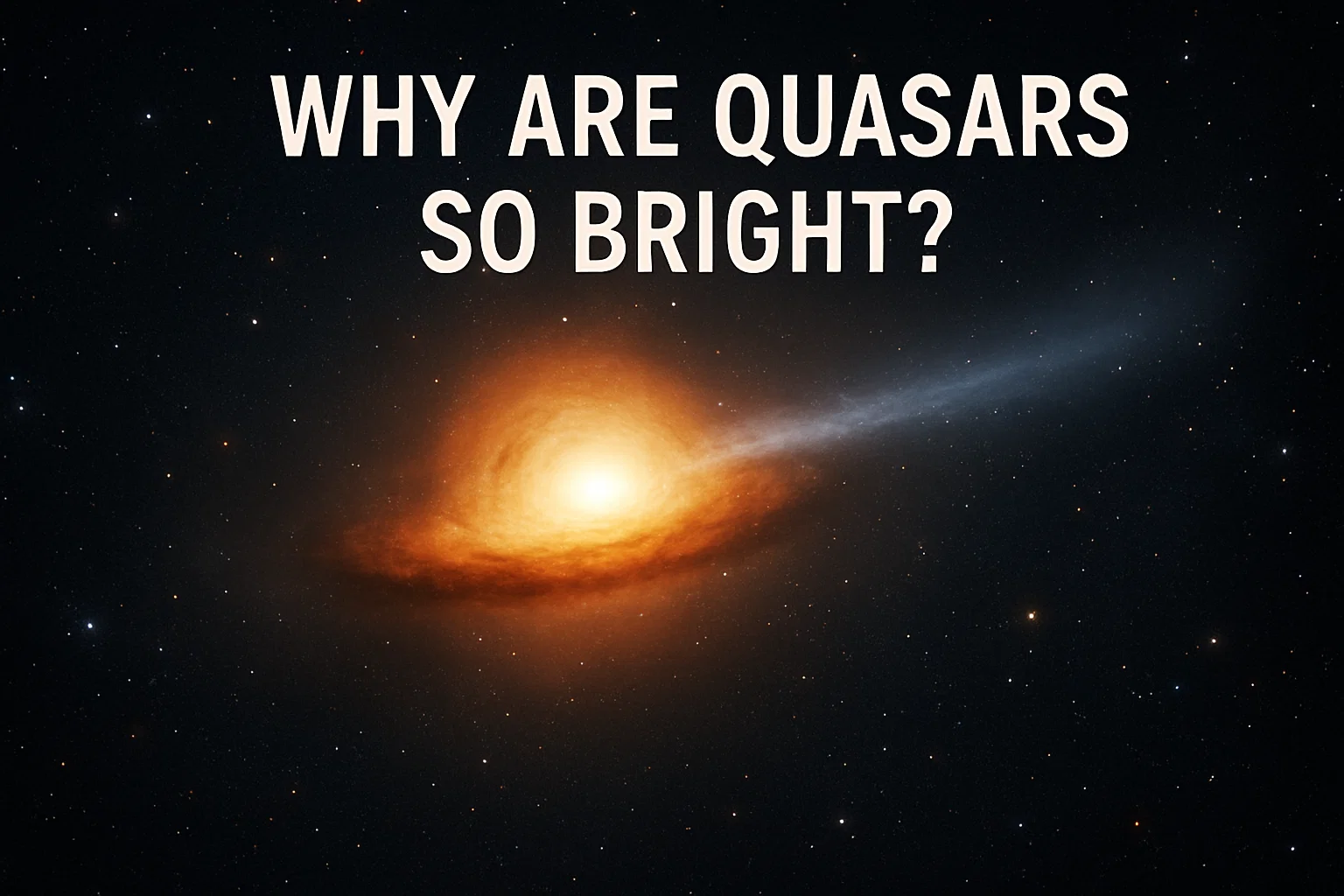
You could take every star in the Milky Way—all 100 billion of them—and bundle them together, and a single quasar would still drown them out. It’s a level of brightness that doesn’t make any intuitive sense. When you look at the night sky, you see stars that are peaceful, steady burners. But out in the deep, dark crushing depths of the early universe, something else entirely was happening. We are talking about objects that shine with the intensity of trillions of suns, yet they pack all that power into a space barely larger than our own solar system.
It’s the ultimate cosmic paradox. How do you cram that much energy into such a tiny box? This isn’t just a matter of “more fuel, more fire.” This is entirely different physics. The question of why are quasars so bright kept astronomers up at night for decades. It defied the logic of nuclear fusion. It hinted at a power source so efficient and so violent that it terrified the people who first did the math. The answer, as we found out, involves the most destructive force in nature: a supermassive black hole in the middle of a gluttonous feeding frenzy.
More in Category:
Difference Between Gas Giant and Star
Difference Between Asterism and Constellation
Key Takeaways
- Gravity as Fuel: The primary energy source isn’t nuclear fusion; it’s the release of gravitational potential energy as matter falls into a deep well.
- Friction is Key: As gas spirals inward, differential rotation creates friction so intense it heats matter to millions of degrees, causing it to shine across the universe.
- The Efficiency Monster: Accretion onto a black hole is vastly more efficient than stellar fusion, converting up to 40% of mass directly into energy.
- Ancient History: Most quasars burned out billions of years ago; we only see them now because their light has spent eons traveling to us.
- The Eddington Limit: There is a physical “speed limit” to feeding a black hole, and quasars ride right on the edge of this limit, balancing radiation pressure against gravity.
What exactly is a Quasar and why was it so hard to identify?
Go back to the late 1950s. Radio astronomy was the new kid on the block. Astronomers were scanning the sky and finding these weird sources of radio waves. They weren’t galaxies, and they weren’t nebulae. When optical telescopes swung around to look at the coordinates, all they saw was a faint, blueish star.
It was maddening. Stars don’t emit massive radio waves like that. So they called them “Quasi-Stellar Radio Sources.” It was a clunky placeholder name that basically meant “looks like a star, acts like a radio tower.” We eventually shortened it to Quasar, which sounds way cooler.
But here is the kicker: they weren’t stars. Not even close. They were the active centers of young galaxies. The reason they looked like points of light is that the galaxy around them was too faint to see, while the center was blindingly bright. Imagine a flashlight so bright you can’t see the person holding it. That’s a quasar. The “object” isn’t a solid surface. It is a region of space where gas is spiraling into a supermassive black hole at breakneck speeds. It’s a death spiral, and it’s the most energetic show in town.
How did Maarten Schmidt crack the code on 3C 273?
The breakthrough moment is actually a great detective story. It was 1963. A Dutch astronomer named Maarten Schmidt was staring at the data for a source named 3C 273. He had a spectrum—a breakdown of the light into its component colors. Usually, you see specific lines that correspond to elements like hydrogen. But Schmidt couldn’t recognize the lines. They were nonsense. They didn’t match any element on the periodic table.
He spent weeks scratching his head. Then, he had a crazy thought. What if these were normal hydrogen lines, but they had been shoved way, way over to the red end of the spectrum?
He ran the calculation. It fit perfectly. The lines were hydrogen, but they were redshifted by 15.8%. In the context of the early 1960s, that was an insane number. It meant 3C 273 wasn’t a star in our galaxy. It was receding from us at 47,000 kilometers per second. It was 2.5 billion light-years away.
The implications hit him like a truck. If this thing was visible from 2.5 billion light-years away, it had to be brighter than 1,000 Milky Ways combined. And it was flickering. That meant it was small—light can only cross a structure as fast as the structure can change brightness. So, you had the energy of a trillion stars packed into a volume the size of the solar system. The mystery shifted from “what is it?” to “why are quasars so bright without blowing themselves apart?”
Why doesn’t nuclear fusion explain this kind of power?
To understand the violence of a quasar, you have to look at efficiency. Our Sun is a fusion reactor. It takes hydrogen protons, smashes them together, and makes helium. It’s a steady, reliable process. But it’s wasteful. When the Sun fuses hydrogen, only about 0.7% of the mass is converted into energy. That’s less than one percent. It’s enough to keep Earth warm, but it’s not enough to power a quasar.
If you tried to power a quasar with nuclear fusion, you would need a cluster of stars so dense they would collapse on themselves. The math just doesn’t work. You need a process that wrings more energy out of every gram of matter.
Enter gravity. Gravity is the unsung hero of energy production. When you drop a brick on your foot, it hurts because gravitational potential energy turned into kinetic energy. Now, imagine dropping a brick onto a neutron star. It would hit with the force of a nuclear warhead. Now, drop that brick into a black hole.
As matter falls deep into the gravity well of a supermassive black hole, it speeds up to a significant fraction of the speed of light. If you can stop that matter suddenly—or make it rub against other matter—you can liberate huge amounts of energy. We are talking about 10% to 40% efficiency. That is 40 to 50 times more efficient than the nuclear fire of a star.
What is happening inside the Accretion Disk?
The black hole itself is dark. We know that. It’s the “hole” part of the name. The light comes from the waiting room: the accretion disk.
Space is messy. Gas clouds don’t just dive perfectly into the center of a black hole. They have angular momentum—they are spinning. As gravity pulls them in, that spin speeds up, just like an ice skater pulling in their arms. The gas flattens out into a pancake shape.
But here is where the magic happens. The gas isn’t moving at one speed. The stuff closer to the hole orbits frantically fast, while the stuff further out moves slower. This creates shear. Layers of gas are rubbing against each other at thousands of miles per second.
Think about the friction burns you get if you slide across a gym floor. Now multiply that by a trillion. This friction generates heat. Incredible heat. The disk glows because it is being tortured by its own viscosity. The temperature climbs to millions of degrees. At that heat, matter doesn’t just glow red; it screams in X-rays and ultraviolet light. The disk becomes a self-luminous dynamo, outshining the rest of the host galaxy by orders of magnitude.
What role do Magnetic Fields play in this chaos?
If it were just gravity, the gas might just spin there forever, like a planet. To get the gas to actually fall into the hole and release its energy, it needs to lose that speed. It needs a brake.
Magnetic fields are that brake. The environment in the accretion disk is a plasma—a soup of charged particles. Moving charges create magnetic fields. Because the disk is spinning at different speeds, these magnetic field lines get twisted, tangled, and snapped.
This magnetic turbulence acts like a thick, viscous goo. It drags on the gas, slowing it down and forcing it to spiral inward. Without these magnetic fields, the black hole would starve. The gas would just orbit safely. The magnetic fields are the spoon that stirs the pot, forcing the material down the throat of the beast and ensuring the friction keeps cranking out light.
How does the Eddington Limit keep the Quasar from exploding?
There is a catch to all this brightness. Light carries momentum. If you stand in the sun, the light is actually pushing on you, though it’s too weak to feel. But inside a quasar, the light is so intense that the pressure is immense.
As the black hole feeds faster, it gets brighter. If it gets too bright, the outward push of the radiation becomes stronger than the inward pull of gravity. If that happens, the quasar literally blows its own food supply away into deep space.
This balance point is called the Eddington Limit. It’s the natural speed limit for black hole growth. A black hole can only eat so fast before it chokes on its own light. The fact that quasars are so visible tells us they are often running right at this redline. They are consuming matter at the absolute maximum physical rate allowed by the laws of the universe. They are engines running at 100% throttle.
Where do the Relativistic Jets come from?
If the accretion disk is the engine, the jets are the exhaust pipes. Not all quasars have them, but the ones that do are spectacular. These are beams of plasma shooting out from the poles of the black hole at 99.9% the speed of light.
They stretch for hundreds of thousands of light-years. But how does something that eats everything launch something that far?
Once again, it’s the magnets. The magnetic field lines anchored in the spinning disk can get twisted into a helix, like a corkscrew towering above the black hole. When charged particles get caught in these lines, they are bead-blasted out into space. The black hole acts like a railgun.
If you happen to be on a planet that is looking straight down the barrel of one of these jets, the brightness is amplified even further by relativity. We call these objects “Blazars.” It’s the same machinery as a quasar, just pointed right at your face.
Why don’t we see Quasars nearby?
This is a question of cosmic archaeology. When we look at the local universe—our neighbors—we see big galaxies with supermassive black holes, but they are quiet. They are sleeping giants.
Quasars are a phenomenon of the young, violent universe. The peak era for quasars was about 10 billion years ago, a time astronomers call “Cosmic Noon.” Back then, galaxies were crashing into each other constantly. These collisions dumped oceans of gas into the centers of galaxies, providing an all-you-can-eat buffet for the black holes.
Today, things have settled down. The universe has expanded. Collisions are rarer. Most of the gas has either been turned into stars or blown away. The black holes have eaten everything within reach and have gone dormant. The reason why are quasars so bright in the distant past but not now is simply a matter of fuel availability. Our local black holes are starving.
Could the Milky Way ever become a Quasar?
Don’t get too comfortable. Our galaxy has a supermassive black hole, Sagittarius A*. It’s relatively small—only 4 million solar masses—and currently, it’s on a strict diet. It barely flickers.
But we are on a collision course. In about 4 to 5 billion years, the Milky Way will smash into the Andromeda Galaxy. Andromeda has its own massive black hole. The collision won’t destroy the stars (they are too far apart), but it will destabilize the gas clouds. Huge streams of gas will be funneled into the cores of the merging galaxies.
It is very likely that this event will wake the dragon. As gas dumps onto Sagittarius A* (or the Andromeda black hole), it will ignite. Our galaxy could flare up into a quasar (or at least a very active galactic nucleus) once again. Any civilization around to see it would see a second, brighter sun in the sky that never sets—and creates lethal doses of X-rays.
How do Quasars act as backlights for the Universe?
Astronomers use quasars for a clever trick. Since they are the brightest things around, they act like lighthouses shining through the fog of the universe.
As the light from a quasar travels billions of years to reach us, it passes through invisible clouds of intergalactic gas. Each cloud absorbs a tiny specific slice of that light. When the light finally reaches Earth, its spectrum looks like a barcode, full of missing slivers.
This is called the “Lyman-Alpha Forest.” By reading this barcode, we can map the distribution of matter in the empty spaces between galaxies. We can determine the chemical composition of the early universe. We can even measure how fast the universe was expanding at different points in history. Quasars are the only reason we know anything about the “empty” void between the stars.
What is the connection to Galaxy formation?
For a long time, we thought black holes and galaxies just sort of grew together. Now, we think the quasar phase might actually control the size of the galaxy.
It’s called “feedback.” A quasar puts out so much energy that it heats up the gas in the entire galaxy. If the gas gets too hot, it can’t clump together to form new stars. The quasar essentially sterilizes the galaxy. It acts as a thermostat. If the galaxy tries to feed the black hole too much, the black hole turns on, blasts the gas away, and stops star formation.
This explains why we don’t see galaxies that are just one giant blob of stars. The central monster regulates the growth.
Why is the study of Quasars still evolving?
You might think we have this figured out. We don’t. We recently found quasars that existed when the universe was only 600 million years old. This is a massive headache for theorists.
How do you build a black hole that big, that fast? To power a bright quasar that early, you need a black hole with a billion solar masses. But the universe wasn’t old enough to grow one by normal feeding methods. It’s like walking into a nursery and finding a six-foot-tall bodybuilder in the crib.
This suggests we might be missing a piece of the puzzle. Maybe black holes formed directly from the collapse of massive gas clouds, skipping the star phase entirely. These “Direct Collapse Black Holes” are currently one of the hottest topics in astrophysics. Quasars are forcing us to rewrite the history of the first billion years of time.
How can you help identify them?
Believe it or not, you don’t need a PhD to hunt for these things. There are so many points of light in the sky, and computers are still struggling to classify them all perfectly. Citizen science projects like Galaxy Zoo often ask people to look at images.
The human eye is remarkably good at spotting patterns that algorithms miss. You might be looking at a weirdly colored dot that turns out to be a record-breaking quasar from the dawn of time. It’s a field where data is flooding in faster than we can process it, especially with new telescopes like the James Webb Space Telescope coming online.
Conclusion
Quasars are the high-beam headlights of cosmic history. They show us a time when the universe was wilder, denser, and far more violent than the quiet void we drift through today. The answer to why are quasars so bright isn’t magic; it’s the ruthless efficiency of gravity. It is the scream of dying matter swirling into a bottomless pit.
They act as the transition point between the primordial soup of the Big Bang and the structured galaxies of the modern era. They are the fires that forged the structure of the cosmos. While they may have burned out billions of years ago, their light is still washing over us, carrying the secrets of how everything began. So the next time you look at a dark patch of sky, remember: deep in that darkness, there might be a ghost of a monster, shining with the light of a trillion suns.
For a deeper dive into the specifics of active galactic nuclei and their energy output, you can check out this detailed resource from ESA Hubble.
FAQs – Why Are Quasars So Bright
What makes quasars so much brighter than entire galaxies?
Quasars are extraordinarily bright because they are powered by supermassive black holes rapidly accreting matter, converting gravitational energy into electromagnetic radiation with up to 40% efficiency, far surpassing nuclear fusion processes.
How was the nature of quasars discovered and identified?
The nature of quasars was discovered through spectral analysis in 1963 by Maarten Schmidt, who identified redshifted hydrogen lines indicating that these objects were distant, energetic centers of young galaxies receding at high speed.
Why can’t nuclear fusion explain the immense power of quasars?
Nuclear fusion is too inefficient and wasteful to power quasars; the energy released as matter falls into a black hole via accretion provides a far more efficient and intense energy source.
What is the role of magnetic fields in the activity of quasars?
Magnetic fields in the accretion disk twisted and tangled by the spinning plasma act as a brake, facilitating matter spiraling inward and generating the intense heat and electromagnetic radiation that make quasars luminous.
Why are quasars no longer common in the nearby universe?
Quasars were prevalent during the early universe about 10 billion years ago when galaxy collisions supplied abundant gas, but today, most black holes are starved of fuel, making quasars rare in the local universe.