

Have you ever tried to really wrap your head around something that’s just mind-bendingly heavy?
I’m not talking about a car, or a skyscraper, or even a mountain. I want you to picture this: you take a single, ordinary teaspoon, you fly it into deep space, and you find one of these strange objects called a neutron star. You dip the spoon in and scoop out a tiny bit of “star stuff.”
Just that single teaspoonful would weigh over five billion tons.
Let that sink in for a second. Five. Billion. Tons. That’s the weight of the entire human population, all 8 billion of us, crushed into a space smaller than a sugar cube.
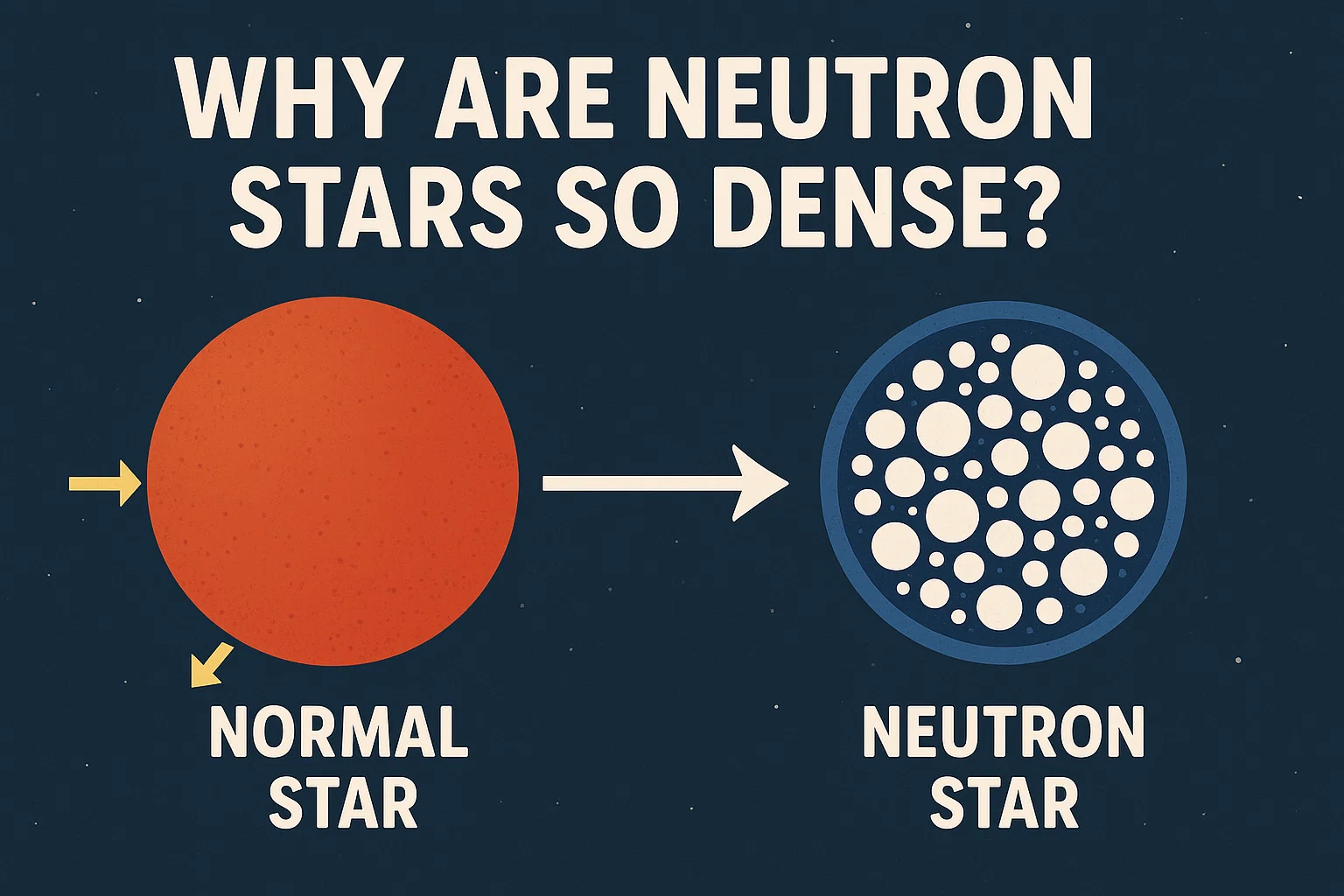
It’s a number so outrageously large it feels fake, like a typo in a science-fiction novel. But it’s not. This is the bizarre reality of the most extreme objects in the universe that aren’t quite black holes. This incredible, almost unbelievable figure leads us, naturally, to the biggest question of all: why are neutron stars so dense?
The answer isn’t a simple one. It’s not a quick soundbite. It’s a story of cosmic violence, the life and death of a star, and a desperate, last-ditch stand by the very laws of physics. To truly get it, we have to journey into the heart of a dying sun and witness the most powerful explosion in the cosmos: a supernova.
More in Celestial Objects Category
Will Our Sun Become a White Dwarf
What Is Left After a Supernova
Key Takeaways
Before we dive deep, here’s the quick-and-dirty version of what we’re about to uncover:
- They’re Stellar Corpses: A neutron star isn’t a “star” like our Sun. It’s the collapsed, leftover core of a massive star (way bigger than our Sun) that died in a catastrophic supernova explosion.
- Gravity’s Ultimate Squeeze: Their mind-boggling density comes from gravity crushing all the parts of an atom together. The empty space that makes up 99.9% of everything you see is violently squeezed out of existence.
- The Great Particle Conversion: During this collapse, the pressure becomes so ungodly high that protons and electrons are literally forced to merge, creating a star composed almost entirely of neutrons.
- Quantum Mechanics Steps In: The only thing stopping the star from collapsing all the way down into a black hole is a powerful, purely quantum-mechanical force called “neutron degeneracy pressure.”
- The Bizarre Result: You end up with an object more massive than our entire Sun, crushed into a perfect sphere that’s only about 12 miles (20 km) wide. A star’s mass in a city’s space.
What Exactly Am I Looking at When I See a Neutron Star?
First, let’s get one thing straight. When we talk about a “neutron star,” the word “star” is a little misleading.
Our Sun is a star. It’s a raging, active ball of plasma. It’s constantly smashing hydrogen atoms together in its core to make helium, a process called nuclear fusion. This process releases the enormous amount of energy that lights and warms our entire planet.
A neutron star is… not that.
A neutron star is a stellar remnant. It is a corpse. It’s the leftover core of a star that already lived its life and died spectacularly. It doesn’t generate any new heat through fusion. It’s just an incredibly hot, leftover ember from that catastrophic explosion, and it will spend the rest of eternity—billions and billions of years—slowly cooling down.
But what an ember it is.
Imagine our Sun, which has a diameter of about 865,000 miles. It’s a colossal thing. Now, imagine taking more than all of the Sun’s mass—say, 1.4 times its mass, a limit known as the Chandrasekhar limit—and crushing it. Squeezing it so hard that it would fit into a ball the size of a city.
We’re talking about 12 miles, or 20 kilometers, from one side to the other.
This is the central paradox of a neutron star. It has the mass of a giant star in the body of a tiny asteroid. This is the very definition of density, and to understand how it gets this way, we have to go back in time and watch its birth.
How Does a Star Even Become This?
You and I are alive because stars are mortal. They live, they burn, and eventually, they die.
For a star like our Sun, the death is a relatively gentle affair. In about 5 billion years, it will swell up into a red giant, puff off its outer layers, and the remaining core will shrink into a small, very-dense object called a “white dwarf.” A white dwarf is dense, for sure—a teaspoon of it would weigh a few tons. But that’s nothing compared to a neutron star.
To get a neutron star, you can’t start with an average star. You need a monster.
You need a star that begins its life with somewhere between 8 and 20 times the mass of our own Sun. For millions of years, this massive star lives in a constant, violent, high-stakes battle with itself.
On one side, you have gravity. Gravity is simple. It’s relentless. It wants to pull every single particle of the star inward and crush it into the smallest possible point.
On the other side, you have nuclear fusion. Because the star is so massive, the pressure and temperature in its core are truly extreme. This pressure is the engine of fusion, which releases a titanic amount of energy. This energy, pushing outward in the form of radiation and hot gas, perfectly balances gravity’s inward pull.
For millions of years, these two colossal forces are locked in a perfect stalemate. The star is stable. But this stability relies on one thing: the star having fuel to burn.
What’s This “Fatal Mistake” a Star Makes?
The star’s whole life is a series of fusion stages, burning heavier and heavier elements as it goes.
First, it burns hydrogen into helium. This lasts for millions of years. When the hydrogen runs low, the core contracts, gets hotter, and starts burning helium into carbon. Then it burns carbon into neon, neon into oxygen, oxygen into silicon. The star’s core becomes layered like a giant, cosmic onion, with the heaviest elements at the center.
Each of these fusion stages releases energy, keeping gravity at bay.
Until the star makes iron.
This is the fatal mistake. Fusing all the elements up to iron releases energy, pushing back against gravity. But fusing iron into heavier elements doesn’t release energy. It consumes it.
The star’s core, now a massive ball of iron, has lost its ability to fight back. The furnace has run out of fuel. The “push” from fusion suddenly, and catastrophically, switches off.
In that instant, gravity wins.
It wins absolutely. It wins immediately. The stalemate that held for millions of years is broken in less than a second.
So, What Happens During the Supernova?
The iron core, which is already the size of the Earth but holds the mass of our Sun, has nothing holding it up. It begins to collapse in on itself.
When I say “begins,” I mean it happens with unimaginable speed. In less than a second, that Earth-sized ball of iron collapses down to the size of a small city. It shrinks from 8,000 miles wide to 20 miles wide.
Just think about that.
Now, picture the star’s outer layers—all those onion layers of silicon, oxygen, carbon, and hydrogen, all of them billions of tons of material. They were just coasting along, supported by the core. Suddenly, the floor has vanished from under them.
They all come crashing down onto the newly-formed, ultra-dense core, accelerating to a significant fraction of the speed of light.
What happens next is the most powerful explosion in the universe: a Type II supernova.
The infalling layers hit the unmovable, ridiculously dense core and rebound with unimaginable violence. It’s like dropping a billion tennis balls onto a solid steel floor all at once. A titanic shockwave is born, and it begins to tear the star apart from the inside out. This shockwave, combined with an unbelievable blast of ghostly particles called neutrinos that stream out from the core, is what obliterates the star, blasting its outer layers into space at 10% the speed of light.
So, the Explosion Doesn’t Destroy the Core?
This is a key point. The explosion doesn’t destroy the core. The core’s collapse causes the explosion.
The core is the engine. The supernova is the outward symptom of that core’s violent formation and the “rebound” off its new, hard surface.
While the rest of the star is seeding the galaxy with heavy elements (the iron in your blood, the calcium in your bones, the oxygen you’re breathing—it was all forged in a star and flung out in a supernova), the core remains.
It’s still there. Battered, but intact. And gravity is still crushing it. The supernova was just the opening act.
Why Doesn’t the Core Collapse into a Black Hole?
This is the million-dollar question. Gravity is still pulling. It is desperately trying to crush this city-sized core into an infinitely small point—a singularity. A black hole.
And sometimes, if the original star was massive enough (more than 20 solar masses), it does. Gravity wins, and a black hole is born.
But for this “Goldliocks” range of massive stars, something fights back. Something new. Something powerful enough to stop gravity itself.
To understand what, we need to shrink down. Way, way down. Think about a normal atom. It has a tiny, dense nucleus (made of protons and neutrons) in the center, and a cloud of electrons “orbiting” it. The key thing you have to remember from high school chemistry is that an atom is almost entirely empty space. The distance between the nucleus and the electrons is, relatively speaking, vast.
The “solidity” of the chair you’re sitting on is an illusion. It’s just the electromagnetic repulsion between the electron shells of your atoms and the chair’s atoms. You’re not really “touching” it.
In a white dwarf (the remnant of a Sun-like star), gravity is strong, but it’s not strong enough to beat this repulsion completely. The collapse is stopped by “electron degeneracy pressure.” But in our supernova core, gravity is far, far too powerful for that.
It breezes right past that stop sign.
What Stops Gravity’s Ultimate Squeeze?
The pressure and density in the collapsing core become so great that the very structure of atoms is destroyed. Gravity squeezes the “empty space” out of existence.
It gets worse. The gravity is so strong that it jams the electrons into the protons.
Think about that for a moment. A negatively charged electron and a positively charged proton are shoved together with such force that they merge. When they do, they become a single, neutrally charged particle: a neutron. This process is called “electron capture,” and it happens on a star-wide scale.
Proton + Electron → Neutron + Neutrino
The entire collapsing core, a mass greater than our Sun, is transformed in an instant. The protons and electrons are, for the most part, gone. The core becomes a gigantic, city-sized ball composed almost entirely of neutrons.
This is the “neutron” in “neutron star.”
Why is a Ball of Neutrons So Dense?
This is the heart of the matter. We’ve done two things.
First, we’ve eliminated all the empty space that makes up 99.999% of normal matter. Second, we’ve packed all the “stuff” (the mass) that was in the nuclei and the electrons into a single type of particle.
We’ve essentially turned the entire star into one giant atomic nucleus.
Seriously. An atomic nucleus has a density of about 10¹⁴ grams per cubic centimeter. A neutron star has… a density of about 10¹⁴ grams per cubic centimeter. They are, quite literally, nuclear-density matter.
This is why a teaspoon of it weighs billions of tons. You are scooping up a teaspoon of pure, unadulterated atomic nucleus, with none of the empty space that makes matter feel “normal.” This is why neutron stars are so dense.
But this still doesn’t answer the final question. We have a ball of neutrons. Gravity is still trying to crush it into a black hole. What stops it now?
What is “Neutron Degeneracy Pressure”?
The collapse is finally, finally halted by one of the strangest and most powerful rules in the quantum world: The Pauli Exclusion Principle.
I know, that sounds like something from a sci-fi movie. But it’s a fundamental rule of the universe. In simple terms, the principle states that two “fermions” cannot occupy the same quantum state at the same time.
Electrons, protons, and neutrons are all fermions.
You can think of it as a cosmic game of musical chairs. Every single neutron in that star must have its own unique “seat”—its own energy level, spin, and position. No two can be identical.
Now, gravity is trying to shove all these billions of billions of billions of neutrons into the same tiny box. It’s trying to force them all into the same “seat.”
But the Pauli Exclusion Principle says “No.”
Can You Explain That Quantum Voodoo in Simple Terms?
Imagine a giant, high-rise parking garage. Gravity is the attendant, and it’s trying to park a billion cars (the neutrons) into the same single parking spot on the first floor.
The Exclusion Principle is the garage rule that says “one car per spot.”
So, the neutrons are forced to fill up other spots. They fill the first floor, then the second, then the third, all the way to the roof. To occupy these “higher” spots (which are higher energy levels), the neutrons have to move incredibly fast, approaching the speed of light.
All of these neutrons, zipping around and desperately trying to avoid being in the same state as their neighbors, create a powerful, collective, outward-pushing pressure.
This isn’t a “hot” pressure like the fusion in a normal star. It’s a purely quantum-mechanical pressure. It’s the universe’s final firewall. This is neutron degeneracy pressure.
And it’s the only thing holding the neutron star up. It’s the only thing standing between this dense ball of matter and the infinite collapse of a black hole.
How Dense Are We Actually Talking?
Let’s try to get a handle on these numbers again, because they are truly absurd. We need some comparisons.
- Density of water: 1 gram per cubic centimeter (g/cm³)
- Density of Osmium (densest element on Earth): ~22.6 g/cm³
- Density of the Sun’s core: ~150 g/cm³
- Density of a white dwarf: ~1,000,000 g/cm³ (That’s one ton per cubic centimeter)
And then, there’s the neutron star. It’s not just a step up. It’s a leap off a cliff.
- Density of a neutron star: ~100,000,000,000,000 g/cm³.
That’s 100 trillion grams per cubic centimeter. Or, one hundred million tons per cubic centimeter.
This is the density I mentioned at the beginning. A single sugar cube of this “neutronium” would weigh what Mount Everest weighs. A thimbleful would outweigh all of humanity. This isn’t an exaggeration for effect. It’s just the math.
What Would This “Neutronium” Matter Be Like?
Honestly? We don’t know for sure. We call it “neutron-degenerate matter,” and it’s a huge, active area of physics research. We can’t make it on Earth. The pressure required is beyond all comprehension.
Based on our best models, this matter would be… weird.
It’s likely a superfluid, meaning it flows with zero viscosity, or friction. If you were to (somehow) stir a cup of it, it would never stop spinning. Ever. At the same time, it’s also probably a superconductor, meaning it conducts electricity with perfect, zero resistance.
We are essentially looking at a city-sized, superfluid, superconducting atomic nucleus. It’s the most exotic, strangest state of matter in the known universe. For a deeper dive into their mind-boggling properties, NASA’s guide on Neutron Stars is a fantastic resource for learning more.
What’s Inside a Neutron Star? Is it Just Neutrons?
This is where things go from “weird” to “purely theoretical.” Since we can’t exactly drill a hole in one, all we have are models. But these models, based on the laws of physics, paint an incredible picture. A neutron star isn’t just a uniform ball of goop; it has layers.
Let’s Peel Back the Layers (Theoretically)
We believe a neutron star has a structure, much like the Earth has a crust, mantle, and core.
- The Atmosphere: A “surface” of superheated gas, probably only a few centimeters thick, held perfectly flat by the insane gravity.
- The Outer Crust: Maybe a kilometer thick. This is the “solid” part. It’s not made of neutrons, but of a crystal lattice of iron nuclei left over from the star’s core, floating in a sea of super-fast electrons.
- The Inner Crust: This is where it gets crazy. As you go deeper, the pressure is so high that the nuclei themselves can’t hold their spherical shape. They get squeezed and deformed into long strings and flat sheets. Physicists, with a wonderful sense of humor, call this “nuclear pasta.” They theorize there are layers of “spaghetti” (long tubes of nuclei), “lasagna” (flat sheets), and “gnocchi” (clumps) as the pressure builds.
- The Outer Core: This is the bulk of the star. Here, we finally find the true neutron-degenerate matter—that superfluid, superconducting sea of neutrons (with a small percentage of protons and electrons mixed in).
- The Inner Core: This is the ultimate mystery. What happens at the very center, where the pressure is at its absolute, unimaginable maximum?
What is This “Quark-Gluon Plasma” I’ve Heard About?
This is the big question that keeps physicists up at night. Neutrons, as it turns out, aren’t fundamental particles. They are made of smaller particles called quarks (which are “glued” together by gluons).
Is it possible that in the very heart of a neutron star, the pressure is so high that the neutrons themselves break?
If that happens, the neutrons would dissolve into a “soup” of free-floating quarks and new. This is a state of matter called a quark-gluon plasma, and it’s thought to be the state of the entire universe for the first few microseconds after the Big Bang.
A neutron star’s core might be the only place in the modern universe where this primordial matter still exists. If so, the object isn’t just a “neutron star” but a “hybrid star,” with a neutron shell and a quark-matter core. Or, if the whole thing converted, it would be a “quark star.” We’re pushing the absolute boundaries of known physics here.
What Does This Insane Density Do?
This density isn’t just a fun fact. It has profound, observable consequences that make neutron stars some of the most fascinating objects in the sky.
Why Do Neutron Stars Spin So Fast?
Neutron stars are the fastest-spinning objects in the universe. We’ve found some that rotate over 700 times per second. Their “day” is shorter than a millisecond.
Why? It’s the same reason an ice skater spins faster when they pull their arms in: conservation of angular momentum.
The original star was huge, and it was spinning. Maybe it completed one rotation every few weeks. That’s a lot of angular momentum. When that star collapsed from a diameter of millions of miles down to just 12 miles, all that momentum was “conserved.” The only way to do that is to spin up to incredible, dizzying speeds.
When these spinning stars have powerful magnetic fields, they can shoot out beams of radiation from their poles. If the beam sweeps across Earth as the star rotates, we see a “pulse” of radio waves. This is what we call a pulsar—it’s not a different object, it’s just a neutron star that we see from the right angle.
What’s a Magnetar, Then?
Sometimes, the combination of dense, superconducting matter and rapid spin creates something even more terrifying: a magnetar.
A magnetar is a neutron star with a magnetic field so powerful it’s almost beyond comprehension. It’s a quadrillion (a thousand million million) times stronger than Earth’s magnetic field. This is the strongest magnetic field in the entire universe. It’s so strong it would wipe a credit card clean from the distance of the Moon. It’s so strong it literally buckles the star’s solid crust, causing “starquakes” that release blasts of gamma rays more powerful than anything else in the galaxy.
What About Their Gravity?
The gravity at the surface of a neutron star is about 200 billion times stronger than Earth’s.
If you (somehow) could stand on one, you would be instantly and utterly flattened into a one-atom-thick layer of plasma coating the surface. A marshmallow dropped onto a neutron star from a few feet up would hit with the force of a nuclear bomb.
This gravity is so intense that it warps spacetime around it. Light itself has to struggle to escape, a phenomenon called gravitational lensing. The escape velocity from a neutron star isn’t 25,000 mph (like Earth); it’s around 100,000 kilometers per second—about one-third the speed of light.
It’s the last stop on the line before the total gravitational victory of a black hole.
The Universe’s Ultimate Recyclers
So, we’ve journeyed from a giant star’s fiery death to the quantum heart of its leftover corpse. We’ve seen that the answer to “why are neutron stars so dense” isn’t a single fact, but a chain of violent, mind-boggling events.
It’s a story that starts with gravity, the universe’s great, relentless compressor.
It’s about a star’s core losing its will to fight, running out of fuel, and collapsing in on itself so fast that it tears its own atoms apart.
The density comes from gravity squeezing out all that empty space, forcing protons and electrons to merge into a new, exotic form of matter: a city-sized sea of pure neutrons.
And finally, it’s a story of quantum mechanics. A tale of the Pauli Exclusion Principle, a fundamental law of physics that plants its feet and, at the last possible second, shoves back against gravity’s infinite squeeze, stopping it cold.
The result is a city-sized object with the mass of a Sun, a density of 100 million tons per cubic centimeter, and a spin of 700 times a second. These objects aren’t just cosmic curiosities. They are the universe’s most extreme laboratories, where we can test our ideas about physics at energies and densities we can never hope to create on Earth.
They are the lighthouses, the magnets, and the ultimate pressure cookers of the cosmos.
FAQ – Why Are Neutron Stars So Dense
Why are neutron stars so incredibly dense compared to other objects in space?
Neutron stars are so dense because gravity collapses the star’s core after a supernova, squeezing all the atoms together and forcing protons and electrons to merge into neutrons, resulting in matter at nuclear densities within a tiny space.
What role does quantum mechanics play in stopping the collapse of a neutron star into a black hole?
Quantum mechanics provides the neutron degeneracy pressure, a force arising from the Pauli Exclusion Principle, which prevents neutrons from being compressed into a black hole by forcing them to occupy separate quantum states.
How does the collapse of a star lead to the formation of a neutron star?
A star with 8 to 20 times the Sun’s mass exhausts its fuel, causing its core to collapse after fusing iron, which halts fusion and results in the core shrinking rapidly, triggering a supernova explosion that leaves behind a dense neutron star.
What makes neutron degeneracy pressure so powerful in resisting further collapse?
Neutron degeneracy pressure is a quantum mechanical force that prevents neutrons from occupying the same quantum state, thus providing an outward push against gravity and stopping the core from collapsing into a black hole.
How dense is a neutron star compared to everyday objects on Earth?
A neutron star’s density is about 10^14 grams per cubic centimeter, which is roughly a hundred million tons per cubic centimeter, making it incredibly dense—so much that a teaspoon of neutron star material would weigh billions of tons.