

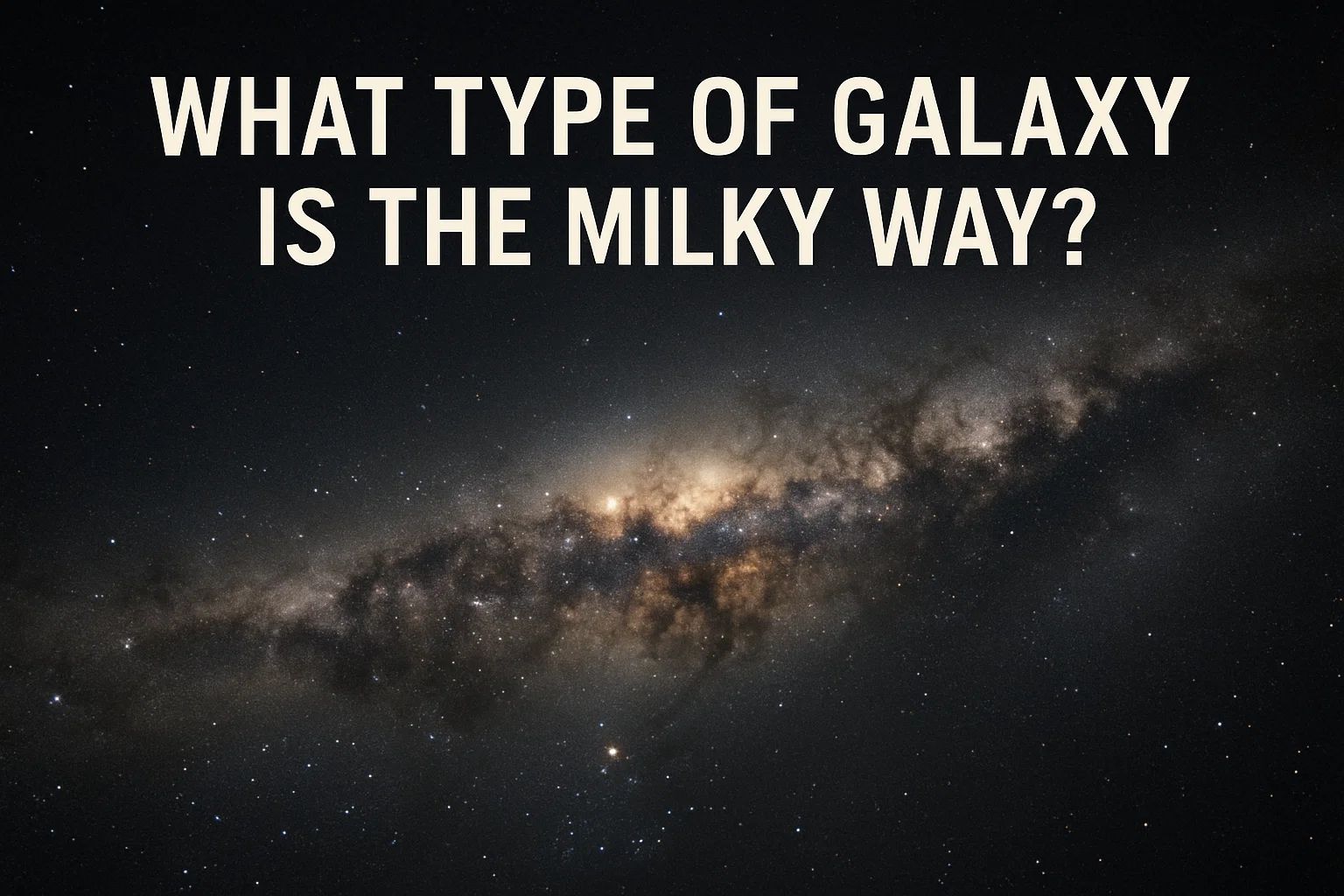
Stand in the middle of a desert, or anywhere far from the light pollution of a city, and look up. If the timing is right, you’ll see it—that faint, milky band stretching across the darkness. It looks like a cloud, or maybe spilled water on a countertop. For thousands of years, our ancestors looked at that same streak of light and made up stories about gods and rivers. They had no idea they were looking at their own body from the inside. They were staring at the cross-section of our galactic city.
We live on a rocky world orbiting a mediocre yellow star, drifting through the suburbs of a structure so massive it defies human comprehension. But knowing our address isn’t enough. We need to know what the house looks like. We need to answer the big question: what type of galaxy is the Milky Way?
For decades, we settled for a simple answer. We told ourselves we lived in a spiral galaxy. It was neat, elegant, and comforting. We pictured a perfect pinwheel spinning in the void. But the universe doesn’t care about our need for simplicity. As our telescopes got bigger and our sensors started seeing in infrared, the picture changed. We realized our home is a lot messier, a lot wilder, and frankly, a lot cooler than a simple spiral. We live in a barred spiral galaxy.
This detail—the “bar”—might sound like a minor architectural quirk, but it changes the entire story of how we got here. It dictates how stars are born, how the black hole in our basement gets fed, and how the whole system holds together. Let’s strip away the textbook dryness and take a real look at the structure of the Milky Way.
More in Category:
Why Are Quasars So Bright and Why Are Blazar Jets Aimed at Earth
Key Takeaways
- The Verdict: The Milky Way is officially classified as a barred spiral galaxy, specifically type SBbc.
- The Bar: A massive, rectangular band of bright stars cuts through the center, acting as a fuel pump for the core.
- Our Address: We don’t live downtown; we live in the Orion Spur, a quiet bridge between two major spiral arms.
- The Engine: The bar funnels gas inward, feeding the supermassive black hole, Sagittarius A*, and sparking new star birth.
- The Future: We are a cannibalistic galaxy currently eating our neighbors, and we are destined to merge with Andromeda.
So, What Exactly Is a Barred Spiral Galaxy?
If you ask an astronomer “what type of galaxy is the Milky Way,” they won’t just say “spiral.” They will likely throw a code at you: SBbc. Let’s break that down because it actually tells you everything you need to know about our shape.
Edwin Hubble, the guy who basically invented modern galactic study, came up with a way to sort galaxies. You have your blobs (ellipticals), your weirdos (irregulars), and your pinwheels (spirals). For the longest time, we thought we were a normal “S” type—a standard spiral. Think of water swirling down a drain; the arms curve right out of the center.
But the Milky Way is an SB galaxy. The “B” stands for Bar.
Imagine you take a ball of dough and stretch it out into a cigar shape. Now, attach streamers to the ends of that cigar and spin it. That’s us. We don’t have a round core; we have a boxy, rectangular bar of stars sitting right in the middle. The spiral arms don’t sprout from the center point; they trail off the ends of this bar.
The lowercase “bc” part of the name just tells you how the arms look. They aren’t wrapped super tight, but they aren’t flopping around loosely either. We are somewhere in the middle, with a distinct central bulge and arms that have a bit of room to breathe.
How Did We Figure This Out Without Leaving the House?
This is the part that always blows my mind. We have never seen the Milky Way from the outside. We can’t send a drone up 100,000 light-years to snap a selfie. We are trapped inside the disk. Imagine you are a chocolate chip inside a cookie, trying to figure out if the cookie is round or square. It’s not easy.
So, how do we know what type of galaxy is the Milky Way if we can’t see it?
We cheated. We used light that our eyes can’t see.
If you look toward the center of our galaxy (specifically toward the constellation Sagittarius) with your naked eye, you see dark patches. That isn’t empty space; it’s dust. Thick, heavy clouds of interstellar soot blocking the view. Visible light can’t punch through that smog.
But infrared light and radio waves can. They sail right through the dust like it’s not even there. By tracking bright red giant stars and measuring the speed of gas clouds using the Doppler shift (the same physics that makes a passing ambulance siren change pitch), astronomers built a 3D map.
In the 1990s, and later with better data from the Spitzer Space Telescope in 2005, the data screamed at us. The stars in the middle weren’t orbiting in a circle. They were moving in elongated paths. The density maps showed a clear, straight structure cutting the core. That was the smoking gun. We had a bar.
Why Should You Care About a Galactic Bar?
You might be thinking, “Okay, so it’s a rectangle instead of a circle. Who cares?”
You should care because the bar is the reason the galaxy is alive.
Think of a standard spiral galaxy as a calm, lazy river. Things orbit gracefully. But a barred spiral? The bar acts like a giant spoon stirring a pot. It creates a gravitational resonance—a specific rhythm that tugs on everything around it.
This bar is a mechanism. It grabs gas from the outer reaches of the galaxy and funnels it violently toward the center. It’s a cosmic bucket brigade. Without the bar, the center of our galaxy would starve.
Because of this structure, gas piles up in the core, gets crushed by gravity, and ignites. This triggers massive bursts of star formation. It also feeds the monster lurking in the dark: our supermassive black hole. The bar effectively keeps the lights on. It turns a static collection of stars into a dynamic, churning engine.
Where Do We Sit in the Grand Scheme?
We love to think we are the main characters of the universe. History is full of us trying to put Earth at the center of everything. But in the galactic context, we are nobodies living in the boonies.
If the Milky Way were New York City, the Galactic Center would be Times Square—bright, crowded, loud, and full of radiation that would kill you.
We live in the equivalent of a quiet suburb in New Jersey.
Our solar system sits about 26,000 light-years from the core. We are roughly halfway out from the center to the edge of the visible disk. But we aren’t even on a main street. We reside in the Orion Spur (sometimes called the Orion-Cygnus Arm).
The Orion Spur isn’t one of the majestic main arms you see in artist renderings. It’s a bridge. It’s a smaller filament of gas and stars connecting two of the massive architectural arms. We are tucked away between the Perseus Arm (on the outside) and the Sagittarius Arm (on the inside).
Honestly? This is great news for us. The major arms are busy places. They are packed with dense gas clouds and massive, unstable stars that explode as supernovae constantly. Living in a quiet spur gives life a chance to evolve without getting fried by an exploding neighbor every few million years.
Is the Milky Way Actually Flat?
Textbooks love to show galaxies as flat disks, like a vinyl record floating in space. It makes for a nice diagram, but it’s a lie.
The Milky Way is warped.
If you could take a spaceship out to the edge and look at our galaxy profile-on, it wouldn’t look like a straight line. It would look like a hat that someone sat on. One side of the disk bends upward, and the opposite side bends downward.
Why the wobble? Because we aren’t alone. We are constantly being pestered by two small satellite galaxies: the Large and Small Magellanic Clouds. These two dwarfs orbit us, and their gravity drags on our disk. It’s like a tug-of-war. They pull on our dark matter halo, which in turn pulls on the stars, creating a vibration that ripples through the galaxy. We are wobbly, flexible, and constantly moving.
What Are the Major Arms That Shape Us?
Even though we live on a minor spur, the shape of the Milky Way is defined by the big players. But here is the thing about spiral arms: they aren’t solid.
People often think spiral arms are like the spokes of a wagon wheel—permanent structures made of stars. They aren’t. They are density waves.
Imagine a traffic jam on a highway. You have a cluster of cars moving slowly. New cars drive into the jam, slow down, move through it, and then speed up as they leave. The “jam” stays in the same spot on the highway, even though the individual cars are constantly changing.
That is a spiral arm. It is a gravitational traffic jam. Stars and gas clouds move into the arm, get compressed, light up, and then eventually drift out.
We generally agree on four main arms spiraling off our central bar:
- The Scutum-Centaurus Arm: One of the two big bosses attached to the bar.
- The Perseus Arm: The other major player.
- The Sagittarius Arm: Our immediate neighbor closer to the core.
- The Norma Arm: The inner arm that’s harder to see.
Mapping these is a nightmare because we have to look through the galaxy to see them, but the data keeps confirming this four-armed, barred structure.
What Is Hiding in the Center?
You can’t talk about what type of galaxy the Milky Way is without talking about the anchor. The thing that holds the center together.
Deep in the middle of the bar, hidden behind light-years of dust, sits Sagittarius A*.
It’s a supermassive black hole. And it is a heavyweight. It packs the mass of four million suns into a space that would fit inside Mercury’s orbit.
But don’t panic. It’s not going to eat us. Black holes aren’t vacuum cleaners; they are just gravity wells. If you swapped the sun for a black hole of the same mass, Earth would keep orbiting exactly the same way (we’d just freeze to death). We orbit Sgr A* from a safe distance, just like we orbit the sun.
Surrounding this black hole is the “Bulge.” In a barred spiral, this isn’t just a round ball. It’s a peanut-shaped swarm of old, red stars. These are the senior citizens of the galaxy, moving in random, chaotic swarms rather than the orderly disk traffic we see out here in the suburbs.
Are We a Lonely Galaxy?
Space is big, but galaxies like to cluster. We are social creatures.
We belong to a gang called the Local Group. It’s a collection of more than 54 galaxies bound together by gravity. Most of these are tiny “dwarf” galaxies that look like smudges of lint.
But there are three big dogs in the yard:
- Andromeda (M31): The alpha. It’s bigger than us and has more stars.
- The Milky Way: The runner-up.
- Triangulum (M33): The little sibling, a spiral that might be orbiting Andromeda.
The gravity in the Local Group is so strong that while the rest of the universe is expanding and flying apart, we are actually getting closer together. We are a tight-knit family, for better or worse.
Did We Grow by Eating Others?
Here is a dark truth about our beautiful barred spiral home: we are cannibals. You don’t get to be a galaxy this size by playing nice. You get big by eating the little guys.
The Milky Way has a history of violence. We are currently surrounded by the ghosts of galaxies we have consumed.
The Gaia space telescope recently found evidence of a massive collision about 8 to 11 billion years ago. We smashed into a dwarf galaxy (dubbed the “Gaia-Enceladus Sausage”—astronomers are great at naming things) and tore it apart. Its stars are now mixed in with ours, moving in weird directions that betray their foreign origin.
Right now, as you read this, we are ripping apart the Sagittarius Dwarf Spheroidal Galaxy. We are stripping it of its stars, stretching them out into long streams that wrap around the Milky Way like spaghetti. Our barred spiral shape is built on a graveyard of smaller galaxies.
What Is the “Halo” Surrounding Us?
When you see a picture of a galaxy, you see the glowing disk. But that’s just the tip of the iceberg.
Surrounding the flat disk is a massive, spherical cloud called the Stellar Halo. This is where the ghosts live. It’s empty, mostly, except for Globular Clusters.
Globular Clusters are beautiful, tight balls of ancient stars. Some of them are almost as old as the universe itself—12 or 13 billion years old. They swarm around the galactic center like bees around a hive. They are the fossils that help us date the age of our home.
But the stellar halo is nothing compared to the other halo. The invisible one.
The Invisible Glue: Dark Matter
If you do the math on the Milky Way, it doesn’t add up.
Stars on the edge of the galaxy orbit at roughly 500,000 miles per hour. According to the laws of physics, based on the visible matter (stars, gas, dust), there isn’t enough gravity to hold them. They should be flinging off into deep space. The galaxy should rip itself apart.
But it doesn’t. It holds together.
This means there is something else there. Something heavy. Something invisible. We call it Dark Matter.
Our bright, beautiful barred spiral is actually embedded inside a colossal sphere of Dark Matter. This invisible halo extends way beyond the visible stars. It outweighs the visible stuff by a huge margin. In reality, the Milky Way is a ball of Dark Matter with a light dusting of stars in the middle. We are just the glitter on the bowling ball.
Are Bars Common or Are We Special?
For a while, we thought having a bar made us special. It turns out, we are pretty trendy.
Recent surveys suggest that anywhere from half to two-thirds of all spiral galaxies have bars. This tells us something crucial about galactic evolution: bars are a sign of maturity.
Young, chaotic galaxies usually don’t have bars. It takes time for the orbits to settle down and for gravity to sculpt that rectangular structure. The fact that the Milky Way is a barred spiral means we are fully grown. We are in our prime. We aren’t a chaotic toddler galaxy anymore; we are a settled, middle-aged system.
But bars might not last forever. Some models suggest they decay over time, only to reform later. It’s like a galactic heartbeat that beats once every few billion years.
What Happens When We Crash?
I mentioned we are in a group with Andromeda. I also mentioned gravity is pulling us together.
In about 4.5 billion years, the party is over. The Milky Way and Andromeda are going to collide.
It won’t be a quick crash. It will be a slow, majestic merger that takes billions of years. But the result is inevitable. The delicate, beautiful spiral arms will be torn apart. The bar will be destroyed. The two supermassive black holes will spiral toward each other and merge.
When the dust settles, the spiral structure will be gone forever. We will become a giant Elliptical Galaxy—a fuzzy, football-shaped blob of stars with no arms and no bar. Astronomers have already named this future monstrosity Milkomeda.
Why Can’t We See the Other Side?
There is a chunk of our own galaxy that is basically a blank spot on the map. We call it the Zone of Avoidance.
Because we live in the disk, looking toward the center is like looking through a dense fog bank. The dust is so thick that visible light can’t get through. This means there is a whole slice of the galaxy on the far side of the core that we can barely see.
It wasn’t until recently, using radio telescopes that can punch through the dust, that we found spiral arms extending around the back. We are still discovering new features in our own backyard because the view is so obstructed. It’s humbling to realize we know more about galaxies millions of light-years away than we do about the far side of our own home.
How Old is This Place?
Dating a galaxy is tricky. You can’t just cut it open and count the rings like a tree. But we can date the oldest residents.
By looking at the chemical makeup of the stars in those ancient globular clusters, we can estimate their birthdate. The oldest stars in the Milky Way are about 13.5 billion years old.
Since the Big Bang was only 13.8 billion years ago, that means our galaxy started forming almost immediately. We are one of the originals. We started as a clump of gas and dark matter, pulling in material, flattening out, and slowly spinning up into the barred beauty we see today.
What Role Does Dust Play in the Classification?
I keep mentioning dust, and you might think of it as a nuisance. But for classifying a galaxy as an SBbc, dust is everything.
The “bc” part of our classification depends on the gas and dust content. Elliptical galaxies are “dead”—they have used up their gas and dust. No new stars are being born there. They are just retirement homes for old stars.
But the Milky Way is alive. We are dirty. We are filled with clouds of carbon and silicon dust. This dust is the raw material for new stars. The fact that we have dark, distinct dust lanes running along our arms is the proof that we are still active. We are still a star factory.
Does Our Shape Matter for Life?
Here is a thought to keep you up at night: the type of galaxy we live in might be the only reason we exist.
If the Milky Way were an elliptical galaxy, star formation would have stopped ages ago. There might not have been enough heavy elements—carbon, oxygen, iron—created to form rocky planets like Earth.
If we were a small irregular galaxy, we might not have the gravity to hold onto the materials we need.
But a barred spiral? It’s the Goldilocks zone.
- The Bar: Keeps the galaxy mixed and active.
- The Arms: Create the density waves that compress gas and birth stars (like our Sun).
- The Spurs: Provide a quiet “safe zone” between the chaotic arms where planets can survive for billions of years without getting nuked by radiation.
Our specific classification, SBbc, provides the perfect balance of activity and stability to let biology happen.
A Tale of Two Galaxies: Us vs. M51
To really get what type of galaxy the Milky Way is, compare us to the poster child of spirals: The Whirlpool Galaxy (M51).
If you look at a picture of the Whirlpool, it is perfect. Two distinct arms, winding clearly from the center. It’s a “Grand Design” spiral. It’s neat. It’s tidy.
The Milky Way is not that. We are messy. Our arms are fragmented. We have feathers, spurs, and bridges connecting things. We have a warp. We have a bar. If the Whirlpool Galaxy is a manicured French garden, the Milky Way is a wild, overgrown forest. But that complexity is what makes it interesting. It shows a history of interactions, collisions, and dynamic movement that a “perfect” galaxy might lack.
Conclusion: The Barred Reality
So, let’s circle back to the question: What type of galaxy is the Milky Way?
It is a barred spiral, type SBbc. But it is also a cannibal, a warped disk, a dark matter trap, and a stellar engine. It is a massive, complex machine roughly 100,000 light-years across, churning out stars and racing toward a collision with its neighbor.
We used to think we lived in a simple pinwheel. We were wrong. We live in something far more dynamic. The bar at the center of our galaxy is the heartbeat of our home, driving the evolution of everything around us.
The next time you are out on a dark night, looking up at that splash of milk across the sky, remember: you aren’t just looking at a static cloud. You are looking at the edge of a massive, rotating bar, seeing the structure of our galaxy from the inside out. It’s a messy, chaotic, beautiful place. And it’s the only home we have.
For more deep dives into the structure of our galaxy and the latest maps, check out the resources from NASA’s Goddard Space Flight Center.
FAQs – What Type of Galaxy Is the Milky Way
How do astronomers determine the structure of the Milky Way without leaving Earth?
Astronomers use infrared and radio waves to look through dust clouds that block visible light, allowing them to map the galaxy’s structure from within by analyzing star movements and gas clouds through Doppler shift measurements.
What is the significance of the galactic bar in the Milky Way?
The galactic bar funnels gas toward the center of the galaxy, fueling star formation and the supermassive black hole Sagittarius A*, thus playing a crucial role in the galaxy’s activity and evolution.
Where is the Milky Way located in the universe, and what is its local environment like?
The Milky Way resides in the Orion Spur, a minor branch between larger spiral arms, and is part of the Local Group of galaxies, including Andromeda and Triangulum. Our position offers a relatively quiet neighborhood conducive to the development of stars and planets.
What is dark matter and how does it relate to the structure of the Milky Way?
Dark matter is an invisible form of matter that exerts gravitational influence, helping to hold the galaxy together because the visible matter alone doesn’t provide enough gravity to keep stars orbiting at high speeds without dispersing.