

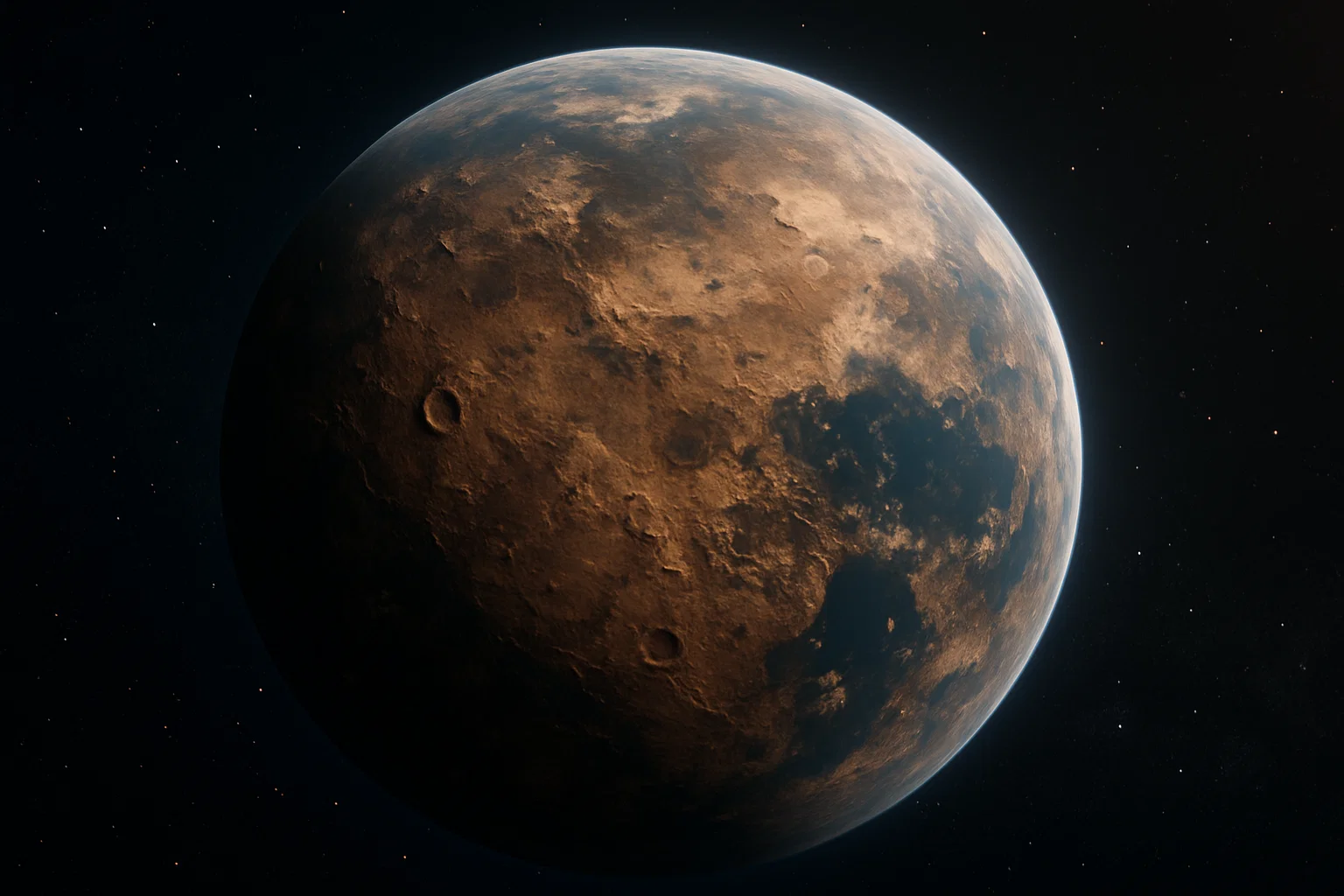
Look up at the night sky. You’re seeing a cosmos packed with… stuff. Stars, sure. Moons and comets, too. And, of course, planets.
But here’s the thing: not all planets are built the same. Some are just massive, swirling balls of gas. Others are tiny, frozen chunks of ice lurking in the dark.
And then, there are the planets like ours. Rocky. Solid. Worlds you could actually stand on.
This brings us to the big question: what is a terrestrial planet?
It sounds formal, but it just describes a specific, incredible class of worlds. We live on one. We’re actively trying to get to another (looking at you, Mars). Two more are our closest planetary neighbors. Figuring out what makes a planet “terrestrial” is really the first step to figuring out our own backyard in the solar system, and maybe even our place in the galaxy. These are the “ground” planets. Let’s dig in.
More in Celestial Objects Category
Difference Between Asterism and Constellation
Difference Between Meteoroid Meteor Meteorite
Key Takeaways
- A terrestrial planet, also called a rocky planet, is a planet composed primarily of silicate rocks or metals.
- These planets have a solid surface, distinguishing them from gas giants (like Jupiter) or ice giants (like Neptune).
- In our solar system, the four terrestrial planets are Mercury, Venus, Earth, and Mars. They are the four innermost planets.
- The typical structure of a terrestrial planet is a dense, metallic core at the center, surrounded by a rocky mantle, and topped with a solid crust.
- Many terrestrial-type planets, called “Super-Earths,” have been discovered orbiting other stars, suggesting they are common in the galaxy.
So, What Exactly Makes a Planet “Terrestrial”?
The word “terrestrial” sounds fancy, but it comes right from the Latin terra. It just means “of Earth.” So, a “terrestrial planet” is literally an Earth-like planet.
But what does that really mean?
It’s a rock.
That’s the simplest, most honest answer. A terrestrial planet has a solid surface, one made of rock and metal. It’s a place you could hypothetically stand (if you ignored little problems like, say, acid-rain atmospheres or furnace-like temperatures). This solid ground is the single biggest feature that separates them from the other main type of planet: the gas giants.
Just think about Jupiter for a second. That’s a colossal, swirling monster of hydrogen and helium. It has no “surface.” You could never land a ship there. As you’d drop into its atmosphere, the gas would just get thicker… and thicker… and thicker… until your ship was crushed like a soda can under unimaginable pressure.
Terrestrial planets are the complete opposite. They are worlds of substance. They’re built from the heavy stuff.
Is “Rocky Planet” Just Another Name for It?
Yep. Pretty much.
You’ll hear scientists and astronomers use “terrestrial planet” and “rocky planet” almost interchangeably. “Terrestrial” is the more formal term, but “rocky” gets right to the point. Both words describe the same core idea: these planets are made of stuff.
That “stuff” is mainly silicate rock, the same kind of material making up the mountains and canyons right here on Earth. They’re also loaded with metals, like iron and nickel, which usually settle into a dense core at the very center of the planet.
How Do These Rocky Worlds Even Form?
To get a rocky planet, you have to go back to the very beginning. Back to the birth of a star.
When a star, like our Sun, flares to life, it’s surrounded by a massive, spinning platter of gas and dust. This is the protoplanetary disk.
Think of it like a giant cosmic record. In the inner grooves, close to the hot, new star, it’s just too warm for light materials—things like water, ice, methane, and ammonia—to hang around. They get vaporized and blasted away to the colder, outer edges of the disk.
So, what’s left behind in that inner, warmer region?
Only the heavy stuff. The durable stuff. We’re talking about tiny particles of iron, silicon, magnesium, and other metals and minerals.
At first, these tiny grains just stick together with static electricity, like dust bunnies forming under your couch. But as they get bigger, they start to pull in more material with their own gravity. They clump up into “planetesimals,” which are basically lumpy, half-finished planets. For millions of years, this process is pure chaos. These planetesimals smash into each other, merge, and grow in a violent, messy process called accretion.
Eventually, all the cosmic billiards settles down. A few big winners are left standing. These are the new terrestrial planets, forged from the heavy-element leftovers of a star’s birth.
Who Are the Rocky Neighbors in Our Solar System?
Our solar system is a picture-perfect example of this whole formation process. The layout is clean. We have four small, rocky planets huddled close to the Sun. Then, after an asteroid belt, you find the four giant “gas and ice” planets ruling the outer system.
Our four terrestrial planets are Mercury, Venus, Earth, and Mars. Let’s do a quick round of introductions.
Mercury: The Swiftest, Smallest Sibling
First up is Mercury. This is the runt of the litter—the smallest of the four, not much bigger than our own Moon. It’s also the closest to the Sun, and it books it, zipping around its orbit in just 88 Earth days. It’s the fastest planet in town.
Life so close to the Sun gives Mercury a split personality. During its long day, the surface gets hot enough to melt lead, soaring past 800°F (430°C). But Mercury has almost zero atmosphere, no blanket to trap that heat. So, the second the sunlight fades, the temperature plummets to a staggering -290°F (-180°C).
It’s a dead, pockmarked world. It looks almost exactly like our Moon, which tells astronomers that its surface is ancient. It hasn’t been reshaped by volcanoes or plate tectonics in a very long time.
So Why Does Mercury Have Such a Huge Core?
Here’s where Mercury gets really weird. Its core is enormous. Scientists believe its metallic iron-nickel core makes up something like 60% of the planet’s entire mass.
To put that in perspective, Earth’s core is only about 30% of its mass.
So what’s the deal? Nobody is 100% sure, but the leading theory is a violent one. It suggests Mercury used to be a much larger planet. Then, billions of years ago, something—a giant object, maybe another forming planet—smashed into it. This colossal impact could have blasted most of Mercury’s lighter, rocky mantle and crust clean off into space. What we see today isn’t the original planet, but the dense, core-dominated “remnant” that was left behind.
Venus: Earth’s “Toxic Twin”?
Next in line is Venus. And Venus is a heartbreaker.
In so many ways, it’s the planet most like Earth. It’s almost the same size. It has almost the same mass. It’s made of the same basic rocky materials. This is why you’ll always hear it called Earth’s “sister planet” or “twin.”
But if Venus is our twin, it’s the evil one.
Venus is a waking nightmare. The planet is permanently smothered in a thick, choking atmosphere of carbon dioxide. The air is so dense that the pressure on its surface is 92 times greater than Earth’s. Standing on Venus would feel like being 3,000 feet (900 meters) deep in the ocean.
That thick CO2 blanket has created a runaway greenhouse effect. All the Sun’s heat gets in, but none of it can get out. Ever. The result is a surface temperature that stays locked at over 860°F (462°C). That’s all day, all night, all year. Venus is, by far, the hottest planet in the solar system, even hotter than Mercury. It’s hot enough to melt lead on the ground.
Why Does Venus Spin Backwards?
As if it weren’t bizarre enough, Venus also spins the wrong way. While Earth and most other planets spin “prograde” (counter-clockwise), Venus spins “retrograde” (clockwise).
It also spins at a crawl. A single “day” on Venus (one rotation) lasts longer than its entire “year” (one orbit around the Sun).
What could cause that? Again, the most likely culprit is a massive, planet-altering impact, or maybe even a few of them, back in the chaotic early days. This just goes to show how two very similar planets can start in the same place, but a few chance events can send them down wildly different paths. One becomes a paradise. The other, a pressure-cooker.
Earth: The Blue Anomaly
Then, there’s home.
Earth is the third rock from the Sun. And as far as we know, it’s one of a kind. It’s the largest of the four terrestrial planets, and it just so happens to be sitting in the “sweet spot” of the solar system, a place where conditions are just right for liquid water to exist on its surface.
And that water is everything.
Liquid water is the magic ingredient, the solvent that allowed complex life to arise. But Earth has more than just oceans. It also has a protective atmosphere, a perfect-for-us mix of nitrogen and oxygen. It has a strong magnetic field, generated by its churning liquid outer core, that shields us from the Sun’s most dangerous radiation.
And it has plate tectonics.
What Makes Plate Tectonics So Important?
This is a huge one. It’s a feature we haven’t been able to confirm anywhere else.
Earth’s crust isn’t one solid, static shell. It’s broken up into giant “plates” that are constantly, slowly moving. They grind against each other, pull away from each other, and slide under each other.
This process is absolutely vital for life as we know it. It acts like a giant recycling program. It churns up nutrients from the mantle, forms new land, and—crucially—helps regulate our planet’s temperature over millions of years by cycling carbon between the atmosphere and the Earth’s deep interior. It’s the ultimate long-term climate-control system. Without it, Earth might have gone the way of Venus a long time ago.
Mars: The Red Planet We’re All Wondering About
Finally, we get to the fourth and final terrestrial planet: Mars.
Mars is the one that captures our imagination. It’s the one we’re all rooting for. It’s smaller than Earth and Venus, and it has only a paper-thin wisp of a CO2 atmosphere. Today, it’s a cold, dusty, and seemingly dead desert.
But Mars has a secret. It wasn’t always this way.
The evidence, now, is overwhelming. We see vast, dried-up river deltas carved into the land. We find minerals in the soil that can only form in the presence of liquid water. NASA’s rovers have literally driven through the remains of ancient, long-dry lakebeds.
Billions of years ago, Mars was a different world.
So, What Happened to Mars?
Mars was once a warmer, wetter, terrestrial world. It was much more like Earth. But something went terribly wrong.
The leading theory pins the blame on its size. Mars is small, and because it’s small, it cooled down faster than Earth did. Its molten iron core—the engine for its magnetic field—eventually solidified.
And when the core froze, the planet’s magnetic shield died.
Without that shield, the Sun’s relentless solar wind was free to blast the planet, stripping away its atmosphere over millions of years. As the air thinned, the pressure dropped. The planet grew cold. And all the liquid water on its surface either evaporated into space or froze solid, locking itself away in the polar ice caps and under the red dust.
Mars died. Its story is a chilling reminder of just how fragile a habitable world can be.
If You Could Slice a Terrestrial Planet in Half, What Would You See?
While the four rocky worlds look wildly different on the outside, they all share the same basic anatomy. If you could cut one open, you’d find it’s built in three distinct layers. It’s like a peach, or an onion.
This layered structure, called differentiation, is a direct result of their formation. Back when the planets were young and molten, the heaviest materials sank to the center, while the lightest stuff floated to the top. Simple physics.
Here’s the basic blueprint, from the inside out:
- The Core: This is the dense, scorching-hot center. It’s made almost entirely of heavy metals, mostly iron and nickel. On Earth (and probably Venus, too), the core is in two parts: a-solid inner core and a liquid outer core. The spinning of this liquid-metal outer core is what generates a planet’s protective magnetic field.
- The Mantle: This is the thick, middle layer. It’s not metal, but it’s not the light rock of the crust, either. It’s a dense, hot, “plastic-like” silicate rock. Think of very thick, gooey oatmeal, or putty. The rock in the mantle isn’t liquid, but it’s so hot and under so much pressure that it can flow and circulate, very slowly, over millions of years. This “convection” is what drives plate tectonics on Earth.
- The Crust: This is the very thin, outermost skin of the planet. It’s the solid, rocky ground we’re all standing on. It’s the lightest and least dense layer, made of rocks like granite and basalt.
This simple three-layer structure is the defining blueprint for what a terrestrial planet is.
Wait, What About Moons and Dwarf Planets?
This is a fantastic question. You look at our Moon, or Jupiter’s moon Io, and they sure look like terrestrial planets. They’re solid. They’re rocky. Some, like Io, are hyper-volcanic, more active than Earth.
So, are they terrestrial planets?
No. But they are “terrestrial-like.”
The official definition of a “planet,” which got very controversial in 2006, comes from the International Astronomical Union (IAU). It has three rules. To be a planet, an object must:
- Orbit the Sun.
- Be massive enough for its own gravity to pull it into a round (or nearly round) shape.
- Have “cleared its orbital neighborhood” of other debris.
Moons fail rule #1. They just don’t orbit the Sun; they orbit a planet. So, even though our Moon has a core, mantle, and crust, it’s technically a “terrestrial-type satellite.”
Why Isn’t Pluto a Terrestrial Planet?
Pluto is the poster child for rule #3. It orbits the Sun (check) and it’s round (check). But it has not cleared its path. It swims in a sea of other icy objects out in the Kuiper Belt, so it doesn’t get to be a “planet.” This is why it was reclassified as a “dwarf planet.”
But Pluto also fails the “terrestrial” test on a more basic level. It’s not a rocky planet. It’s an ice planet. Its “rock” is actually rock-hard frozen water. Its “mantle” might be a slushy liquid water ocean, and its “crust” is made of exotic ices like frozen nitrogen and methane. It’s a completely different kind of world, born in the deep-freeze of the outer solar system.
Can All Terrestrial Planets Host Life?
This is the big one, isn’t it? When we hunt for life in the universe, we’re almost always looking for terrestrial planets. But as we’ve just seen from our own neighbors, “terrestrial” does not mean “habitable.”
Just being a rock isn’t enough. Not by a long shot.
For life (at least, life as we understand it), a rocky planet needs to be in a very, very special place.
The “Goldilocks Zone”: What Is It Really?
You’ve heard the term: the “Goldilocks Zone.” The more technical name is the “Circumstellar Habitable Zone.”
It’s not really about temperature; it’s about energy. The Goldilocks Zone is simply the narrow-band of orbits around a star where it is not too hot, and not too cold, for liquid water to exist on the planet’s surface.
Get too close to the star (like Venus), and any water boils away into the atmosphere, kicking off a runaway greenhouse effect. Get too far (like Mars today), and all the water freezes solid.
Earth is, quite literally, in the perfect spot.
But even the right location isn’t a magic guarantee. Mars is almost in the Goldilocks Zone, and it’s a frozen desert. A planet also needs a stable atmosphere, a protective magnetic field, and the right mix of chemical ingredients to get the whole “life” thing started.
Are There Rocky Planets Out There in Other Star Systems?
For almost all of human history, we only knew of our four. That was it. But in the last 30 years, our entire understanding of the galaxy has been turned upside down.
Dramatically.
We now know, with 100% certainty, that our solar system is not unique. Using incredibly powerful instruments like the Kepler Space Telescope and the TESS satellite, astronomers have confirmed the existence of thousands of planets orbiting other stars.
We call them “exoplanets.” And a whole lot of them appear to be terrestrial.
Finding “Super-Earths”: What Have We Discovered?
We are getting astonishingly good at finding these new worlds. Programs like the NASA Exoplanet Exploration are cataloging a mind-boggling zoo of new planets.
One of the most common types of planets we’ve found so far is something our solar system doesn’t even have. We call them “Super-Earths.”
These are terrestrial, rocky planets that are significantly bigger than Earth but still smaller than ice giants like Neptune. They are worlds that are twice, five times, or even 10 times more massive than our own.
What would a planet like that even be like? Would its super-strong gravity hold onto a thick, life-giving atmosphere? Or would it be a “water world,” a rocky core completely smothered by a single, globe-spanning ocean hundreds of miles deep?
We don’t know yet. But we are on the razor’s edge of finding out. With new instruments like the James Webb Space Telescope, we are just now beginning to sniff the atmospheres of these distant rocky worlds, looking for the tell-tale chemical fingerprints of water, methane… and maybe, just maybe, life.
So, What’s the Big Picture on Rocky Worlds?
It’s a world born from fire and chaos, built from the heavy metal and rock that survived a star’s fiery birth. It’s a planet with solid ground under your feet. A planet with a differentiated core, a mantle, and a crust.
It’s a category that includes the scorched, iron-heavy husk of Mercury. It includes the toxic, runaway-greenhouse inferno of Venus. It includes the frozen, red-dust desert of Mars.
And it includes us.
Earth. The only terrestrial planet, out of all the billions we now suspect are out there, that we know for a fact is a home.
It’s a powerful reminder. While rocky planets may be everywhere, a planet like ours—a living, breathing, vibrant terrestrial world—is unbelievably precious.
FAQ – What Is a Terrestrial Planet
What are the main structural layers of a terrestrial planet?
A terrestrial planet typically has three layers: a dense, metallic core at the center; a surrounding rocky mantle; and a solid crust known as the lithosphere.
Can terrestrial planets support life, and what conditions are necessary?
While terrestrial planets are the most likely candidates to host life, they require being in the right location, such as the Goldilocks Zone, and must have a stable atmosphere, magnetic field, and the right chemical ingredients for life to develop.