

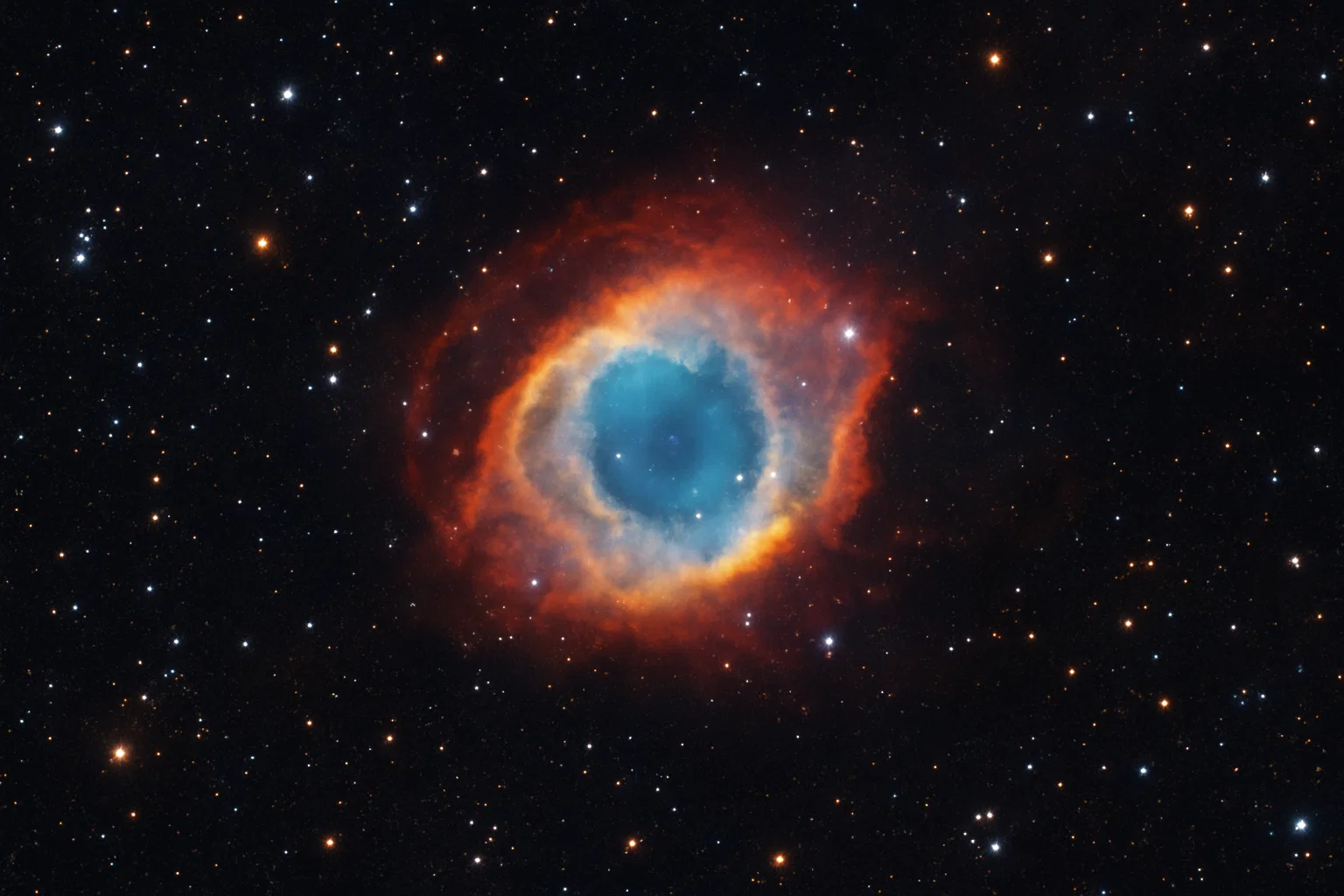
Ever see those wild, breathtaking images from the Hubble Space Telescope? The ones that look like cosmic butterflies, ethereal rings, or maybe a giant, spooky eye staring back from the void? You’re often looking at vast, swirling clouds of iridescent gas. In many cases, what you’re seeing is a planetary nebula.
But… what is a planetary nebula?
Right off the bat, you should know it’s one of the most confusing misnomers in all of astronomy.
Here’s the problem: these things have absolutely nothing to do with planets. Not a single thing. They aren’t “planetary” in any sense of the word. Planets aren’t born there. Planets don’t die there.
So what is it? A planetary nebula is a glorious, complex, and colorful shroud. Think of it as the final, dramatic act for a star just like our very own Sun. It is, quite literally, the glowing ghost of a dying star. Understanding these ghosts means understanding the ultimate fate of our solar system. It’s a critical piece of the cosmic puzzle of how we, you and I, even got here.
More in Celestial Objects Category
Will Our Sun Become a White Dwarf
What Is Left After a Supernova
Key Takeaways
Before we dive deep into the cosmos, here are the most important things to know about planetary nebulae:
- A planetary nebula is an expanding, glowing shell of ionized gas and dust.
- It’s created by a star with a low-to-intermediate mass (like our Sun, from 0.8 to 8 times its mass) as it reaches the end of its life.
- The name is a historical mistake. Early astronomers thought their round, fuzzy appearance resembled planets like Uranus through their small telescopes.
- They are incredibly short-lived, lasting only about 10,000 to 20,000 years—a mere blink of an eye in cosmic time.
- These nebulae are vital cosmic “recycling plants.” They spread heavy elements like carbon, nitrogen, and oxygen, forged inside the dying star, out into the galaxy. This material seeds the next generation of stars and planets.
So, Why the Confusing Name? Did Astronomers Just Get It Wrong?
Pretty much, yeah. But we can cut them some slack.
The name was coined way back in the 1780s by the brilliant astronomer William Herschel. You might know him as the guy who discovered the planet Uranus. You have to remember the technology he was working with. His telescopes were state-of-the-art for the 18th century, but they were just toys compared to what we have today.
When he pointed his telescope at these objects, he wasn’t seeing the intricate, colorful structures we get from Hubble. He just saw small, fuzzy, greenish-blue discs.
So, in his viewing log, he jotted down that these objects had a “planetary” appearance. What he meant was they looked round and disk-like, a lot like the new planet Uranus he’d just found. The name “planetary nebula” (since “nebula” is just the old Latin term for any “cloud”) was born from that simple visual comparison.
It’s a classic story of science, really. We make an observation, we give it a name, and then our technology improves and we discover what it really is. By the time astronomers figured out these were dying stars and not planets, the name was already stuck. And it’s been confusing astronomy students ever since.
What Kind of Star Creates a Planetary Nebula?
This spectacular end? It isn’t the fate for every star in the sky. Not by a long shot.
A star’s entire life story—and especially its death—is dictated by one single thing: its initial mass. How much “stuff” it was born with.
Planetary nebulae are the exclusive domain of low-to-intermediate-mass stars. This category includes stars that begin their lives with about 0.8 to 8 times the mass of our Sun. Since this covers a huge portion of all stars, including our own, it’s a very common end-of-life path.
But what about the stars that don’t fit this profile? Their stories are just as dramatic, but very different.
What Happens to Really Massive Stars?
Stars that are truly enormous—we’re talking more than 8 or 10 times the mass of our Sun—live fast and die young. They burn through their nuclear fuel at an absolutely furious rate.
They don’t get to go out with the “gentle” puff of a planetary nebula. Oh no.
Their end is far, far more violent. When a massive star finally runs out of fuel, its core collapses catastrophically. This collapse triggers a universe-shattering explosion we call a supernova. It’s a blast so powerful it can outshine an entire galaxy for a few weeks. What’s left behind is an exotic, hyper-dense remnant: either a neutron star or, if the star was massive enough, a black hole.
And What About Tiny Stars?
Then, on the other end of the spectrum, we have the little guys. Red dwarf stars.
These are the most common type of star in the Milky Way, all of them less than half the mass of our Sun. Think of them as the misers of the cosmos. They sip their hydrogen fuel incredibly slowly. Because of this, they have lifespans that are almost incomprehensibly long. We’re talking trillions of years, far longer than the current 13.8-billion-year age of the universe.
That’s right. Because their lifespans are so long, not a single red dwarf has ever “died” in the history of the cosmos. They’re all still just babies.
They’re too small to ever get hot enough to fuse heavier elements, so they’ll never swell into red giants or puff off a planetary nebula. Their fate is much quieter. They will simply, quietly, and slowly burn until they’ve converted all their hydrogen to helium. Then they’ll just fade away, becoming a cold, dark ball of helium called a black dwarf.
How Does a Star Like Our Sun Actually Make One?
The creation of a planetary nebula isn’t an instant thing. It’s a multi-step process that begins long before the nebula itself even starts to glow.
It’s really the story of a star’s final, unstable days.
And it all starts when a star like our Sun runs out of the main fuel it’s been burning for billions of years: hydrogen.
The Red Giant Phase: The Beginning of the End?
For about 10 billion years, a star like our Sun is happy. It just sits there, stably fusing hydrogen into helium in its core. This process, called the main sequence, is a perfect balancing act. The outward push of fusion energy perfectly counters the inward pull of gravity.
But when that hydrogen in the core finally runs out, the balance is broken.
Gravity wins. For a moment. The core, which is now just helium “ash,” begins to collapse and heat up. This new, intense heat ignites the unburned hydrogen in a shell surrounding the core. This new shell-burning is incredibly intense, generating even more energy than before.
All that immense outward pressure forces the star’s outer layers to swell up like a giant balloon. The star expands, and expands, and expands—growing 100 to 200 times its original size. As its surface expands, it cools, turning a deep, menacing red.
The star has become a Red Giant. And yes, this is the exact fate of our Sun in about 5 billion years. It will swell so large it will swallow Mercury, Venus, and almost certainly Earth.
What Are These “Thermal Pulses” I’ve Heard About?
A Red Giant star is not a stable star. It has entered its final, sputtering, chaotic phase, known as the Asymptotic Giant Branch (AGB).
Deep inside, a new round of fusion has kicked off, with the helium in the core (and later, in a shell) fusing into carbon and oxygen. This new helium-burning shell is wildly unstable. It doesn’t burn smoothly.
Instead, it leads to periodic, runaway bursts of energy called “thermal pulses.” Every few thousand years, the shell “flashes,” releasing a massive amount of energy in a very short time. You can think of each pulse as a giant cosmic “hiccup” that shakes the entire star.
These pulses are the key. They are the mechanism that builds the nebula. Each pulse is so violent that it blasts a huge portion of the star’s outer atmosphere—its hydrogen and helium envelope—clean off into space.
So the Star Just… Puffs Away?
That’s exactly what happens. It’s not one big kaboom, like a supernova. It’s a series of powerful “puffs” that happen over thousands and thousands of years.
With each thermal pulse, the star sheds another shell of its own material. This gas, rich in the elements the star has spent its life creating, billows away from the star at a pretty slow speed, just a few dozen kilometers per second.
Slowly, layer by layer, the star ejects its outer half. This expanding cloud of gas and dust is what we call the “proto-planetary nebula.” It’s the raw material. At this point, it’s still dark and cold, just floating in the space around the star… waiting for the lights to turn on.
What Makes a Planetary Nebula Glow So Brightly?
An expanding cloud of gas is one thing. But what makes it light up like a giant, cosmic neon sign?
The answer, it turns out, lies in what was left behind.
After the star has successfully puffed away its outer layers, the only thing that remains is the part that gravity refused to let go of: the star’s original, incredibly dense core.
The Star’s Hot, Naked Core: The White Dwarf?
Precisely. This exposed core is a brand new white dwarf.
And it is one of the most extreme objects in the universe. Imagine this: about 60% of the Sun’s original mass, crushed into a ball no bigger than our planet. It’s an Earth-sized sphere of super-compressed carbon and oxygen. The gravity is so intense that a single teaspoon of its material would outweigh a pickup truck.
This white dwarf isn’t really a “star” anymore, not in the traditional sense. It’s not fusing anything. There are no nuclear reactions happening in its core. It is, for all intents and purposes, a dead stellar ember.
But… it is unbelievably hot.
Freshly uncovered from the heart of the Red Giant, this white dwarf’s surface temperature is over 100,000° Kelvin (that’s 180,000° F). Our Sun’s surface, by comparison, is a “cool” 5,800° K. This intense heat makes the white dwarf shine with a fierce, blue-white light.
How Does This Tiny Core Light Up That Huge Cloud?
This is where the real magic happens. The white-hot white dwarf unleashes an absolute torrent of high-energy ultraviolet (UV) radiation.
This intense UV light streams out in all directions and slams into that expanding shell of gas the star puffed away thousands of years earlier. This radiation is so powerful that it violently strips the electrons right off the atoms in the gas cloud. Scientists call this process ionization.
The gas cloud becomes a hot, energized sea of free-floating atomic nuclei and electrons.
But this chaotic state doesn’t last. The electrons are constantly “recombining” with the atoms. And when an electron is recaptured, it cascades down the atom’s energy levels. As it does, it releases its excess energy—not as UV light, but as photons of visible light.
This process is called fluorescence. It’s the exact same principle that lights a neon sign. The white dwarf is the “power supply,” the UV light is the “electricity,” and the gas cloud is the “neon gas” that glows.
Why Do They Have Such Weird and Beautiful Shapes?
This, right here, is one of the biggest and most exciting questions in modern astrophysics.
Think about it. If our model was just a single, perfectly round star gently “puffing” out perfectly round shells of gas, what would we get? We’d get a perfect, simple sphere, every single time.
But that’s not what we see.
Sure, we see some spheres. But we also see stunning “butterfly” nebulae with two giant lobes. We see “hourglass” shapes. We see intricate rings with complex knots, and even bizarre, rectangular structures. The famous “Cat’s Eye Nebula” looks like a bafflingly complex knot of gas.
A simple, single-star model just can’t explain this. These beautiful, intricate shapes must be sculpted by other forces.
Does Having a “Friend” Make a Difference?
This is the leading theory. A lot of stars, maybe even most of them, are not alone. They’re born in binary (two-star) or even multi-star systems.
If our dying star has a companion star orbiting it, that companion’s gravity is going to have a massive influence.
As the star swells into a Red Giant, its companion can start siphoning off material. Or, the two stars might enter a wild “common envelope” phase where they both orbit inside the Red Giant’s atmosphere. This crazy interaction can spin the star up rapidly and “shepherd” the ejected gas. Instead of flowing out in all directions, the gas gets funneled into a dense disk or torus around the stars’ equator.
Later, when the star’s fast “wind” (a stream of particles from the white dwarf) kicks in, it can blast out of the star’s poles but gets blocked by that dense equatorial disk. This “blowtorch” effect is what scientists believe creates those stunning “bipolar” or “butterfly” shapes.
What About Magnetic Fields?
The dying star’s magnetic fields are another crucial ingredient. As the core contracts and spins, its magnetic field can get wound up, tangled, and amplified.
These powerful, invisible magnetic fields can act like cosmic channels, funneling the ionized gas (the plasma) into specific directions. They could be the reason we see those jet-like structures and fine-detailed “rays” in so many nebulae. The star’s own rotation also plays a huge part.
The whole system becomes this incredibly complex dance of gravity, magnetism, and fluid dynamics.
Is It Just One Big “Puff”?
Not at all. Remember, the star ejects its gas in multiple, distinct “pulses.” This creates a series of nested, expanding shells, like a cosmic set of Russian dolls.
But the star’s death is a continuous process. A “fast wind” of particles starts blowing off the central white dwarf, moving at thousands of kilometers per second. This super-fast wind slams into the slower-moving shells that were ejected earlier.
This collision is like a sonic boom in space. It creates shock fronts that heat the gas and sculpt the bright, intricate rims and filamentary structures we see. The complex beauty of a planetary nebula isn’t one thing. It’s the sum of all these parts: binary companions, magnetic fields, and multiple ejections all interacting over thousands of years.
What Colors Are We Actually Seeing?
The iconic, almost psychedelic colors in Hubble images are one of their most defining features. So, are those colors “real”?
The answer is a classic “yes, but…”
The colors aren’t arbitrary; they aren’t just picked to look pretty. They are a direct, scientific representation of the nebula’s chemistry. As we just learned, different elements, when they get zapped with energy, glow at very specific, signature wavelengths—or colors—of light.
Why Are They So Green and Red?
The two most dominant colors you’ll typically see in a planetary nebula are a deep red and a very specific shade of blue-green.
- Deep Red (Hydrogen-alpha): This color comes from ionized hydrogen. Since hydrogen is, by far, the most abundant element in the universe (and in the star’s outer layers), this red glow is almost always present. It maps out the main body of the nebula.
- Blue-Green (Oxygen-III): This color is the signature of “doubly-ionized” oxygen (that’s oxygen atoms that have lost two electrons). This particular green light was so strange and so strong in early astronomical observations that scientists briefly thought it was a new element. They even named it “nebulium.” We now know it’s just plain old oxygen, glowing under very specific, low-density conditions that are impossible to recreate here on Earth.
It just so happens that our eyes are extremely sensitive to this particular shade of green. That’s why those early visual observers so often described these objects as “greenish.”
What About Those “False Color” Images?
To really study these objects, astronomers use special filters on their telescopes. These filters let them isolate the light from just one element at a time.
They might take one picture that only captures the red light from hydrogen. Then they’ll take another that only captures the green light from oxygen, and maybe a third that only captures the blue light from helium.
Initially, these are all just black-and-white images.
To create the final, full-color composite, they “map” each of these filtered images to a color. A common choice is the “Hubble Palette,” where hydrogen is assigned to green, sulfur to red, and oxygen to blue.
This isn’t done to trick us or just to “make it pretty.” It is a vital scientific tool called false-color imaging. It allows scientists to instantly see the chemical structure of the nebula. When they look at a Hubble Palette image, they can immediately say, “Ah, that blue region is rich in oxygen, which means it’s highly ionized, while that red-hot rim is full of sulfur, indicating a shock front.”
For a stunning look at what this data reveals, check out the Hubble Space Telescope’s gallery. You can see how mapping different elements to different colors helps untangle the nebula’s complex physics.
Are These Nebulae Just Pretty Pictures, or Are They Important?
So, are they just pretty pictures? Or are they actually important?
They are far more than just pretty pictures. Planetary nebulae are one of the most important cogs in the grand machine of the cosmos. In a very real sense, they are the reason we are here.
Where Do All the “Heavy Elements” Come From?
The Big Bang, which kicked off our universe, produced almost exclusively hydrogen and helium. That’s it.
Every other element on the periodic table—the carbon in your DNA, the nitrogen in our atmosphere, the oxygen you’re breathing right now, the calcium in your bones—all of it had to be forged.
And the only place that can happen is inside the nuclear furnace of a star.
Throughout its life, a star like our Sun fuses hydrogen to helium, and then helium to carbon and oxygen. In its final AGB phase, other reactions cook up elements like nitrogen and neon. These “heavy elements” (which, to an astronomer, is anything heavier than helium) are the literal building blocks of life.
But what good are those elements if they stay locked inside the star?
So We Are Star Stuff?
This is where the planetary nebula comes in. It’s the delivery mechanism.
As the star puffs away its outer layers, it’s not just ejecting hydrogen and helium. It’s “dredging up” the carbon, nitrogen, and oxygen from its core and blasting them out as well.
The planetary nebula is the star’s last act: it seeds the interstellar medium—the gas and dust floating between stars—with these new, life-giving elements.
This newly enriched material drifts through the galaxy. Millions of years later, in another part of the galaxy, a cloud of this “polluted” gas and dust will collapse under its own gravity. It will form a new star and a new solar system.
This new system will have something the first generation of stars didn’t: the raw materials to build rocky planets like Earth, and the chemical ingredients necessary for life.
Carl Sagan’s famous phrase, “We are made of star-stuff,” isn’t just poetry. It is a literal, scientific fact. The very atoms that make up your body were forged in the heart of a long-dead star and cast out into the cosmos in a final, beautiful puff.
How Long Does a Planetary Nebula Last?
For all their cosmic beauty and importance, a planetary nebula is a fleeting thing. On a cosmic timescale, they are gone in the blink of an eye.
The entire “glowing” phase of a planetary nebula lasts for only about 10,000 to 20,000 years.
Think about that. Our Sun’s lifespan is 10 billion years. 10,000 years is… nothing. It’s almost instantaneous. This is why, even though this is a common fate for stars, we don’t see more of them in the sky. We only see the ones that just happen to be in this brief, shining moment right now.
Why Do They Disappear So Quickly?
They fade away for two simple reasons, and both happen at the same time.
- The Nebula Expands: The gas cloud, which was ejected at tens of kilometers per second, never stops expanding. It just keeps getting bigger, thinner, and more spread out. After 10,000 or 20,000 years, it has become so diffuse that it simply becomes too thin to see. It eventually just melts back into the interstellar medium, becoming indistinguishable from the rest of the gas and dust out there.
- The Star Cools Down: That central white dwarf is a “dead” ember. It has no internal fuel source. It’s just a hot rock losing heat to space. It’s still incredibly hot, but it is cooling. After about 10,000 years, its surface temperature finally drops below the point where it’s no longer emitting enough high-energy UV radiation to ionize the gas cloud.
The power supply gets unplugged.
The lights go out. The beautiful glow fades. The atoms in the nebula stop fluorescing and go back to being a dark, invisible cloud of gas. All that’s left is a tiny, cooling white dwarf, beginning its lonely, trillion-year-long journey to fade into a cold, dead black dwarf.
Will Our Sun Create a Planetary Nebula?
Yes. Absolutely.
Our Sun is a textbook-perfect candidate. It has the right mass, it’s a single star, and it’s well into its middle-aged life. This is its definitive, non-negotiable fate.
But you have plenty of time to make plans. This whole process won’t even begin for another 5 billion years.
What Will That Be Like for Earth?
Unfortunately, humanity will not be around to see it. The creation of the Sun’s planetary nebula will be preceded by its Red Giant phase.
In about 5 billion years, our Sun will begin to swell. It will expand, scorching the inner solar system. The oceans on Earth will boil away. The atmosphere will be stripped, and the surface of the planet will melt into a global ocean of magma.
It is terrifyingly likely that the Earth itself will be completely engulfed by the Sun’s expanding outer layers and vaporized.
Will Our Solar System Have Its Own Nebula?
It sure will. After the Red Gphase, our Sun will go through its thermal pulses. It will puff its outer layers, and that gas will drift out past the orbits of Mars and the gas giants.
The Sun’s core will collapse into a hot white dwarf.
This white dwarf will then flood the solar system with UV radiation, lighting up that expanding cloud of gas. For about 10,000 years, the solar system will be home to a brilliant, glowing planetary nebula. From star systems light-years away, alien astronomers might point their telescopes in our direction. They’d see a beautiful, new “planetary nebula,” a silent, colorful tombstone marking the place where a star and its family of planets once lived.
How Can We See These Faint Objects?
The good news is you don’t need to wait for our Sun’s demise to see one. And you don’t even need access to the Hubble Space Telescope.
While many planetary nebulae are incredibly faint, a few are bright enough to be seen with a good pair of binoculars or a modest backyard telescope.
What’s the Best Way for an Amateur to Look?
Looking for these objects is a classic challenge for amateur astronomers. It’s a rite of passage. Here are two of the most famous and “easiest” targets to find in the night sky:
- The Ring Nebula (M57): You can find this one in the summer constellation Lyra (the harp). Through a telescope, it looks like a perfect, tiny, ghostly “smoke ring” or a cosmic Cheerio. It’s a classic example of a nebula that we just happen to be viewing right down the “barrel.”
- The Dumbbell Nebula (M27): Look for this one in the constellation Vulpecula (the fox). This was the very first planetary nebula ever discovered. It’s one of the brightest, and its bipolar, “apple-core” or “dumbbell” shape is pretty clear even in small telescopes.
Why Are Telescopes Like Hubble and Webb So Important?
While we can spot these objects from Earth, it’s the great observatories up in space that give us those mind-blowing details.
The Hubble Space Telescope has been the king of planetary nebulae for over 30 years. By seeing in visible light from high above Earth’s blurry atmosphere, it has delivered the high-resolution, iconic images that first revealed their shockingly complex shapes.
But now, the James Webb Space Telescope (JWST) is starting a whole new revolution. Webb sees in infrared light, which is invisible to our eyes. This lets it do two amazing things Hubble can’t:
- It can peer right through the dust to see the central star and the inner structures that are normally hidden from view.
- It can see the cooler gas and complex molecules that don’t glow in visible light.
Together, Hubble and Webb are giving us the complete picture, from the hot, ionized gas on the outside to the cool, molecular heart within. For the first time, we’re finally able to piece together how these cosmic masterpieces are actually built.
A Fleeting, Cosmic Masterpiece
It’s a misnomer, a signpost, a ghost, and a cradle. It’s a star’s final, defiant, beautiful gasp. It is the universe’s elegant way of taking the old and making it new, recycling the ashes of one star’s life to provide the ingredients for the next.
These objects are a memento mori for a star. They are a fleeting, 10,000-year-long piece of art that enriches the entire galaxy before fading quietly back into the dark. More than anything, they are a profound reminder that even in death, the stars give us the gift of life.
FAQ – What Is a Planetary Nebula
How does a star like our Sun form a planetary nebula?
A star like our Sun begins the process when it runs out of hydrogen fuel in its core, expands into a Red Giant, and then enters the asymptotic giant branch phase, where it periodically ejects shells of gas through thermal pulses. These ejected layers form the glowing nebula, while the remaining core becomes a white dwarf that illuminates the gas.
Why are the shapes of planetary nebulae so varied and intricate?
The diverse shapes are influenced by additional factors such as binary star companions, magnetic fields, and stellar winds. These forces sculpt the expelled gas into complex forms like butterflies, hourglasses, or rings, rather than simple spheres.
How long does a planetary nebula last, and why does it fade away so quickly?
A planetary nebula lasts only about 10,000 to 20,000 years because its gas disperses into space as it expands and becomes too diffuse to detect, and the central white dwarf cools down, reducing UV radiation needed to keep the gas ionized.