

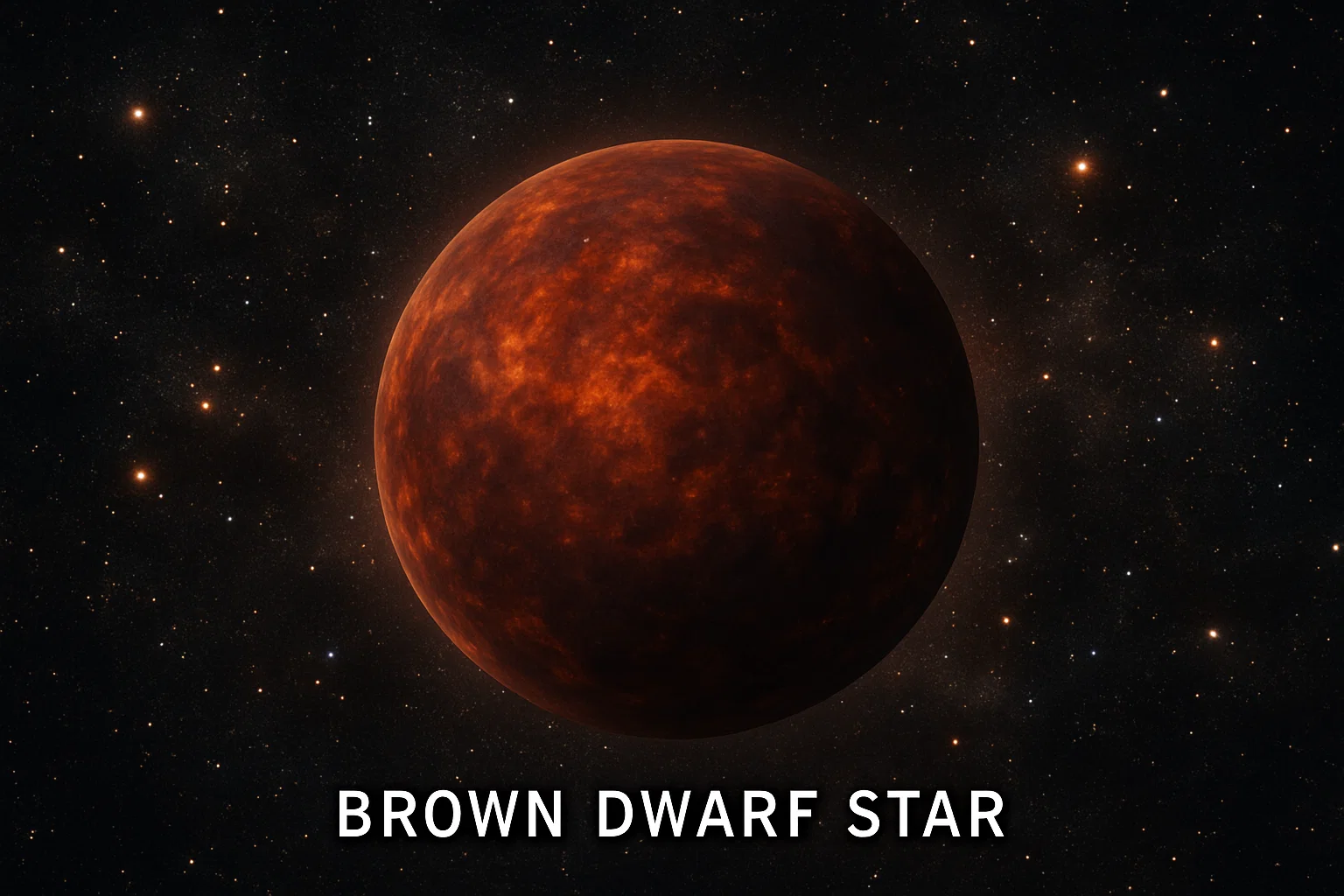
The universe usually likes distinct buckets. You have stars, massive engines of nuclear fire that light up the void. You have planets, smaller lumps of rock or gas that orbit those stars. It seems simple enough. But the cosmos gets messy. It creates things that don’t fit neatly into our human-made boxes. Right in that uncomfortable middle ground, sitting in the darkness between a gas giant and a red dwarf, you find the brown dwarf.
You probably ended up here because you want a straight answer to a tricky question: what is a brown dwarf star?
Think of them as the cosmic middle child. They are too big to be planets, yet they lack the sheer mass to ignite the full glory of a star. For years, they were just a mathematical ghost story—predicted on paper, but invisible to our telescopes. Now, we know they swarm our galaxy by the billions. They hold the secrets to how star systems form, and they might even host life on their own orbiting worlds.
We are going to strip away the textbook dryness. We need to look at the violent weather, the crushing gravity, and the strange, cooling lives of these “failed stars.”
More in Celestial Objects Category
Difference Between Gas Giant and Star
Difference Between Asterism and Constellation
Key Takeaways
- The Definition: A brown dwarf acts like a bridge between the heaviest gas giant planets and the lightest stars.
- The Mass Rule: They generally weigh between 13 and 80 times the mass of Jupiter.
- Failed Ignition: They form like stars but can’t sustain hydrogen fusion, which earns them the title “failed stars.”
- Strange Colors: Despite the name, they aren’t brown. They glow magenta, orange, or distinctively red depending on their temperature.
- Cosmic Abundance: Though hard to see, they are likely as common as regular stars in our galaxy.
So, What Is a Brown Dwarf Star in Plain English?
To really get this, you have to look at how things are born in deep space.
Stars and planets usually have different birth certificates. A star forms when a massive cloud of gas and dust collapses under its own gravity. It gets tight. It gets hot. Eventually, the core ignites. A planet, on the other hand, builds itself from the leftover scraps swirling around that new star.
Brown dwarfs break the rules. They form just like stars do. A gas cloud collapses. Gravity pulls everything toward the center. The object spins and heats up. It looks like a star is about to be born.
But then, the engine stalls.
Gravity just isn’t strong enough. The object doesn’t have enough mass to crunch its core tightly enough to spark hydrogen fusion. That fusion is what makes the Sun shine. Without it, the brown dwarf becomes a “failed star.” It glows from the heat of its formation, but it has no way to generate new energy. It is born, and then immediately begins a long, slow death, cooling down for the rest of eternity.
Why Do We Call Them Failed Stars?
“Failed star” sounds a bit judgmental, right? Like the object didn’t study hard enough. But in physics, the term fits perfectly.
A star’s life is a constant war. Gravity tries to crush the star inward. The energy from nuclear fusion pushes outward. In a stable star like the Sun, these two forces tie. The star stays the same size.
In a brown dwarf, gravity loses the war before it really begins. The core never gets hot enough—around 10 million degrees Kelvin—to fuse ordinary hydrogen. Instead, the core stabilizes because of quantum mechanics. The electrons inside get packed so tightly they resist being squeezed any further. This is called “electron degeneracy pressure.” It stops the collapse. The object becomes a stable ball of gas, but the lights never fully turn on.
Does Mass Determine Destiny?
Astronomers love drawing lines in the sand. Since brown dwarfs look a lot like Jupiter and a lot like small stars, we need a way to tell them apart. We use mass.
The magic zone sits between 13 and 80 Jupiter masses.
If an object has less than 13 times the mass of Jupiter, we call it a planet (usually). If it has more than 80, it creates enough pressure to fuse hydrogen, and we call it a Red Dwarf star.
Why Is the Number 13 So Special?
You might wonder why we picked 13. It isn’t arbitrary. It comes down to a specific heavy type of hydrogen called deuterium.
Deuterium is easier to burn than regular hydrogen. Even though a brown dwarf fails the main test, it passes the pop quiz. Objects above 13 Jupiter masses can fuse deuterium for a short time. It provides a brief flash of internal energy—maybe a few million years. This deuterium burning is the smoking gun. It proves the object isn’t just a planet. It has its own internal fire, however fleeting.
What Color Is a Brown Dwarf? (Hint: Not Brown)
If you hopped in a starship and flew right up to one, you wouldn’t see a brown ball of dirt. The name “brown dwarf” is actually just a placeholder. Jill Tarter coined it in 1975 because she needed a name for these dark objects, and “infrared dwarf” didn’t roll off the tongue.
So, what would you actually see?
It depends on how old—and how cold—the dwarf is.
- The Young Ones: A young, hot brown dwarf glows a dull, angry red. It looks like a charcoal briquette that you just pulled out of the fire.
- The Middle-Aged: As they cool to roughly 1500 Kelvin, they likely turn a deep magenta or hazy violet.
- The Old Timers: The coolest ones, the Y-dwarfs, reflect almost no visible light. If you shined a flashlight on them, they might look dark orange or even a deep, bruised purple due to sodium and potassium in their atmosphere.
Most of their energy blasts out as infrared light. Our eyes can’t see it, but our skin would feel it as intense heat.
How Do We Organize These Weird Objects?
Astronomers categorize stars by letters: O, B, A, F, G, K, M. But brown dwarfs are too cool for that list. We had to invent three new letters to extend the sequence: L, T, and Y.
The L Dwarfs
These are the heavyweights. They are the hottest and youngest of the bunch. They look very similar to M-type stars (red dwarfs). Their atmospheres are scorching hot. We are talking 2,500 to 1,300 Kelvin. At these temperatures, dust grains made of metal and rock form in the atmosphere.
The T Dwarfs
This is where things get distinct. The T dwarfs cool down enough for methane to form. Methane absorbs light, which gives these dwarfs a very specific signature in our telescopes. They look less like stars and more like Jupiter.
The Y Dwarfs
These are the ghosts. We only started finding them recently. They are incredibly cold. Some Y dwarfs have temperatures around 80°F (27°C). That is literally room temperature. You could theoretically exist comfortably in the vicinity of one, provided you didn’t get crushed by gravity or poisoned by the atmosphere. They represent the very bottom of the barrel before you hit rogue planets.
What Is the Weather Like on a Failed Star?
You think a hurricane on Earth is bad? Brown dwarfs have weather that would strip the skin off your bones in seconds.
Because they spin incredibly fast—some rotate once every 3 hours—their atmospheres whip around in violent bands. But the clouds aren’t made of water.
On the hotter L-dwarfs, the clouds are made of hot sand and molten iron. Yes, you read that correctly. It rains liquid iron.
As the dwarf cools into a T-dwarf, that iron rain settles deep into the interior. The upper atmosphere clears up, replaced by clouds of salts and sulfides. The storms on these objects rival the Great Red Spot on Jupiter, but they cover the entire surface. Astronomers have actually made maps of these storms by watching the brightness of the brown dwarf change as it spins. We watch the clouds rotate in real-time.
Can Brown Dwarfs Host Their Own Solar Systems?
This is the plot twist everyone loves. Just because a brown dwarf isn’t a full star doesn’t mean it can’t be the center of attention.
We have seen disks of dust and gas swirling around young brown dwarfs. These are the exact same planet-building factories that exist around stars. In fact, we have found planetary-mass objects orbiting brown dwarfs.
Take the system 2M1207. It is a brown dwarf with a companion about 5 times the mass of Jupiter. Is that companion a planet? Or is it just a smaller brown dwarf? The line blurs.
But could life exist there? Maybe. A rocky planet orbiting very close to a brown dwarf would get some heat. However, the clock is ticking. Since the brown dwarf constantly cools down, its “habitable zone” (where water stays liquid) moves inward and eventually vanishes. Any life would have to migrate or freeze.
How Did We Finally Catch Them?
Knowing what is a brown dwarf star and actually finding one are two different things.
Theorists knew they existed in the 1960s. The physics demanded it. But for thirty years, every search came up empty. They were just too dim. They got the nickname “The Missing Link.”
Then came 1995. It was the golden year for sub-stellar astronomy.
Two teams made history. One team found Teide 1 in the Pleiades star cluster. Another team imaged Gliese 229B, a small, dim companion orbiting a red star. Gliese 229B had methane in its spectrum. That was the smoking gun. Stars are too hot for methane; it breaks apart. Finding methane meant this object was something new.
Since then, infrared surveys like 2MASS and NASA’s WISE mission have found thousands. They were hiding in plain sight, just too cool for our old telescopes to notice.
Why Are They So Hard to Find?
It comes down to the “glare” problem.
Brown dwarfs are often faint companions to bright stars. Trying to see a brown dwarf next to a star is like trying to see a firefly buzzing next to a stadium floodlight. The star washes everything out.
This is why we find most of them floating alone in the void or orbiting very far from their parent stars. We detect them by their heat, not their light. This is also why the James Webb Space Telescope is such a game changer. Its instruments are tuned specifically for infrared light. It can see the faint heat glow of a brown dwarf from light-years away, peering through dust clouds that block normal telescopes.
The Size Paradox: When Adding Mass Doesn’t Make You Bigger
Physics does something counter-intuitive with these objects.
If you eat too many burgers, you get bigger. If a planet gathers more gas, it usually gets bigger. But brown dwarfs defy this logic.
A brown dwarf with 20 times the mass of Jupiter is roughly the same physical size (radius) as a brown dwarf with 70 times the mass of Jupiter. They are both about the size of Jupiter itself.
How does that work?
It goes back to that electron pressure. As you pile more mass onto a brown dwarf, the gravity squeezes it tighter. The object doesn’t expand; it just gets denser. The atoms pack closer together. So, the heaviest brown dwarf is a super-dense ball of gas, barely larger than the lightest one. If you stood on the surface of a heavy brown dwarf, the gravity would be hundreds of times stronger than on Earth.
The Neighbors Next Door
We used to think the Alpha Centauri system was our only close neighbor. Brown dwarfs proved us wrong.
In 2013, Kevin Luhman discovered a pair of brown dwarfs dancing around each other just 6.5 light-years away. We call the system Luhman 16. It is the third closest system to the Sun.
Think about the implications. We missed a neighbor sitting right on our doorstep for centuries because it was dark. This fuels the speculation: could there be a brown dwarf even closer? Could a Y-dwarf be orbiting the Sun in the Oort cloud, a light-year away, unseen and cold? It is unlikely we would have missed it by now, but the possibility keeps some astronomers up at night.
Rogue Planets vs. Brown Dwarfs
The universe loves to blur lines. We have found objects floating in deep space that are only 6 or 7 Jupiter masses.
Are these tiny brown dwarfs? Or are they planets that got kicked out of their solar systems?
We call them “rogue planets” or “free-floating planetary mass objects.” The distinction usually comes down to how they were born.
- If it collapsed from a gas cloud on its own, we tend to call it a sub-brown dwarf.
- If it formed around a star and got ejected by gravity, it is a rogue planet.
Functionally, they are almost the same. They are lonely worlds drifting in the dark. But the “sub-brown dwarf” label shows just how far down the rabbit hole goes. Star formation doesn’t just stop at 13 Jupiter masses. It might go all the way down to 1 Jupiter mass.
Why Do Brown Dwarfs Matter?
You might ask, “Who cares about a dead star?”
You should. Brown dwarfs are the laboratories of the galaxy.
Because they cool down, they pass through temperature ranges that mimic exoplanets. But unlike exoplanets, they don’t have a blinding star next to them. We can look at a brown dwarf and clearly study its atmosphere. We can see how clouds form, how winds blow, and what chemicals exist in that temperature range.
They are our practice targets. By understanding the chemistry of a T-dwarf, we learn what to look for on a habitable planet orbiting a distant star. They teach us about the physics of extreme gravity and the chemistry of cold atmospheres.
The Future of the Universe belongs to Them
Stars die. Our Sun will swell into a Red Giant, scorch the Earth, and then shrink into a white dwarf. Massive stars blow up.
But brown dwarfs? They are the survivors.
They sip their fuel (if they fuse at all) or just simply sit there, retaining their heat for billions of years. Because they don’t undergo violent explosions, they remain intact. Trillions of years from now, when the last stars burn out and the galaxies go dark, the brown dwarfs will still be there. They will be slightly warmer than the freezing void, the last silent sentinels of a universe that has run out of power.
Final Thoughts on the Cosmic Misfits
So, what is a brown dwarf star? It is the universe proving that size isn’t everything.
They are the bridge between the geology of planets and the nuclear physics of stars. They are violent, stormy, and incredibly common. They hide in the shadows, holding the mass of the galaxy together.
We used to look up and see points of light. Now we know that the darkness between those lights is full of objects. The brown dwarfs are out there, billions of them, cooling slowly in the dark. They remind us that the universe is far more crowded—and far more interesting—than we ever imagined.
FAQ – What Is a Brown Dwarf Star
What exactly is a brown dwarf star?
A brown dwarf star is an object that bridges the gap between the heaviest gas giant planets and the lightest stars, with a mass typically between 13 and 80 times that of Jupiter. They form like stars but do not have enough mass to sustain hydrogen fusion, earning them the title ‘failed stars.’
Why are brown dwarfs called ‘failed stars’?
Brown dwarfs are called ‘failed stars’ because, unlike stars, they cannot sustain hydrogen fusion in their cores due to insufficient mass. They form like stars but are unable to ignite nuclear fusion, so they glow from residual heat rather than true stellar light.
How do scientists distinguish brown dwarfs from planets and stars?
Scientists distinguish brown dwarfs primarily by their mass, which falls between 13 and 80 Jupiter masses. Objects less than 13 Jupiter masses are generally considered planets, while those more than 80 Jupiter masses can fuse hydrogen and are classified as stars. The key marker is if they can fuse deuterium, a heavier hydrogen isotope, which indicates they are not just planets.
What is the significance of the different types of brown dwarfs (L, T, and Y)?
The types of brown dwarfs are categorized based on their temperature and atmospheric characteristics. L dwarfs are the hottest and look similar to red dwarfs, T dwarfs cool enough for methane to form giving them a Jupiter-like appearance, and Y dwarfs are the coldest, reflecting almost no visible light and representing the lowest temperature objects in this category.