

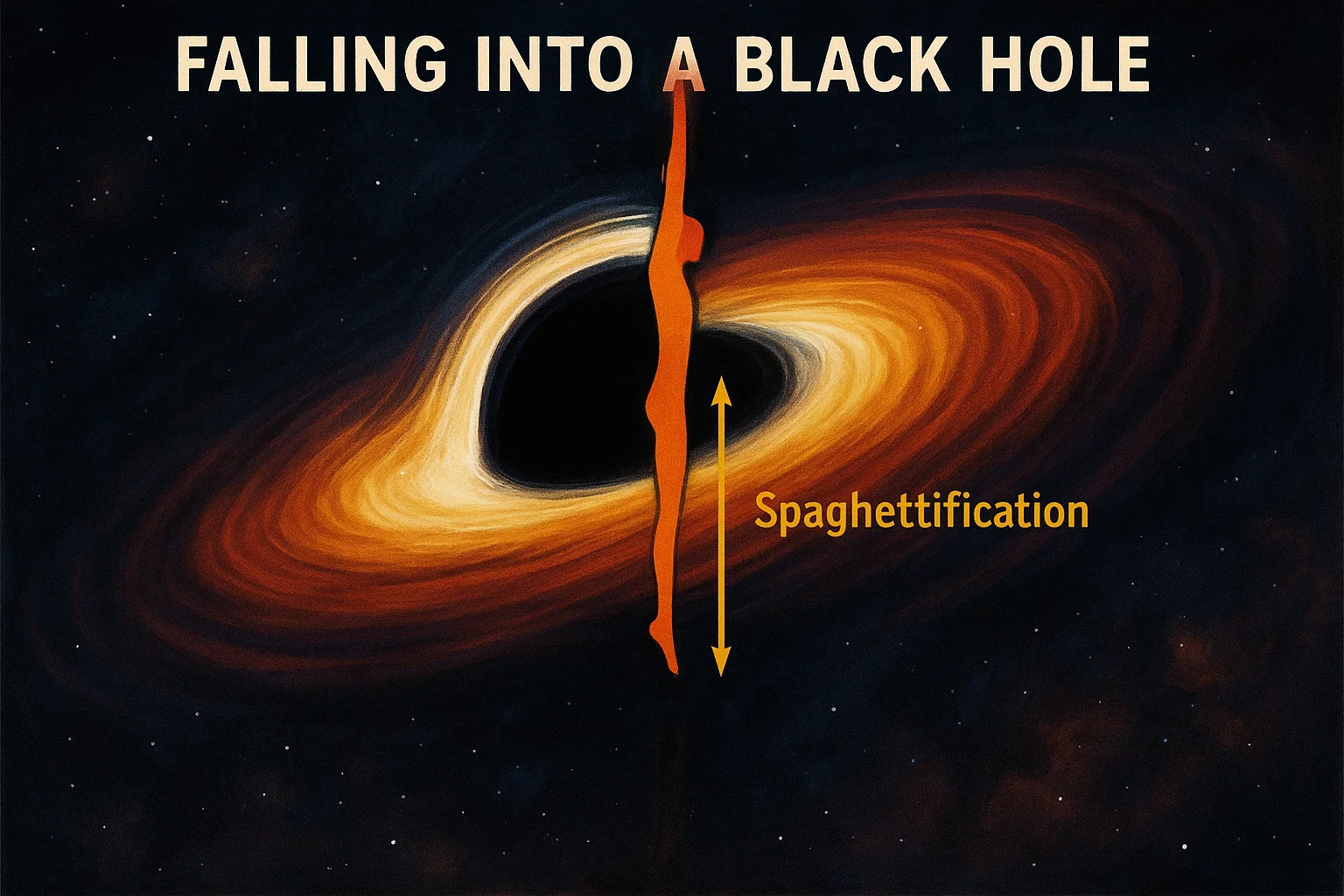
It’s the ultimate nightmare scenario, isn’t it? A terrifying, completely irresistible question. In the entire cosmic zoo of bizarre and violent objects, nothing grabs our imagination quite like a black hole. They are the universe’s final word. Points of such impossible density that the rules of physics, the very laws that build our reality, just… stop. So, what happens if you fall into a black hole?
The short answer is grim: you die. But the how… oh, the how is one of the most fascinating, mind-bending trips in all of science. It’s a journey that involves a horrifying stretching, a reality-warping twist on time, and an end point that we literally cannot comprehend.
This isn’t just a simple plunge. It’s a one-way voyage across a boundary that separates our universe from… well, from something else. The star of this gruesome show is a wonderfully descriptive and terrifyingly accurate term: spaghettification.
Let’s take that trip. Let’s find out exactly what would happen to your body, your sense of time, and your very atoms as you fall toward the abyss.
More in Celestial Objects Category
Why Are Neutron Stars So Dense
Key Takeaways
Before we take the plunge, here’s the mission briefing on what happens when you fall into a black hole:
- Your Death Is Certain: There is no escape. Once you cross a boundary called the “event horizon,” physics itself makes a return trip impossible.
- You Get “Spaghettified”: The most likely cause of death is spaghettification. This is where the black hole’s tidal forces stretch your body into a long, thin strand of atoms.
- Time Warps Dramatically: To an outside observer, you would appear to slow down and freeze in time at the edge of the black hole, never crossing. To you, however, time would feel perfectly normal as you fall, while the entire future of the universe flashes before your eyes.
- The Black Hole’s Size Matters: Your experience depends heavily on the type of black hole. A “small” stellar-mass black hole would spaghettify you before you even reached the event horizon. A supermassive black hole would let you cross the horizon completely unharmed… for a little while.
- The End Is a Mystery: You are ultimately crushed at the “singularity,” a point of infinite density where our understanding of space and time completely breaks down.
So, What Is a Black Hole, Anyway?
Before we dive in, let’s get our bearings. What is this monster we’re facing?
A black hole is not an empty “hole.” It’s the exact opposite. It is an unimaginable amount of matter—think of a star, or millions of stars—crushed into an impossibly small space.
Picture our Sun. It’s massive. Now, imagine crushing that entire Sun down to the size of a small city. The gravity of that tiny, ultra-dense object would be so immense that its escape velocity—the speed you’d need to get away—would be faster than the speed of light.
And since nothing in the universe can travel faster than light, nothing can escape.
Not a spaceship. Not a planet. Not even light itself.
That’s a black hole. It’s the ultimate prison, protected by a boundary made of pure, warped geometry.
Is It Really a Hole?
Think of it less as a hole and more as a sphere of influence. The “black” part is just what we see from the outside: a perfect circle of darkness where light has been trapped. This boundary of no return, this “edge,” is called the event horizon.
The “hole” part only makes sense if you think about it in four dimensions. Albert Einstein taught us to think of space and time as a single, interwoven fabric: “spacetime.” A massive object, like a planet or a star, just puts a “dent” in this fabric, and we feel that dent as gravity.
A black hole, however, doesn’t just dent spacetime. It punctures it. It creates a bottomless gravitational well.
Once you fall into that well, all possible paths, all directions in space and time, lead to only one place: the center.
Where Do These Things Even Come From?
Understanding what happens if you fall into a black hole means knowing which kind you’re falling into. They mainly come in two popular sizes:
- Stellar-Mass Black Holes: These are the “small” ones, though they’re still several times more massive than our Sun. They’re born when a truly giant star—much, much bigger than our own—runs out of fuel and dies. The star’s core collapses under its own crushing weight, triggering a massive supernova explosion. While the outer layers blast into space, the core keeps collapsing forever, shrinking into a black hole.
- Supermassive Black Holes: These are the behemoths. We’re talking millions, or even billions, of times the mass of our Sun. Scientists believe one of these giants lurks at the center of virtually every large galaxy, including our own Milky Way. (Ours is named Sagittarius A*.)
This size difference isn’t just a fun fact. It is the single most important factor in determining when and how you die.
I’m Drifting Toward a Black Hole. What Do I See First?
Your journey doesn’t start with instant death. Long before you’re in any real physical danger, the view out your spaceship window would become the most spectacular—and terrifying—sight in the cosmos.
The first thing you’d notice is how the black hole bends light. You’d see a perfect black circle, a void, silhouetted against the starry background. But it’s not just a circle. It’s surrounded by a chaotic swirl of light.
If the black hole is “feeding” on a nearby star or gas cloud, that material gets whipped into a swirling, white-hot pancake called an accretion disk. This disk of doomed matter grinds against itself, heating up to millions of degrees from friction. It blazes brighter than an entire galaxy.
Why Does Everything Look So Warped and Weird?
This is where Einstein’s theories get real. The black hole’s monster gravity bends spacetime, and light has to follow those curves. This effect is called gravitational lensing.
You wouldn’t just see the stars behind the black hole. You’d see them warped and smeared into strange arcs, even multiple copies of the same star. The black hole acts like a cosmic funhouse mirror. Looking at that bright accretion disk, you’d even see its back side, as light from behind the black hole is bent around and shot toward your eyes.
You’d be seeing the universe in a way no human ever has.
Is the Black Hole… Blue?
As you accelerate, picking up speed on your fall toward the black hole, the light from the stars and gas in front of you would get… weird. It would become strangely energized. This is the Doppler effect, but for light. Just as a siren’s pitch rises as it comes toward you, the frequency of light waves from your destination increases.
Light shifts toward the high-frequency end of the spectrum. Visible light becomes blue. Then violet. Then ultraviolet, and eventually into high-energy X-rays and gamma rays. The universe in front of you would become a blinding, high-energy blaze.
Looking back, it’s the opposite. The universe you left behind would stretch into red, then infrared, then radio waves, fading away.
What Is This “Event Horizon” I Keep Hearing About?
This is the most famous part of the black hole. The event horizon is, simply, the point of no return.
It’s often called the “surface” of the black hole, but it’s not a surface at all. There’s nothing solid to stand on.
Think of it like a river speeding up as it approaches a massive waterfall. Far upstream, the river is slow, and you can easily swim back to shore. Then, the current gets stronger. At some point, you cross an invisible line where the water is moving so fast that no matter how hard you swim, you will go over the falls.
The event horizon is that line. The “water” is spacetime itself, flowing into the black hole. Once you cross it, spacetime is flowing “in” faster than the speed of light. Since you can’t travel faster than light, you cannot swim back.
You are caught in the current.
So, It’s Like a Surface?
No. This is the critical part. It’s not a wall. It’s not a membrane. It’s just a location in space.
If you were falling, you wouldn’t feel a thing as you crossed it. There would be no bump, no sign, no “Welcome to the Black Hole” banner. You could be holding your phone, and it would work. You could turn on a flashlight, and it would light up… but the beam of that flashlight, if you pointed it “outward” toward home, would simply be pulled “inward” with you.
You wouldn’t even know the exact moment you’d crossed it.
But you would be doomed.
If I Cross It, Can I Send a Text Message Out?
No. This is the “event” part of the event horizon. It’s an information boundary.
Once you cross it, no event—no text, no radio signal, no scream for help—can ever reach the outside universe.
You are fundamentally disconnected from all of reality. You are inside a bubble of spacetime that is pinching off from the rest of the cosmos. Your fate was sealed the moment you crossed.
What Does My Friend Watching from a Spaceship See?
This is where things get truly bizarre. Your journey is completely different depending on who’s watching.
Let’s imagine your friend, “Anna,” stays behind in a ship at a safe distance and watches you fall in with a powerful telescope.
What she sees is one of the strangest predictions of General Relativity.
Why Do I Look Like I’m Frozen in Time?
As you fall deeper into the black hole’s gravity well, Anna sees time itself slowing down for you. This is gravitational time dilation. The stronger the gravity, the slower time flows relative to someone in weaker gravity.
To her, your fall will appear to get slower… and slower… and slower. As you get infinitesimally close to the event horizon, she will see you seem to stop, frozen in time. You would appear to hover at the edge, never, ever crossing.
Do I Look… Red?
At the same time, the light from your body and your ship has to fight its way out of that massive gravity well to reach her telescope. This struggle costs the light energy. And as light loses energy, its wavelength gets stretched, shifting it toward the red end of the spectrum.
This is called gravitational redshifting.
So, Anna would watch you slow down, get redder and redder, dimmer and dimmer… until your image just stretched, faded, and effectively vanished from her view. She would never see you cross. To her, you are a frozen, redshifted ghost plastered on the edge of the black hole for all eternity.
But What Do I Actually Experience?
Your perspective? It’s completely different.
To you, time feels perfectly normal. Your watch ticks along, one second per second. You don’t feel “frozen.” You feel like you’re falling, and fast.
In fact, if you look back at Anna’s ship, you’d see her, and the entire universe you left behind, moving in fast-forward. As you fall, you’d see the entire future history of the cosmos play out at an accelerating rate. Stars would be born and die. Galaxies would collide.
It’s the ultimate trade-off. You get to see the future of the universe… but you can never tell anyone about it.
Do I Even Notice Crossing the Event Horizon?
This brings us back to the most important question: what size black hole are we falling into?
If you are falling into a stellar-mass black hole (the small kind), you would be dead long before you got to the event horizon. You wouldn’t even see it. Why? Spaghettification.
But.
If you chose your doom wisely and aimed for a supermassive black hole (like Sagittarius A* at our galaxy’s center), the experience is far more subtle. The gravity at its event horizon is, counter-intuitively, much “gentler.”
You would sail across the event horizon without feeling a thing.
You’d be alive. You’d be… fine.
For a little while.
Okay, I’m Inside. When Does This “Spaghettification” Start?
You’ve done it. You’ve crossed the event horizon of a supermassive black hole. You’re alive.
But you’re on borrowed time. Now, the main event begins.
This is the fate that awaits everyone who falls into a black hole, regardless of its size. It’s just a matter of when it happens. The scientific term for it is “tidal disruption,” but the nickname is so much better.
Why Is It Called “Spaghettification”?
Because that is exactly what happens. The black hole’s gravity will literally stretch you into a long, thin noodle of atoms.
Imagine you are falling in feet-first. As you get closer to the center—the singularity—the gravitational pull is not uniform across your body. The black hole is pulling on your feet dramatically harder than it is pulling on your head.
If the pull on your feet is, say, 1,000 pounds, the pull on your head, just six feet “above,” might only be 900 pounds. This difference in pull is the tidal force.
How Does Spaghettification Actually Work?
This differential pull is what scientists, with a grim sense of humor, call a “tidal force.” (It’s the exact same principle that causes ocean tides, as the Moon pulls on the “near” side of the Earth harder than the “far” side).
But here, the force isn’t gentle. It’s catastrophic.
As you fall, the difference in gravity between your head and feet rapidly mounts to millions, then billions, of pounds. You are being stretched. Violently. At the exact same time, every other part of your body—your shoulders, your hips—is also being pulled toward that single point at the center.
So, while you are stretched vertically, you are squeezed horizontally.
You would be extruded through space like pasta dough through a machine. Your bones would snap. Your muscles, skin, and organs would tear apart. Eventually, the very atoms and molecules that make you you would be unzipped, forming a single, thin stream of particles, a long piece of atomic spaghetti, spiraling down toward the center.
You Said the Black Hole’s Size Matters. How?
This is the key to your short-term survival. The when of spaghettification depends entirely on the black hole’s mass.
Tidal forces get strong when the gravity changes abruptly over a short distance. This is called a steep “gravity gradient.”
- Stellar-Mass Black Holes: These are small and incredibly dense. Their gravity gradient is extremely steep. The tidal forces near their event horizon are monstrous. You would be torn to shreds, spaghettified into a stream of plasma, thousands of miles before you even reached the event horizon.
- Supermassive Black Holes: These are giants. Their event horizons are enormous, and their mass is spread out over a much larger area. Because of this, their gravity gradient is much “gentler.” The difference in gravity between your head and feet at the event horizon would be almost zero.
This leads to the most mind-blowing fact about falling into a black hole.
So, a Smaller Black Hole Is More Dangerous?
Absolutely. From a “not-being-instantly-shredded” perspective, a smaller black hole is infinitely more violent.
You die a horrible, stretched-out death before you ever even “get inside.” It’s an agonizing, public execution.
What About a Supermassive Black Hole (Like Sagittarius A*)?
This is the “stealth” option.
If you fell into Sagittarius A*, the 4-million-solar-mass black hole at the center of the Milky Way, you would cross the event horizon completely unharmed. You’d be alive and conscious in this new, inescapable region of spacetime.
From the outside, your friend Anna would see you frozen at the edge. But you would be inside, floating, looking around.
For a few brief, terrifying seconds, you would be the only human to have ever crossed this ultimate boundary.
Of course, this reprieve is temporary. The journey always ends the same way. As you continue to fall toward the center, the gravity gradient will steepen, the tidal forces will build, and spaghettification will begin. You have merely postponed your fate from before the horizon to after it.
What Am I Heading Towards Inside? The Singularity?
Yes. Once you’re inside the event horizon, all paths lead to the center. All of spacetime is flowing, dragging you toward the black hole’s “end point”: the singularity.
Your thin stream of spaghettified atoms, all that remains of you, rushes toward this final destination at nearly the speed of light.
What Is the Singularity?
We have no real idea.
According to Einstein’s theories, the singularity is a point of zero volume and infinite density. It’s the “point” where all the mass of the black hole (billions of suns’ worth, perhaps) is crushed.
It’s a place where spacetime curvature becomes infinite. It’s a place where gravity becomes infinitely strong. It is, in short, a place where all of our current laws of physics—all of General Relativity—break down completely. The equations return “infinity,” which is physics’ way of saying, “We don’t know what’s going on here.”
Do We Even Know What Happens There?
No. This is the true “terra incognita.”
To understand what really happens at the singularity, we would need a new theory of physics, a “theory of everything” that successfully unites General Relativity (the science of the very large) with quantum mechanics (the science of the very small).
We don’t have that theory. Not yet.
Does your atomic stream just… stop? Is it crushed out of existence? Is it, as some theories suggest, the “seed” for another universe? We don’t know. And we can’t. The singularity is, by its very nature, shielded from our universe by the event horizon. We can never, ever see it.
Could I Use a Black Hole to Time Travel?
This is a common question in science fiction. And the answer is… sort of, but not in the way you’d want.
As we covered, by falling in, you are “traveling” into the future of the outside universe. You get to see it all flash by. But it’s a one-way trip. You can’t come back.
Some theories about rotating black holes (called Kerr black holes) suggest the singularity might not be a “point” but a “ring.” In theory, you could fly through the ring and emerge… somewhere else. Maybe another universe. Maybe another time. However, most physicists believe that even if this “wormhole” were possible, it would be so unstable that it would collapse the instant a single photon tried to pass through it, let alone a spaceship.
For more on the cutting edge of black hole theory, NASA’s black hole page is an incredible resource.
Is It Possible to Survive?
No.
The universe is a vast, beautiful, and sometimes terrifying place. Black holes represent its most extreme nature. They are not portals to other dimensions; they are not shortcuts across the galaxy. They are the final, graceful, and unbelievably violent graves of stars.
To fall into one would be the last, and most profound, experience a person could ever have. You would be a witness to the very edge of reality, seeing firsthand where the laws of our universe are pushed to their absolute breaking point, before becoming part of that mystery yourself.
FAQ – What Happens If You Fall Into a Black Hole
What is spaghettification in the context of black holes?
Spaghettification refers to the stretching of an object or person into a long, thin strand of atoms due to the extreme difference in gravitational pull on different parts of the body as they near a black hole’s singularity.
How does the size of a black hole affect what I experience when falling in?
The size of the black hole determines the severity of tidal forces; in stellar-mass black holes, spaghettification occurs before reaching the event horizon, while in supermassive black holes, you can cross the event horizon unharmed for a brief period before spaghettification begins.
Can I send messages or signals after crossing the event horizon of a black hole?
No, once you cross the event horizon, it is impossible to send messages, signals, or any information to the outside universe, as this boundary marks the point of no return where information cannot escape.
What is the singularity inside a black hole, and do we understand it?
The singularity is a point of infinite density and zero volume where our current understanding of physics breaks down. We do not know what actually happens there because it is hidden behind the event horizon and requires a new theory to fully comprehend.