

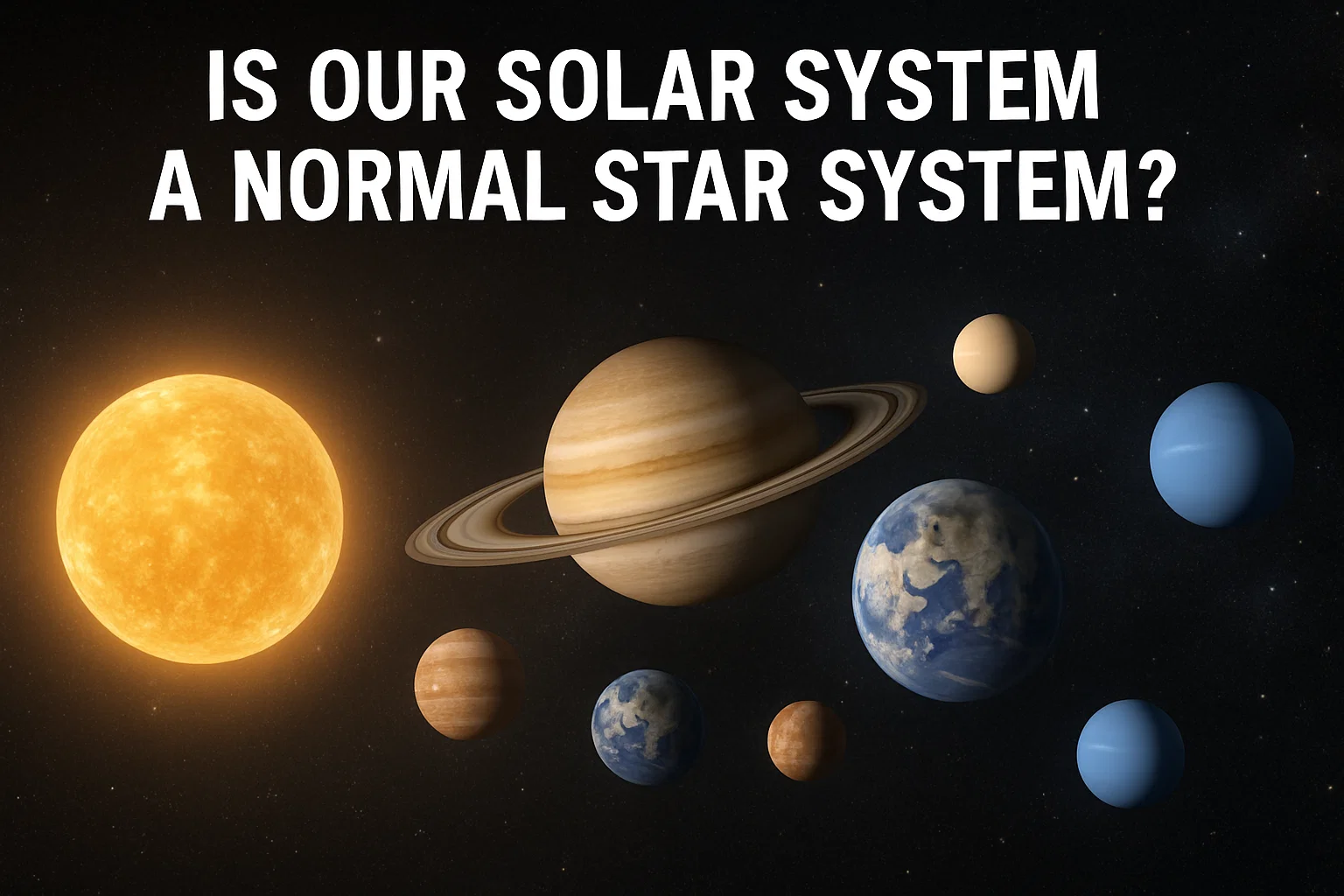
I still remember dragging my dad’s old telescope onto the back lawn, shivering in the cold, just to catch a glimpse of Jupiter. When I finally got the focus right, I saw those tiny moons lined up like pearls on a string. It looked perfect. Orderly. Like a clock mechanism ticking away in the dark. For the longest time, we all bought into this idea that our cosmic neighborhood—rocky worlds hugging the warmth of the Sun, giant gas planets chilling in the back—was the standard blueprint for the universe. We assumed we were just the average, boring baseline.
Then the data started pouring in, and that illusion shattered.
Since planet hunters started spotting worlds around other stars in the ’90s, we haven’t found mirrors of our own home. We found madness. We saw gas giants roasting inches from their stars and planets swinging in wild, oval loops. It forces us to confront a reality that makes some astronomers uncomfortable: is our solar system a normal star system? Or are we actually the freaks of the Milky Way?
This isn’t just about winning a cosmic popularity contest. It matters because our specific, weird layout might be the only reason you and I are here to think about it. If our architecture is rare, life might be too.
More in Category:
Will Our Sun Become a White Dwarf
Why Are Neutron Stars So Dense
Key Takeaways
- The Sun is Elite: Don’t believe the “average star” hype; our Sun is bigger and brighter than 90% of the galaxy’s population.
- We Missed the Super-Earth Trend: The most common planet type in the universe is totally missing from our inventory.
- Our Orbits are Too Perfect: While our planets move in neat circles, most other systems look like a tangled mess of elliptical paths.
- Jupiter is Our Bodyguard: Our gas giants stayed far out, unlike the “Hot Jupiters” elsewhere, acting as gravitational shields for Earth.
- A Place for Everything: Our clean split between inner rocky worlds and outer giants is a rare, organized trait.
How Does Our Sun Stack Up Against the Neighbors?
You’ll hear it in documentaries all the time: “The Sun is an average, yellow dwarf star.” It sounds humble. It’s also misleading. Sure, in the grand charts of stellar evolution, it sits in the middle. But if you took a random scoops of stars from our galaxy, you’d see we are actually living in the top 1% of real estate.
Most of our neighbors are red dwarfs (M-dwarfs). These guys are small, dim, and notoriously angry. They make up about 75% of the stars out there. Our Sun is a G-type star, making it more massive and stable than the vast majority of the galaxy.
This isn’t just a stat sheet victory; it’s survival. Red dwarfs are known for violent temper tantrums, blasting their planets with sterilizing flares. Our Sun? It’s comparatively chill. It gives us a steady, reliable glow that hasn’t fried our atmosphere in billions of years. So, when you ask is our solar system a normal star system, start with the star itself. We are already outliers just by waking up to a yellow sun.
Where in the World Are the Super-Earths?
Here is the weirdest part of the census. If you look at the thousands of planets Kepler found, one type pops up everywhere: Super-Earths. These are worlds bigger than Earth but smaller than Neptune. The galaxy is absolutely littering with them.
Now look at us. Mercury, Venus, Earth, Mars. Then a massive void until you hit Jupiter. We have zero Super-Earths. It’s like walking into a grocery store that sells every fruit except apples. It’s a gaping hole in our lineup.
Why did we miss out on the galaxy’s favorite planet? One theory, the “Grand Tack,” suggests Jupiter acted like a wrecking ball billions of years ago. It might have migrated inward, smashed up the first generation of planets (maybe Super-Earths?), and then drifted back out. We might be living on the debris left over from a planetary demolition derby.
Why Don’t Our Gas Giants Roast?
Before we had data, we assumed gas giants always lived in the frozen suburbs of a star system. Then we found the “Hot Jupiters.” These monsters orbit their stars closer than Mercury orbits the Sun, whipping around in days, their atmospheres boiling off into space.
In our neck of the woods, Jupiter and Saturn keep a respectful distance. They stayed out in the cold. This separation is a dealbreaker for life on Earth.
Jupiter is basically our bouncer. Its massive gravity well flings dangerous asteroids and comets out of the system before they can impact us. If Jupiter had migrated all the way in—becoming a Hot Jupiter—it would have punted Earth into deep space long ago. The fact that our giants stayed put is a huge anomaly that saved our skin.
Is Our “Heavy Metal” Obsession Rare?
Stars are mostly gas, hydrogen, and helium. But astronomers call anything heavier than that “metals.” Our Sun is surprisingly rich in metals like iron, carbon, and oxygen compared to the galactic average.
You need these heavy materials to build planets. You can’t make a rock like Earth or the core of a Jupiter out of hydrogen gas. Because the Sun had a high metal budget at birth, the dust cloud around it was thick with building blocks.
Studies show a clear link: stars with high metallicity get gas giants. Stars with low metal content usually end up with nothing or just tiny, lonely rocks. We live in a high-end, material-rich district.
Why Is Our System So Flat and Boring?
Picture a dinner plate. That’s us. The planets orbit in a flat plane and move in nearly perfect circles. It’s incredibly tidy. We take this stability for granted because it’s all we’ve ever known.
But out there? It’s a mess. Many exoplanetary systems look like a swarm of angry bees. Planets have “eccentric” orbits, meaning they move in stretched-out ovals. They swing in close to get fried, then loop way out into the deep freeze.
- Eccentric Orbits: Imagine summer boiling the oceans and winter freezing the atmosphere solid. That’s life on an eccentric rock.
- Circular Orbits: We get a nice, steady temperature all year.
Our circular orbits are the unsung heroes of habitability. If we had the “normal” oval orbits seen elsewhere, complex life would have had a much harder time getting a foothold.
Did We Win the Lottery Being Solo?
Next time you look at the night sky, remember this: half of those points of light aren’t single stars. They are binary systems (two stars) or even triples. If you lived there, you’d have two shadows and double sunrises.
Binary systems are chaotic. The gravity of two stars tugging on planets makes orbits unstable. Planets get tossed around or ejected entirely. Living around a single star like the Sun is actually the “boring” option.
But boring is good. Boring means you don’t get flung into interstellar space on a Tuesday. So, is our solar system a normal star system? Being a single star puts us in the minority, but it’s a stable minority. We skipped the gravitational drama of a binary relationship.
The “Kepler Dichotomy”: Is It Just Us?
Okay, we have to talk about the elephant in the room: selection bias. The telescopes we use are biased. They are really good at finding big planets close to their stars because those block the most light. A system like ours—with small planets and distant giants—is really hard to spot.
Jupiter takes 12 years to orbit the Sun. To confirm it exists from a distance, you’d need to watch it cross the Sun multiple times. We literally haven’t been watching long enough to find many true twins of our system.
But even accounting for that, our setup looks rare. We aren’t just missing from the data because we’re shy; we’re missing because the other types of systems are overwhelmingly common.
Why Are We Segregated?
Our layout is shockingly organized:
- Inner Zone: Small rocks (Us).
- The Border: Asteroid Belt.
- Outer Zone: Gas Giants.
- The Hinterlands: Kuiper Belt.
It’s segregated. In other systems, it’s a mishmash. You find gas giants hugging the star, or Neptune-sized worlds mixing it up with rocky ones. Our system looks like someone sorted the laundry.
This structure implies a very specific history. The giants formed fast and far out, eating up the gas before the Sun blew it away. The rocky planets formed later from the scraps. This distinct two-step process might be the secret sauce for a habitable system.
Does the “Quietness” Matter?
The universe is a violent place. We see systems where worlds have smashed together, creating massive rings of dust. We see planets that have been swallowed by their stars. Compared to that, our solar system is eerily quiet.
We haven’t had a major collision since the Moon formed 4.5 billion years ago. That long stretch of peace allowed life to crawl out of the oceans. If we were a “normal,” chaotic system, we wouldn’t be here having this conversation.
We can thank the resonance between Jupiter and Saturn for this. They locked into a gravitational groove early on, cleared out the junk, and then settled down.
The Hunt for “Solar System 2.0”
Astronomers really want to find a twin. We call them “Solar System analogs.” Finding one would prove we aren’t a fluke. But it’s been frustratingly hard.
We find stars like the Sun. We find planets like Earth. But finding a system with both, arranged in the same way, is the holy grail. You can check the stats yourself at the NASA Exoplanet Archive; the data highlights just how unique our configuration appears to be.
Most systems have a “packed” inner region. They have three or four planets crammed inside the orbit of Mercury. Our system is totally empty there. Why? We don’t know, but that emptiness makes us stand out.
Could Life Handle a “Normal” System?
Just because we are weird doesn’t mean we are the only way. Life is stubborn. Maybe biology on a Super-Earth around a red dwarf is the standard, and we are the weirdos.
But the hurdles there are huge:
- Tidal Locking: One side of the planet cooks; the other freezes.
- Flares: Red dwarfs can strip away an atmosphere in a weekend.
- Chaos: Unstable orbits make long-term evolution a nightmare.
Our “Goldilocks” status isn’t just about distance. It’s about the type of star, the circular path, the giant bodyguards, and the lack of drama.
The Verdict
So, let’s circle back: is our solar system a normal star system?
From everything we see right now, the answer is a hard no. We are bigger than average, we are missing the most common planets, our orbits are strangely round, and our layout is freakishly organized.
We are a custom-tailored suit in a world of off-the-rack clothing.
Why Being a Freak is Good News
It’s easy to look at the numbers and feel insignificant. If we are an anomaly, are we a mistake? I don’t see it that way. The fact that our system is so distinct gives us a roadmap. We know exactly what to look for now.
We aren’t just hunting for “planets.” We are hunting for yellow stars, circular orbits, and distant Jupiters. We’ve narrowed the search.
More importantly, our rarity highlights how fragile this whole experiment is. We live in a protected bubble of order in a galaxy that loves chaos. It makes our little blue dot feel that much more important to protect.
Final Thoughts
We grew up with models of the solar system hanging in our classrooms, thinking that was the standard. We were wrong. The universe is wilder, messier, and more diverse than we gave it credit for.
Our solar system is a rare island of calm. While we might not be “normal” by the statistical standards of the Milky Way, that abnormality is the only reason we exist. We are the lucky ones. As our tech gets better, maybe we will find a twin out there in the dark. But until then, we have to own it: we are the oddballs of the galaxy.
FAQs – Is Our Solar System a Normal Star System
Is our solar system considered typical or unusual compared to others in the Milky Way?
Our solar system is quite unusual compared to others in the galaxy, with its organized, circular orbits, distant gas giants, and lack of common planet types like Super-Earths, making it a rare, stable configuration.
How does the Sun compare to other stars in the Milky Way?
While often called an ‘average’ star, the Sun is actually one of the brighter and more massive stars, placing it in the top 1% of stellar real estate in the galaxy, which contributes to the stability of our solar system.
Why are Super-Earths absent in our solar system?
The absence of Super-Earths in our system might be due to past events like the migrating inward of Jupiter, which possibly eliminated these planets during the early formation period, leaving a gap in our planetary lineup.
What role do gas giants like Jupiter play in protecting Earth?
Gas giants such as Jupiter act as gravitational shields, deflecting or capturing dangerous asteroids and comets, preventing them from impacting Earth, which has been crucial in maintaining conditions suitable for life.
Is the peaceful, circular orbit structure of our planets common in the universe?
No, most exoplanetary systems have eccentric, elongated orbits and chaotic arrangements; our flat and orderly system is rare and likely essential for the development and sustainability of life on Earth.