
You stand in the backyard on a crisp, clear night. You look up. It’s peaceful. The pinpricks of light seem static, eternal, and clean. We call them stars. It’s a simple word for a simple visual. But if you had eyes that could see into the infrared, or a telescope powerful enough to peer into the dark, dusty nebulas of the Milky Way, you’d see something very different. You would see violence. You would see chaos. You would see glowing, spinning, thrashing spheres of gas that look like stars but don’t quite act like them.
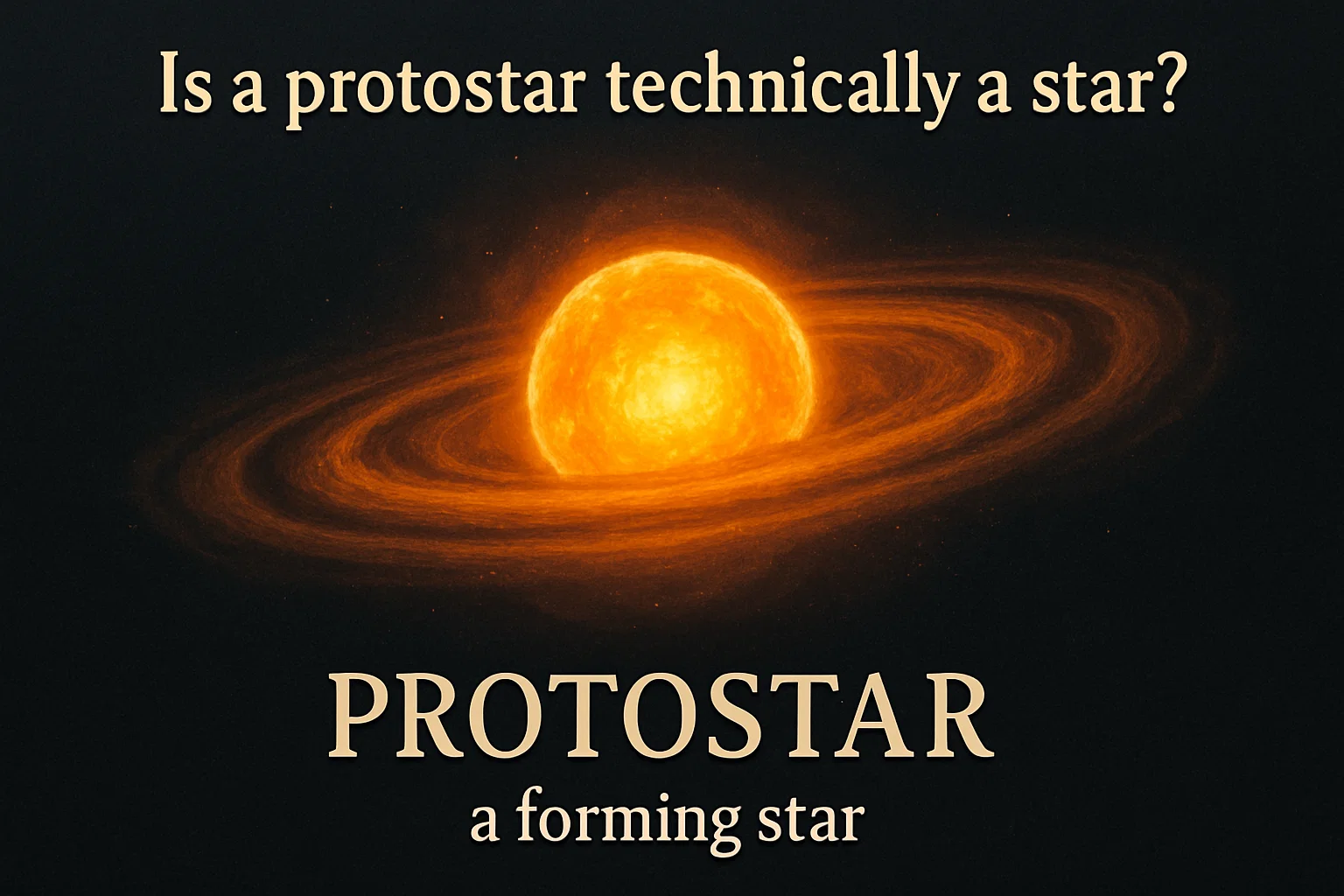
Astronomers call these angry infants “protostars.”
It brings up a question that sounds simple but unravels the entire fabric of astrophysics: is a protostar technically a star? You might think, “It glows, it’s hot, it’s in space—sure, why not?” But science is picky. The distinction between a protostar and a “real” star isn’t just semantics. It is the difference between a car rolling down a hill and a car driving up it. One is coasting; the other has an engine that works. To understand this, we have to pop the hood on the universe.
More in Celestial Objects Category
What Happens If You Fall Into a Black Hole
Key Takeaways
- The Engine is Missing: A true star fuses hydrogen into helium; a protostar hasn’t started that engine yet.
- Gravity is the Boss: Protostars shine because gravity crushes them, creating heat, not because of nuclear reactions.
- It’s Just a Phase: Think of a protostar as a stellar embryo—it’s the chaotic developmental stage before birth.
- Size Doesn’t Guarantee Success: If a protostar doesn’t grab enough mass, it fails to ignite and becomes a Brown Dwarf.
- Invisible to Eyes: You can’t see them without infrared equipment because they hide inside thick, dusty blankets.
What Exactly Does It Take to Earn the Title of “Star”?
We throw the word “star” around loosely. Movie stars, gold stars, shooting stars (which are rocks). But to an astrophysicist, the definition is rigid. It has to be. If we didn’t have a strict cutoff, we’d have to call Jupiter a star just because it’s a big ball of gas.
Here is the gold standard: Hydrostatic Equilibrium powered by Nuclear Fusion.
That is a mouthful, so let’s break it down. A star is a battleground. On one side, you have gravity. Gravity wants to crush everything toward the center. It is relentless. On the other side, you have pressure pushing out. In a true star, that outward pressure comes from the core fusing hydrogen atoms into helium. This nuclear explosion creates enough energy to hold gravity back. The star stabilizes. It creates its own light. It sustains itself.
How Does a Patch of Empty Space Decide to Become a Sun?
Space is not a perfect vacuum. It’s messy. Drifting between the existing stars are colossal clouds of molecular hydrogen, helium, and silicate dust. These “molecular clouds” are the coldest places in the universe. They are dead quiet. They can float there for millions of years, doing absolutely nothing.
Then, something kicks the hornet’s nest.
Maybe a supernova goes off nearby and slams a shockwave into the cloud. Maybe the cloud drifts through a spiral arm of the galaxy and gets squeezed. Whatever the trigger, gravity wakes up. It grabs a pocket of gas and starts pulling.
The Great Collapse
Once gravity gets a grip, it doesn’t let go. The gas falls inward. As it falls, it spins. It’s the classic ice-skater effect: bring your arms in, and you spin faster. The cloud shrinks, spins, and flattens. The center gets dense. It gets hot. This rotating knot of gas is the seed. It is the protostar.
It looks like a star. It acts like a heavy object. But it is technically still just a gathering storm.
So, Is a Protostar Technically a Star or Just a Pretender?
Let’s not beat around the bush. No, a protostar is not technically a star.
It is a precursor. It is the raw material assembling itself. Calling a protostar a star is like calling a pile of lumber and bricks a house. Sure, the shape is starting to look right, and all the materials are there, but you can’t live in it yet.
In the Main Sequence definition—which is the club our Sun belongs to—membership requires fusion. A protostar is strictly an object that is still gathering mass from its parent cloud. It hasn’t disconnected its feeding tube. It is collapsing under its own weight, and that collapse is the only thing keeping it warm. It hasn’t “turned on” yet.
If the Engine Isn’t Running, Why Does It Shine So Brightly?
This is where it gets confusing. If you look at a protostar through an infrared telescope, it is blazing hot. Some protostars are actually thousands of times brighter than the Sun will be once it settles down.
If there is no fusion, where is the juice coming from?
The answer is gravitational contraction.
Imagine holding a rock high above your head. That rock has potential energy. Drop it on your toe, and that energy becomes kinetic (and painful). Now, imagine dropping a trillion trillion tons of gas onto a central core.
As the gas slams into the protostar, the energy of that impact turns into heat. The protostar is also squeezing itself tighter and tighter. When you compress a gas, it heats up. This is the Kelvin-Helmholtz mechanism. The protostar glows because it is being crushed, not because it is burning. It’s a heat born of friction and impact, not nuclear fire.
At What Moment Does the Protostar Officially Graduate?
The transition isn’t subtle. It is the most violent event in the life of a solar system.
The core keeps getting hotter. Gravity keeps squeezing. The temperature climbs to 1 million degrees. Then 5 million. But hydrogen is stubborn; protons repel each other naturally. You need to force them together.
Finally, the core hits the magic number: roughly 10 million Kelvin.
At this temperature, the protons are moving so fast that they can’t avoid each other. They smash together. They fuse. A tiny bit of mass converts into pure energy, following Einstein’s famous
E=mc2E=mc^2E=mc2
.
- The Flash: The core ignites.
- The Push: A shockwave of energy blasts outward.
- The Balance: This new outward pressure stops the collapse dead in its tracks.
The object stops shrinking. It stabilizes. At that exact second, the answer to “is a protostar technically a star” flips from “no” to “yes.” The protostar is dead; the Main Sequence star is born.
What is the Deal With the Violent T-Tauri Phase?
Before it settles down to be a nice, reliable provider of light like our Sun, the young object goes through a rebellious teenage phase. We call this a T-Tauri star.
This occurs right at the borderline of our definition. The object has stopped gathering mass. It has blown away the surrounding dust cloud with fierce winds. It is visible to the optical telescope. But strangely, it might not have started full fusion yet. It’s still shrinking just a little bit.
T-Tauri stars are erratic. Their brightness jumps up and down wildly. They shoot massive jets of X-rays into space. They represent the final crossover point. They are the “missing link” between the protostar and the true star. They prove that nature rarely works in neat, tidy boxes.
Can a Protostar Fail to Launch?
This is the tragic side of the story. Gravity is trying to ignite the engine, but sometimes, there just isn’t enough gas in the tank.
If the collapsing cloud fragment has less than about 0.08 times the mass of our Sun, the core never gets hot enough. It squeezes and squeezes, but it stalls out before it hits 10 million degrees. Fusion never triggers.
We call these Brown Dwarfs.
They are the “failed stars” of the galaxy. They are warm, and they glow dimly in the infrared, but they slowly cool down over billions of years. They occupy a lonely middle ground—too huge to be planets, too small to be stars. If you asked, “is a protostar technically a star” in this case, the answer remains “no” forever.
How Do Astronomers Spy on These Hidden Nurseries?
If protostars are wrapped in thick, dark clouds of dust, how do we even know they exist? If you point a normal telescope at the Orion Nebula, you see glowing gas, but you also see dark, ink-black patches where no stars shine.
Those dark patches are where the action is.
Visible light gets blocked by dust. It bounces off. But infrared light cuts right through.
To study protostars, astronomers had to wait for technology to catch up. Telescopes like Spitzer and the new James Webb Space Telescope (JWST) look at the universe in heat, not light. When they point at those dark clouds, the darkness vanishes. Instead, they see bright, glowing beacons. They see jets of gas shooting out from the poles of the protostars. They see the swirling disks where planets are being made.
These instruments allow us to watch the “is a protostar technically a star” debate play out in real-time across the galaxy.
Learn more about how NASA views these stellar nurseries here.
Why Does the Distinction Matter to Anyone But Scientists?
You might wonder why we are splitting hairs here. Who cares if it’s a “star” or a “protostar”?
It matters because it changes the math of the universe.
If you assume a protostar is a Main Sequence star, your calculations for the age of a star cluster will be wrong by millions of years. You will misinterpret the chemical composition of the surrounding space.
Protostars are also the factories of life. It is during this “not-quite-a-star” phase that planets form. The dust swirling around the protostar clumps together to build Earths, Jupiters, and Marses. If we don’t understand the physics of the central protostar—its heat, its magnetic fields, its radiation—we can’t understand how our own solar system came to be.
How Long Does This Pre-Stellar Phase Last?
Time is relative. To a human, a protostar lasts forever. To the universe, it’s a blink.
The duration depends entirely on weight.
- Heavyweights: Massive stars (blue giants) rush through the protostar phase. Gravity crushes them so hard they ignite in just 100,000 years.
- Middleweights: Stars like our Sun take their time. They spend about 10 million years growing and contracting before they ignite.
- Lightweights: Small Red Dwarfs take the scenic route. They can stay in the contraction phase for 100 million years.
So, for a Red Dwarf, the answer to “is a protostar technically a star” is “check back in a hundred million years.”
What About the Disk and the Jets?
A protostar is never alone. It is always the center of a chaotic system. As the cloud collapses, it spins faster, creating an accretion disk. This is a flat pancake of dust and gas feeding the star.
But protostars are messy eaters. They can’t swallow everything at once. Magnetic fields twist up and shoot material out of the north and south poles at hundreds of miles per second. These are called Herbig-Haro objects.
When we see these long, glowing jets cutting through space, we know there is a baby star hidden in the dust, throwing a tantrum. It’s one of the key signatures astronomers look for. It’s the cosmic equivalent of a “Baby on Board” sign.
Can You See a Protostar Tonight?
If you have a simple pair of binoculars, you can look at the sword of Orion. You will see a fuzzy patch. That is the Orion Nebula. It is the closest massive star-forming region to Earth.
You won’t see the protostars themselves—they are too deep in the dust—but you are looking at their incubator. Inside that glow, thousands of objects are currently struggling to answer the question, “is a protostar technically a star?”
Some will make it. Some will fail and become Brown Dwarfs. Some will become massive blue supergiants that will explode in a few million years.
The Final Verdict on the Definition
It is the gathering of materials. It is the heating of the core. It is the revving of the engine before the race starts. A star is defined by its ability to stand up to gravity using the power of nuclear fusion. A protostar is still losing that fight, shrinking day by day, getting hotter and denser until it finally pushes back.
But don’t let the technicality fool you. The protostar phase is the most magical time in a stellar life. It is where solar systems are forged. It is where the raw chaos of the universe organizes itself into light and order. It might not technically be a star yet, but it is the most important object in the sky.
FAQ – Is a Protostar Technically a Star
Why does a protostar shine brightly if it hasn’t started fusion yet?
A protostar shines brightly due to gravitational contraction, which compresses the gas, heating it through friction and impact, but does not involve nuclear fusion.
When does a protostar officially become a star?
A protostar officially becomes a star when its core reaches approximately 10 million Kelvin, triggering nuclear fusion that balances gravitational collapse and stabilizes the star.
What is the T-Tauri phase and its significance?
The T-Tauri phase is a rebellious teenage stage where a star has stopped gathering mass, shows erratic brightness, and may not have begun fusion, marking the transition from protostar to main sequence star.
Can a protostar fail to become a star, and what are Brown Dwarfs?
Yes, if a cloud fragment has less than about 0.08 times the mass of the Sun, it cannot ignite fusion and becomes a Brown Dwarf, which is a failed star that glows dimly in infrared.