

Stand in an open field tonight and look up. It looks calm, doesn’t it? The stars are steady pinpricks of light; the moon hangs there like a rock. It feels permanent. But that is a lie. If you could rewind the clock 4.6 billion years, you wouldn’t see the orderly, clockwork solar system we live in today. You would see a catastrophe.
We are standing on the cold, hard ash of a stellar firework show. The story of our creation is violent, unlikely, and incredibly messy. Understanding how planets form from a protoplanetary disk isn’t just an academic exercise for astronomers in high towers. It is the origin story of every atom in your body and every rock beneath your feet.
For a long time, we had to guess how this happened. We had models and math, but we were blind. That changed recently. With new eyes like the ALMA observatory and the James Webb Space Telescope, we can peer into stellar nurseries across the galaxy. We can catch solar systems in the act of being born. It turns out, building a planet is a lot like cooking a chaotic dinner—you need the right ingredients, precise timing, and you have to hope the oven doesn’t blow up.
More in Category:
How Does a Star Become a Red Giant
What Are the Largest Known Stars
Key Takeaways
- Gravity Runs the Show: It all begins with a massive, cold cloud collapsing on itself.
- Spin to Win: The conservation of angular momentum is why we live on a flat plane, not a swarm.
- The Dust Bunny Phase: Continents start as microscopic specks sticking together with static electricity.
- The Snow Line Rule: Where you form determines what you are—rocky dwarf or gas giant.
- The Neighborhood Bully: Jupiter likely moved around, wrecking the early solar system before settling down.
What Starts the Cosmic Engine?
Before you get a planet, or even a sun, you need a cloud. But not just any cloud. We are talking about a molecular cloud—a colossal, freezing beast of gas and dust floating in the void. These things are massive, spanning light-years across, and they are incredibly cold, just a few degrees above absolute zero.
Ideally, these clouds would just hang there forever. Gas pressure pushes out, gravity pulls in, and they stay in equilibrium. To get a solar system, you need to break that balance. You need a kick.
Usually, a supernova does the job. A massive star nearby reaches the end of its life and detonates, sending a shockwave rippling through the galaxy. That shockwave slams into our quiet molecular cloud. It crunches the gas together, creating pockets of high density.
Once a clump gets dense enough, gravity takes the win. It stops being a polite tug-of-war and becomes a landslide. The cloud collapses inward. As the gas falls toward the center, it picks up speed and friction causes heat. The center begins to glow. That is your protostar. The sun is waking up. But it’s not alone.
Why Do We Live on a Flat Plate Instead of a Sphere?
If everything falls toward the center, why don’t planets orbit in a beehive swarm? Why is the solar system flat?
It comes down to the same reason a pizza chef spins dough to flatten it out. The original cloud had a tiny bit of rotation. Maybe it was just drifting lazily, but as it collapsed, that spin accelerated. It’s the figure skater effect—pull your arms in, and you spin faster.
This collapsing cloud speeds up so much that centrifugal force kicks in. The material at the “poles” of the cloud falls straight into the star without an issue. But the stuff at the “equator” feels a push outward. It’s trapped. Gravity pulls it in, spin pushes it out.
The result? The cloud flattens into a pancake.
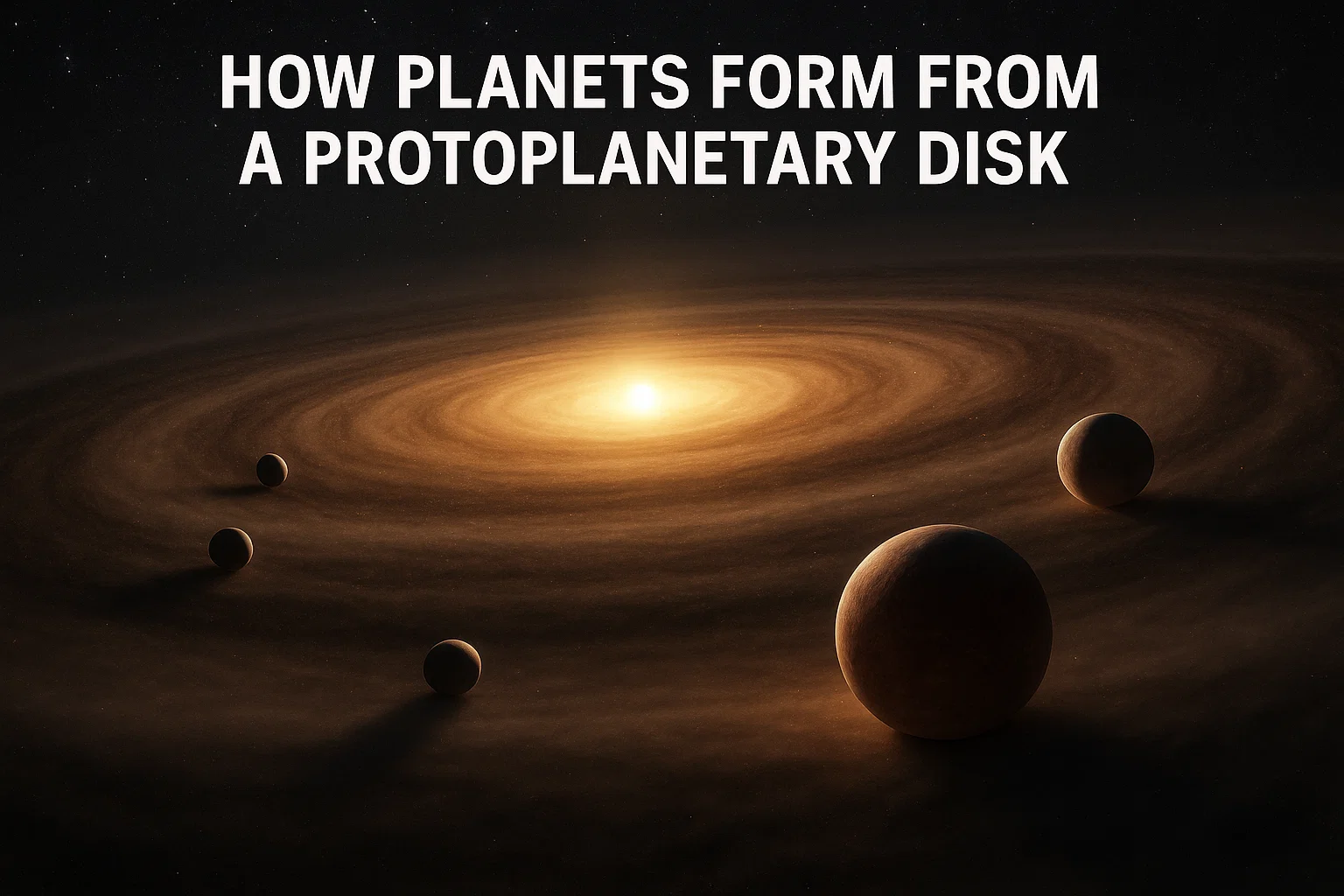
We call this the protoplanetary disk. This is the factory floor. It takes about 100,000 years to form, which is a blink of an eye in cosmic time. It’s 99% gas (hydrogen and helium) and 1% “dust”—tiny grains of carbon, silicon, and iron. That 1% is what we are made of.
How Do You Build a World from Cigarette Smoke?
This is the part that baffled physicists for decades. The dust in this disk is microscopic. We are talking microns wide—finer than the smoke from a blown-out candle. How do you get from a speck of smoke to Mount Everest?
You can’t use gravity yet. A speck of dust has basically zero gravitational pull. If you put two grains next to each other, they will just sit there.
The answer is static electricity.
It’s the same physics that makes dust bunnies gather under your sofa. These tiny grains are swirling around in the turbulent gas of the disk. They gently bump into each other. Because of electrostatic charges, they stick. They form fluffy, fractal chains of dust.
These clumps grow. They sweep up more dust. They turn into pellets, then pebbles, then rocks the size of your fist. It sounds smooth, but this is actually the most dangerous time to be a baby planet. The gas in the disk acts like a headwind. As these rocks orbit, they plow through the gas, losing energy. If they slow down too much, they spiral into the star.
The Great Barrier: How Do We Get Past the “One-Meter” Problem?
Here is where the old theories fell apart. We call it the “Meter-Size Barrier.”
Calculations showed that once these rocks grew to about a meter wide (three feet), the game should be over. At this size, they are too big for static electricity to hold them together. If they smash into each other, they don’t stick—they shatter. Worse, the gas drag on a meter-sized boulder is immense. It should spiral into the sun in less than a century.
By all rights, planets shouldn’t exist. The universe should be filled with lonely stars and dust, but no rocks.
Clearly, we are here, so nature found a loophole. The leading idea right now is something called “streaming instability.”
Think of the Tour de France. Cyclists ride in a peloton to cut wind resistance. In the disk, pebbles and rocks start to draft off each other. They cluster in the gas lanes. Eventually, these swarms of rocks get so dense that they create their own collective gravity.
Suddenly, you don’t need to stick rocks together one by one. The entire swarm collapses under its own weight. In a flash, you go from a cloud of pebbles to a massive asteroid 100 kilometers wide. You skipped the dangerous middle sizes entirely. You have survived the filter.
Welcome to the Violent Era of Planetesimals
Now you have planetesimals. These are the seeds of planets. They are city-sized chunks of rock and ice, and they are hungry.
At this size, gravity is finally strong enough to do the heavy lifting. A planetesimal drives through the disk, pulling in everything in its path. It eats dust, pebbles, and smaller rocks. It clears a lane.
But it’s not peaceful. There are thousands of these things whizzing around. Traffic control is non-existent.
They smash into each other constantly. It’s a demolition derby. Some collisions are constructive—two rocks hit slowly and merge, making a bigger rock. Some are destructive—they hit fast and pulverize each other back into dust.
This violence creates heat. Incredible heat. The baby planets melt from the inside out. The heavy stuff—iron and nickel—sinks to the middle to form a core. The lighter stuff—silicates—floats to the top to form a mantle. This differentiation is crucial. Without an iron core, Earth wouldn’t have a magnetic field, and without that, the sun would have stripped away our atmosphere long ago.
Why Is Jupiter So Much Bigger Than Earth?
Look at the solar system. You have four puny rocky worlds on the inside, and four massive gas giants on the outside. Why the split?
It’s all about the Frost Line (sometimes called the Snow Line).
Imagine a campfire. Close to the fire, it’s too hot for ice to exist. Any water there is steam. Farther back, away from the heat, ice can survive.
In the early solar system, the sun was the campfire. Close to it (where Mercury, Venus, Earth, and Mars formed), it was blazing hot. Water and methane couldn’t freeze. The only solids available to build planets were rock and metal. But rock and metal are rare—they make up a tiny fraction of the universe’s material. So, the inner planets had very little material to work with. They grew slowly and stayed small.
Cross the Frost Line (roughly between Mars and Jupiter), and everything changes. Out here, it’s cold. Water, ammonia, and methane freeze into solid ice.
Ice is everywhere. It’s common. Suddenly, the planetesimals here had ten times more solid material to build with. They didn’t just grow; they exploded in size.
Runaway Growth: The Gas Giant Explosion
The embryos out past the Frost Line hit a critical tipping point. They got so massive—about ten times the mass of Earth—that their gravity became terrifyingly strong.
They became strong enough to hold onto the lightest gases: hydrogen and helium.
Remember, the disk is 99% gas. The inner planets were too small to grab this gas; it just slipped away. But the outer cores were heavy enough to trap it. Once they started eating gas, they couldn’t stop.
The more gas Jupiter ate, the heavier it got. The heavier it got, the more gas it pulled in. It’s a runaway feedback loop. Jupiter likely swelled from an icy rock to a gas titan in just a few million years. It starved the other planets, hoarding the bulk of the disk’s mass for itself. Saturn tried to keep up, but Jupiter beat it to the buffet.
The Inner System: A Slow-Motion Car Crash
While Jupiter was gorge-eating gas, the inner solar system was still playing bumper cars with rocks.
We call this “Oligarchic Growth.” A few dozen Mars-sized embryos emerged from the chaos. They had cleared their lanes, but they weren’t done. They started tugging on each other, destabilizing orbits.
This is the final assembly of Earth. It wasn’t built piece by piece; it was built by smashing massive planetary embryos together.
The most famous of these collisions happened to us. A planet roughly the size of Mars, which we call Theia, came hurtling out of the gloom and sideswiped the proto-Earth.
The impact was apocalyptic. It melted the Earth’s surface completely. It blasted trillions of tons of debris into orbit. Over time, that ring of debris coalesced to form the Moon. We are likely a chimera, a mash-up of two different worlds.
Did The Planets Move?
If you look at a textbook from the 1990s, it shows the planets forming in their neat little orbits and staying there.
We now know that is almost certainly wrong.
Planets migrate. A massive object like Jupiter creates waves in the gas disk, like a boat moving through water. These waves sap energy from the planet’s orbit.
We think Jupiter migrated inward, deep into the solar system, bulldozing asteroids and starving Mars of material (which explains why Mars is so small). Then, Saturn formed and pulled Jupiter back out. This “Grand Tack” dance rearranged the furniture of the solar system. It suggests our neighborhood isn’t a static monument, but dynamic, shifting real estate.
The End of the Line: Clearing the Fog
Eventually, the party has to end. The protoplanetary disk can’t last forever.
As the sun fully matured, it entered the T-Tauri phase. It became violent, blasting out powerful solar winds and intense UV radiation.
This wind acted like a leaf blower. It stripped away the remaining gas and dust in the disk, blowing it out into interstellar space. This moment was crucial. It stopped Jupiter and Saturn from growing. If the wind had waited another few million years, Jupiter might have become a second star, and we wouldn’t be here.
The gas was gone. The planets were built. But the cleanup crew was still working.
The Late Heavy Bombardment: A Parting Gift
Even after the planets formed, there was junk everywhere. Leftover planetesimals, asteroids, and comets cluttered the system.
Over the next few hundred million years, the gravity of the giant planets flung these leftovers around. Many were ejected from the solar system entirely. Many were thrown into the sun. And many smashed into the inner planets.
This is the Late Heavy Bombardment. If you look at the moon with binoculars, the pockmarked craters you see are the scars from this era.
But this bombardment might have been our salvation. Earth formed hot and dry. It’s likely that these impacting comets and water-rich asteroids delivered the oceans we swim in today. They crashed into the surface, vaporized, and eventually rained down to form the seas.
Why This Matters
When we ask how planets form from a protoplanetary disk, we are really asking how we survived the odds.
The process is riddled with failure points. You can spiral into the star as a pebble. You can shatter as a rock. You can get ejected by a gas giant. You can get sterilized by radiation.
Yet, here we are.
- The dust stuck.
- The swarms collapsed.
- The giants moved back.
- The water was delivered.
We are the survivors of a cosmic demolition derby. And as we look out with the James Webb telescope, seeing these same disks around other stars, we realize that this chaotic, beautiful, violent story is happening millions of times over, all across the galaxy.
For a deeper dive into the specific missions hunting for these origins, check out NASA’s Exoplanet Exploration Program.
FAQs – How Planets Form From a Protoplanetary Disk
What is the initial stage that leads to the formation of planets?
The process begins with a molecular cloud, a colossal, cold gas and dust cloud in space, which collapses under gravity after a disturbance such as a supernova shockwave.
Why do planets in our solar system lie mostly on a flat plane?
Planets lie on a flat plane because the original molecular cloud had a slight rotation, causing it to flatten into a protoplanetary disk due to centrifugal force during collapse.
How do tiny dust particles in a protoplanetary disk merge to form larger bodies?
Dust particles stick together through static electricity, forming small clumps that grow into pebbles, rocks, and eventually planetesimals through electrostatic forces before gravity takes over.
What is the ‘Meter-Size Barrier’ and how is it overcome in planet formation?
The ‘Meter-Size Barrier’ refers to the difficulty of growing from meter-sized rocks to larger bodies, as they tend to break apart or spiral into the star. It is overcome by streaming instability, where pebbles cluster and collapse under their own gravity into larger planetesimals.
Why is Jupiter so much larger than Earth?
Jupiter’s size is due to its formation beyond the Frost Line, where abundant ice increased available solid material, and its ability to rapidly accrete gas once its core reached a critical size, leading to a runaway gas accretion.