

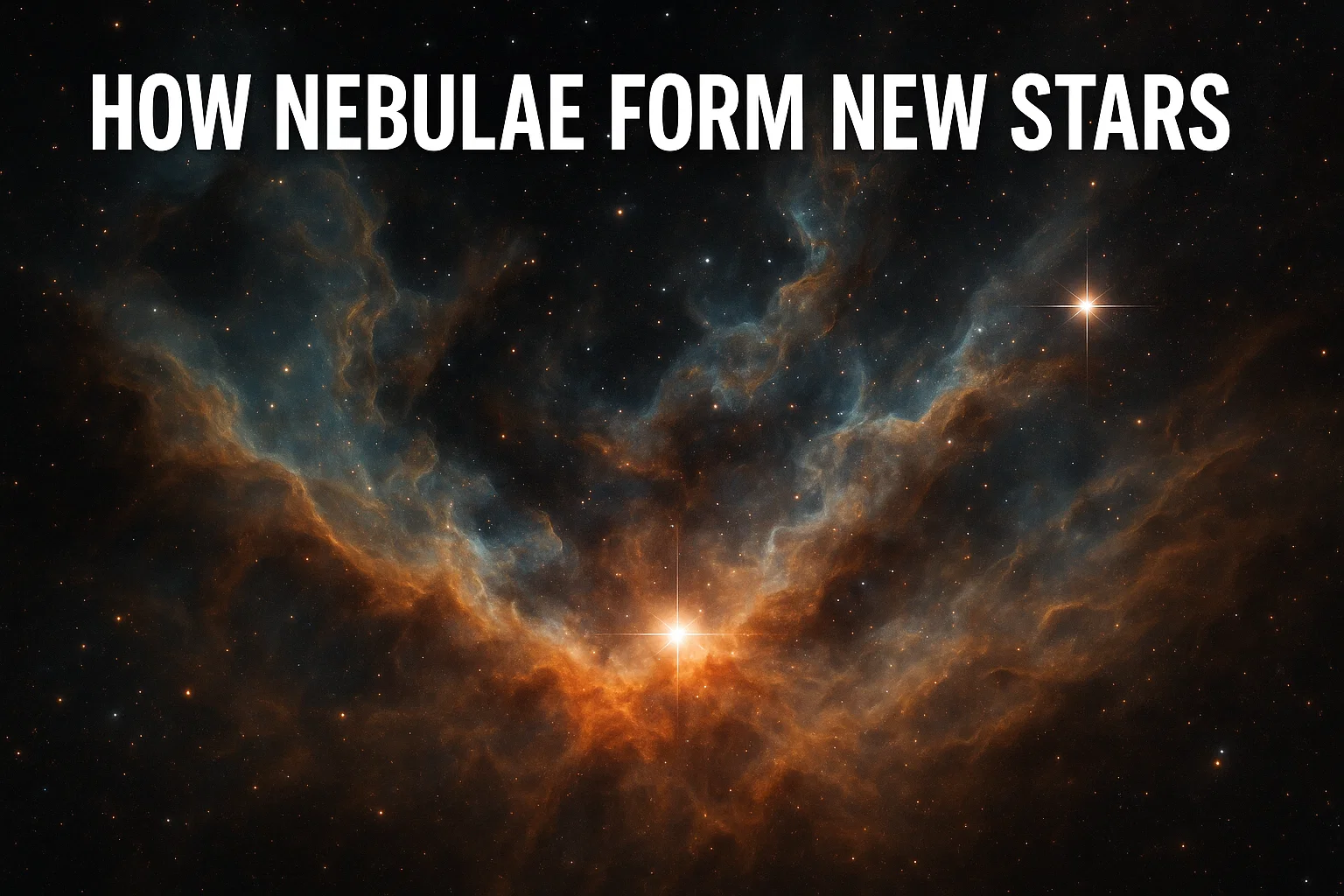
You look up, and it’s quiet. Deceptively quiet. The night sky feels like a painting that dried billions of years ago. But that’s dead wrong. It’s a lie. If your eyes could see in infrared or listen to radio waves, the galaxy wouldn’t look peaceful at all. It would look like a construction zone. It’s a chaotic, violent, messy factory floor where gravity is constantly crushing massive clouds of gas until they ignite into nuclear fire.
I’ve always loved the irony of it: the stars that guide us, that give us life, are born from the coldest, darkest, dirtiest corners of the cosmos. To understand the universe, you can’t just admire the finished product. You have to get into the grime. You have to understand how nebulae form new stars. It isn’t a gentle process. It’s a catastrophe of gravity, pressure, and heat that somehow results in a sun.
More in Category:
Why Are Quasars So Bright and Why Are Blazar Jets Aimed at Earth
Key Takeaways
- Gravity is the bully: Star formation is essentially gravity winning a fight against gas pressure.
- It starts in the freezer: The process only works in molecular clouds that are incredibly cold, allowing matter to clump together.
- Spinning keeps it alive: As the cloud collapses, it spins faster, creating a flat disk that feeds the star and eventually builds planets.
- The pivot point: A protostar is just a hot ball of gas until fusion kicks in; that’s the moment it actually becomes a star.
- Mass is everything: The amount of gas a star grabs in the beginning dictates its entire life story, from color to lifespan.
Why are nebulae so messy and huge?
Before we get to the crushing part, look at the raw material. A nebula isn’t just a cloud; it’s a graveyard and a nursery rolled into one. It’s mostly hydrogen gas—about 90%—with some helium and a sprinkling of “dust” (carbon, silicon, iron) left over from stars that died eons ago.
These things are colossal. We aren’t talking about a cloud that covers a city; we’re talking structures that span hundreds of light-years. But they aren’t uniform. They are lumpy. The most critical ones for us are the dark nebulae, or molecular clouds.
They are dense, opaque, and freezing. And I mean absolute zero kind of freezing (around 10 Kelvin). This cold is vital. If the gas were hot, the atoms would be zipping around too fast for gravity to catch them. The cold slows everything down, making the gas sluggish enough for gravity to get a grip.
What kicks off the collapse?
Gas naturally wants to expand. It hates being confined. For millions of years, a nebula sits in a stalemate: gravity pulls in, thermal pressure pushes out. It’s balanced. It’s boring.
So, how nebulae form new stars requires a trigger. Something has to shove that cloud over the edge.
Usually, it’s an external event. Maybe a massive star nearby goes supernova, slamming a shockwave into the cloud. Maybe the nebula drifts into one of the galaxy’s spiral arms, getting compressed like cars in a traffic jam. Whatever the cause, pockets of gas get squeezed. The density spikes. Suddenly, gravity overcomes the internal pressure. The stalemate breaks. The cloud starts to fall in on itself.
How does the Jeans Instability dictate the chaos?
This is where the physics gets cool. There’s a specific threshold called the Jeans Instability. Think of it as the tipping point of no return.
Sir James Jeans figured out that for a cloud of a specific temperature and density, there is a critical mass. If you pile up enough gas in a small enough space, the internal pressure simply cannot hold up the roof anymore. The structure fails.
Once a clump of gas crosses this line, the collapse isn’t a drift; it’s a runaway train. Gravity gets stronger as the object gets smaller, which pulls it in faster, which makes gravity stronger. It’s a self-feeding loop of destruction that is creating something new.
Why doesn’t it just make one giant monster star?
You’d think a massive cloud would just shrink into one massive star, right? But nature is messier than that. The cloud is turbulent. It’s swirling and churning.
As the giant cloud collapses, it fragments. It breaks into smaller chunks, and those chunks break into even smaller ones. It’s like dropping a glass pane; it doesn’t just shrink, it shatters.
Each of these shards becomes a separate cocoon for a potential star. This is why stars are almost never born alone. They are born in litters, in clusters of hundreds or thousands, siblings drifting apart over millions of years.
Why does the collapsing cloud start spinning like a top?
This is the “pizza dough” physics. Nothing in space is perfectly still. The original cloud had a tiny, almost imperceptible rotation. Maybe it was just tumbling slowly.
But as gravity crushes that cloud down from light-years across to something the size of our solar system, that spin speeds up. It has to. It’s the conservation of angular momentum—the same reason a figure skater spins faster when she pulls her arms in.
The flattening
This spin changes the shape entirely. Gravity pulls everything toward the center, but the rotation creates a centrifugal force that pushes outward at the equator. The poles collapse easily, but the middle pushes back.
The result? The sphere creates a pancake. It creates an accretion disk.
This disk is the pantry. The star in the middle eats from it, growing fatter and hotter, while the scraps left behind in the disk eventually clump together to form planets. It’s weird to think about, but the Earth is just leftover debris from the Sun’s lunch.
What is life like inside a Protostar?
At the center of that disk, things are getting hellish. This object is now a “protostar.” It’s not a star yet. It’s not fusing anything. It’s just a ball of gas getting squeezed to death.
The heat here isn’t nuclear; it’s gravitational. Imagine taking the air in a massive room and compressing it into a thimble. The friction and pressure generate immense heat. The protostar glows, but not with the clean light of a sun—it burns with a dull, angry red, mostly in infrared, hidden behind a curtain of dust.
How does the star stop itself from collapsing forever?
During this phase, the protostar is volatile. It’s a moody, violent object (often called a T-Tauri star). It has powerful magnetic fields that twist and snap.
Gravity wants to keep crushing it down to a singularity. But the core is becoming so dense that heat can’t escape. The internal pressure skyrockets, pushing back against the crush. It slows the collapse, but it doesn’t stop it.
To handle the insane amount of spin it has built up, the star often ejects material. It blasts jets of gas out of its poles at hundreds of miles per second.
These jets—Herbig-Haro objects—punch through the surrounding nebula. It’s a pressure release valve, allowing the star to settle down and continue gathering mass without spinning itself apart.
When does the engine finally turn on?
This is the finish line. The core temperature has to hit a specific magic number: roughly 10 million degrees Kelvin.
Before this moment, the star is just a hot, glowing ball of gas. But at 10 million degrees, the protons in the core are moving so fast that they can’t avoid each other anymore. They slam together with enough force to overcome their electrical repulsion. The strong nuclear force snaps them shut.
Hydrogen fuses into helium.
The missing mass is energy
When those protons fuse, a tiny fraction of their mass vanishes. It converts directly into pure energy, following Einstein’s $E=mc^2$.
This energy explodes outward from the core. Finally, the star has a weapon to fight gravity. The outward blast of fusion energy perfectly balances the inward crush of gravity. The collapse stops. The star stabilizes. It has entered the Main Sequence.
Does every cloud make it?
No. The galaxy is full of failures.
Sometimes, a fragment collapses, gets hot, and glows… but it just doesn’t have enough mass. It never gets heavy enough to reach that 10 million degree ignition point. Gravity loses its grip before the fire starts.
These are Brown Dwarfs. They are the “almost” stars. They sit in the dark, warm but never shining, blurring the line between a giant planet and a tiny star.
On the other hand, if a star gets too fat—over 150 times the mass of the Sun—it’s doomed in a different way. The radiation pressure becomes so intense it literally blows the star apart before it can settle. Nature has strict weight limits.
How do big stars ruin the neighborhood?
If the cloud births a massive O or B type star, the peace is over. These giants burn hot and blue, and they scream radiation.
They unleash ultraviolet light and stellar winds that act like a sandblaster on the surrounding nebula. They erode the very cloud that made them. You’ve seen the “Pillars of Creation”? Those pillars are being destroyed. They are being evaporated by the massive stars nearby.
It’s a race. Can the smaller stars around them finish forming before the giant star blows all the gas away? Often, the answer is no. The giant sterilizes the nursery, shutting down the factory for everyone else.
What happens to the disk debris?
The star is on. It’s stable. But the disk is still there, swirling around it.
This is where we start. Dust grains in the disk hit each other and stick. They form pebbles. Pebbles form rocks. Rocks smash together to form planetesimals. It’s a cosmic demolition derby.
Gravity sorts it out. The heavy stuff (rock and metal) stays near the heat—that’s Mercury, Venus, Earth, Mars. The gases get pushed further out where it’s cold enough to freeze—creating Jupiter, Saturn, Uranus, Neptune.
Why should you care about this?
Understanding how nebulae form new stars isn’t just about pretty pictures from the Hubble telescope. It’s about knowing your genealogy.
High-authority resources like NASA’s Science Mission Directorate have spent decades mapping this out, and the conclusion is humbling. Without this violent collapse, without the heat and the pressure, the universe would be a dark, boring soup of hydrogen. There would be no carbon for your cells, no oxygen for your lungs, no iron for your blood.
Every atom in your body that isn’t hydrogen was cooked up in one of these stellar furnaces. You are walking, talking nuclear waste.
Is this still happening?
Right now. As you read this.
The Milky Way produces about three solar masses worth of new stars every single year. In the Orion Nebula, in the Eagle Nebula, in dark clouds you can’t even see with the naked eye, gravity is winning.
New suns are turning on. New planets are crashing together. The galaxy is breathing, recycling the old dead stars into fresh, metal-rich solar systems. It’s a cycle that won’t stop for billions of years. So the next time you see a dark patch in the Milky Way, don’t think of it as empty space. Think of it as a factory, grinding away in the dark, building the next generation of light.
FAQs – How Nebulae Form New Stars
What role does the Jeans Instability play in star formation?
The Jeans Instability defines the critical mass and density a gas cloud must reach for gravity to overcome thermal pressure, causing the cloud to collapse runaway, ultimately forming new stars.
Why does a collapsing gas cloud fragment into multiple stars rather than one large star?
A collapsing gas cloud fragments because turbulence, swirling motions, and instabilities cause it to break into smaller clumps, each of which can independently collapse into individual stars, often forming star clusters.
How does a protostar differ from a mature star?
A protostar is a hot, glowing ball of gas that is still accumulating mass and has not yet begun nuclear fusion, while a mature star maintains a stable fusion process in its core and emits consistent light.
Why do massive stars tend to disrupt their surrounding nebulae?
Massive stars burn hotter and produce intense ultraviolet radiation and stellar winds that erode, ionize, and disperse the surrounding gas and dust, effectively shutting down further star formation nearby.