

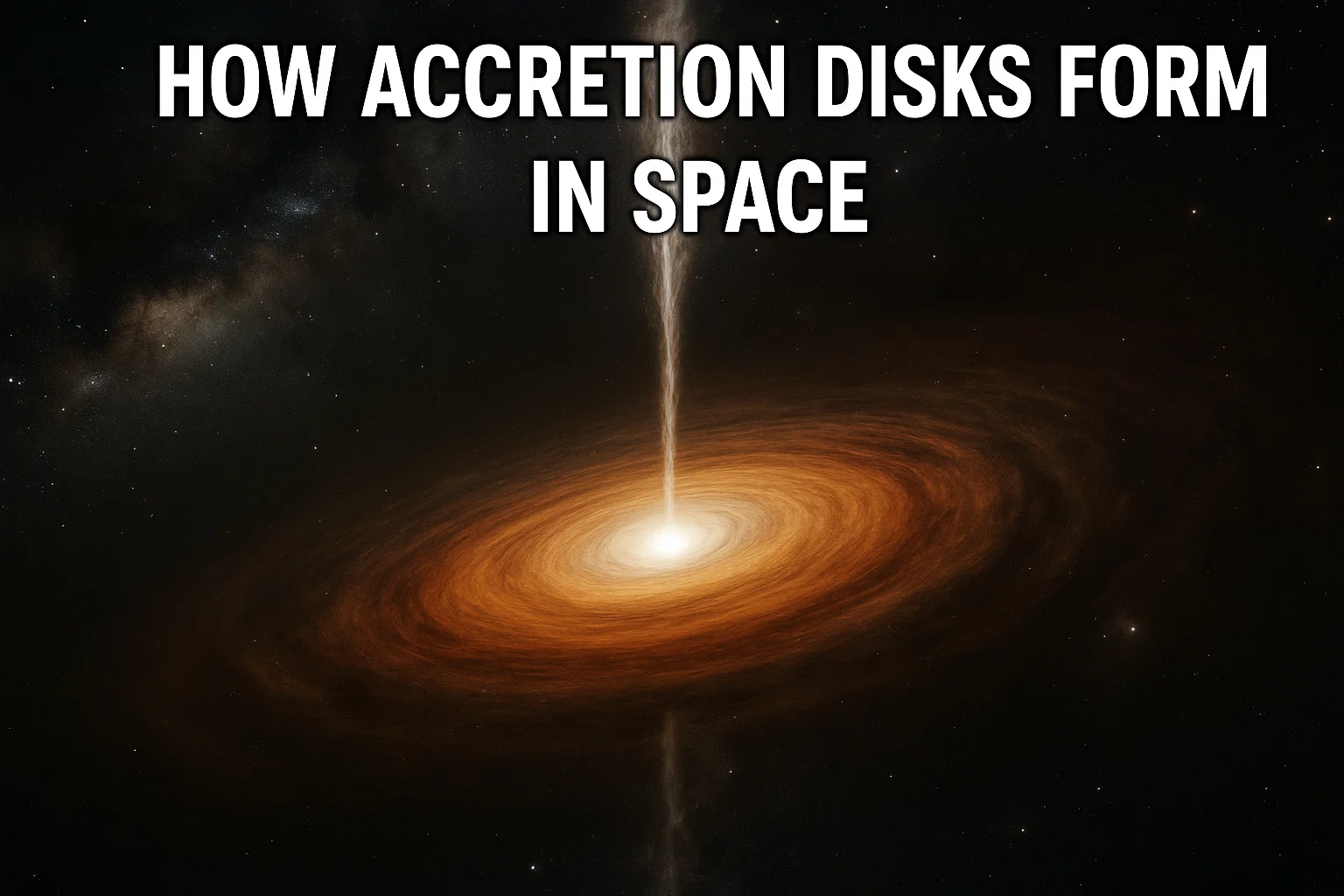
You’ve seen the pictures. We all have. That glowing, fiery doughnut surrounding a black hole in the movie Interstellar, or the recent, blurry-but-beautiful snapshots from the Event Horizon Telescope. They look static, like frozen rings of fire. But they aren’t. They are violent, chaotic engines that power the brightest lights in the universe.
Most people look at space and think it’s quiet. It isn’t. Especially not here.
We know gravity is the boss in space. It pulls everything together. So, the obvious question is: why doesn’t all that gas and dust just crash straight into the center? Why does it spin? And seriously, how do these messy, giant clouds transform into such neat, flat, rotating disks?
Figuring out exactly how accretion disks form in space is basically the holy grail of astrophysics. It tells us how our own solar system came to be. It explains why quasars can outshine entire galaxies. It’s a story about a fight between gravity and momentum, and it gets pretty intense.
More in Category:
How Does a Star Become a Red Giant
What Are the Largest Known Stars
Key Takeaways
- Gravity pulls, but spin wins: Angular momentum is the invisible wall that stops matter from falling straight down, forcing it into orbit instead.
- It’s a demolition derby: The flattening happens because gas particles violently collide, canceling out their up-and-down movements until only a flat sheet remains.
- Friction is the fuel: You need internal friction—mostly from magnetic turbulence—to rob the gas of energy so it can spiral inward.
- They are everywhere: The physics that builds a solar system is shockingly similar to the physics feeding a supermassive black hole.
- They are hot: We aren’t talking warm; we are talking millions of degrees, generating X-rays just from the sheer friction of matter rubbing together.
What on Earth (or Space) is an Accretion Disk?
Let’s strip away the jargon for a second. An accretion disk is just a bunch of diffuse material—gas, plasma, dust—orbiting a massive body. That body could be a star that’s just waking up, a super-dense neutron star, or a black hole.
Gravity grabs this material. But space is huge, and things rarely aim perfectly for the center. The stuff carries speed and direction—momentum. As it gets close to the massive object, that momentum forces it to swing around rather than dive in. The result is a flattened, spinning pancake of doom where material slowly spirals down the drain.
Think of it like water circling a plug hole, except the water is superheated plasma and the drain is a bottomless pit.
Where Does the Raw Material Come From?
It always starts with a cloud.
If we are talking about how stars are born, we are looking at giant molecular clouds. These are massive, cold nurseries of hydrogen and dust floating in the void. If we are talking about supermassive black holes, the “food” comes from gas clouds wandering through the galactic center, or maybe an unlucky star that got too close and was shredded apart by tidal forces.
So, how does a shapeless, fluffy cloud turn into a flat disk?
Gravity kicks off the party. Maybe a shockwave from a distant supernova slams into the cloud, or maybe it just gets so heavy it collapses under its own weight. It starts to shrink.
Here is the kicker: that cloud was already moving. Everything in space rotates a little bit. As the cloud collapses, it acts like an ice skater pulling his arms in during a spin. This is the conservation of angular momentum. A cloud light-years across might only be rotating at a few meters per second. But crush that down to the size of a solar system, and that rotation speeds up. A lot.
Why Doesn’t the Stuff Just Fall Straight Down?
This is the part that confuses people. Gravity pulls in. So why doesn’t the gas just go in?
It’s a cage match between gravity and centrifugal force.
Imagine you tie a rock to a string and spin it around your head. The string is gravity pulling the rock toward you. The speed of the rock keeps the string tight. If you try to pull the rock closer (shorten the string), it spins faster.
In space, gas particles falling toward a black hole have “angular momentum.” They are moving sideways relative to the hole. Gravity yanks them in, but their sideways speed makes them miss the target. They swing past.
If these particles were ghosts and could pass through each other, they’d just orbit in crazy, random loops forever. It would look like a swarm of angry bees, not a disk. But gas particles aren’t ghosts. They crash into things.
How Does a Messy Swarm Become a Flat Disk?
This is the violent part. Astronomers call it “flattening,” which sounds gentle. It is not.
Gas particles are slamming into each other constantly. Imagine a particle zooming high above the equator of the new star, diving down. Another particle is zooming up from below. Bam. They collide.
When they crash, they cancel out their vertical motion. The “up” energy and the “down” energy smash together and turn into heat. They stop moving vertically.
But here is the catch: they don’t lose their rotational speed. They are both spinning around the star in the same direction, so that motion is preserved.
Over thousands of years, these relentless collisions kill off almost all the vertical movement. The only place left to exist safely is the equator. The system naturally beats itself into the flattest, lowest-energy shape possible: a thin disk.
What Actually Pushes the Matter Into the Hole?
Okay, so we have a disk. It’s flat. It’s spinning. It’s stable. Why doesn’t it just stay there forever? Saturn’s rings are an accretion disk that stopped feeding. Why do black hole disks keep feeding?
For the central monster to eat, the food needs to slow down. It needs to lose angular momentum so gravity can take over again.
This requires friction. We call it “viscosity.”
If you stir a cup of honey, it stops spinning pretty fast because honey is thick—it has high viscosity. In an accretion disk, the inner rings spin faster than the outer rings (thanks, Kepler). This means layers of gas are rubbing against each other. Fast inner layers drag on slow outer layers. This friction transfers energy outward and lets the inner stuff spiral inward.
Is It Just Regular Friction?
Here is where the physics gets weird.
For decades, scientists were stuck. They ran the numbers, and simple molecular friction—gas atoms bumping into each other—wasn’t enough. If that was the only friction, it would take longer than the age of the universe to build a star.
Something else had to be acting like a spoon, stirring the pot violently.
The answer is magnetism. Specifically, the Magnetorotational Instability (MRI). It sounds like a mouthful, but the concept is cool. Magnetic fields thread through the gas. Because the inner part of the disk spins faster, it drags the magnetic field lines with it, winding them up tight like a spring.
This creates tension. The magnetic field wants to snap back. This magnetic tension acts like a chaotic brake, violently slowing down the inner material and flinging its momentum to the outer material. This magnetic turbulence is the “effective viscosity.” It’s what forces the matter to spiral down the drain at a speed that matches our observations.
How Do Protoplanetary Disks Differ?
When we talk about how accretion disks form in space around baby stars, we are talking about our own origins. These are called T Tauri disks.
They are the chill cousins of the black hole disks. They are cooler, made of dust grains and gas. As the magnetic turbulence dies down in certain zones, dust grains gently bump into each other and stick.
- Dust turns to pebbles.
- Pebbles clump into boulders.
- Boulders smash together to build planets.
It’s happening right now in places like the Orion Nebula. You can spot these dark teardrops against the bright nebula background. That’s a solar system brewing. The physics is identical to the black hole version, but the temperature is low enough that you could (theoretically) fly a ship through it without instantly vaporizing.
Why Do They Shine Like Beacons?
Quasars are the brightest things in the universe. They are just accretion disks around supermassive black holes. Where does the light come from?
Friction again.
As that gas spirals inward, it gets compressed into a tighter and tighter space. It rubs against its neighbors furiously. This dumps kinetic energy into heat.
In a planet-forming disk, it might just glow warm in infrared. But drop that same gas toward a neutron star or a black hole, and gravity accelerates it to a significant fraction of light speed. The friction becomes cataclysmic. The gas hits millions of degrees.
At that temperature, matter screams in X-rays. This makes accretion disks the most efficient energy factories in existence—way more efficient than the nuclear fusion powering our sun. You are converting gravitational potential energy directly into light.
What Happens at the Edge of the Abyss?
For black holes, the disk is the waiting room.
As material gets close to the Event Horizon, things get trippy. Time dilation kicks in. The light from the gas gets stretched and reddened. Eventually, it crosses the line. We lose it. It adds to the mass of the black hole.
But not all of it falls in. Black holes are messy eaters.
How Do Jets Launch?
One of the wildest side effects of how accretion disks form in space is the launch of relativistic jets. You’ve probably seen the pictures: a galaxy with a massive beam of plasma shooting out of the center like a laser.
That’s the disk doing that.
The spinning disk twists the magnetic field lines into a tight helix—a corkscrew shape towering up from the poles of the black hole. Charged particles in the disk get snagged on these magnetic lines.
Instead of falling in, they get flung outward, guided by the magnetic cage. They get accelerated to 99.9% the speed of light. These jets can punch holes through entire galaxy clusters, blowing away gas that would otherwise form stars. The disk effectively regulates the growth of the galaxy around it.
Do Binary Systems Make Different Disks?
Yes, and they are volatile.
Picture a normal star and a dense white dwarf orbiting each other. If they get close enough, the white dwarf’s gravity starts stripping the skin off the normal star. It sucks the hydrogen right off the surface.
This stream of stolen gas misses the white dwarf and curls around it, forming a disk. These are called Cataclysmic Variables.
Why “cataclysmic”? Because the disk is unstable. Sometimes it dumps too much gas onto the white dwarf at once. The pressure spikes, nuclear fusion ignites on the surface, and boom—you get a Nova explosion.
How Do We Actually See Them?
We usually can’t take a selfie of a disk. They are too far away and too small. M87* was a rare exception because it is a monster.
So, how do we know they exist? We listen to the light.
We use spectroscopy. We break the light into a rainbow. Because the disk is spinning crazy fast, we see the Doppler effect.
- Blue Shift: The side of the disk coming toward us looks bluer.
- Red Shift: The side spinning away looks redder.
This creates a signature “double-peaked” spectral line. It’s the fingerprint of a rotating disk. By measuring the width of that line, we can tell you exactly how fast it’s spinning and how heavy the black hole is, all without ever seeing a picture.
What Stops the Feeding Frenzy?
There is a speed limit. It’s called the Eddington Limit.
As matter falls in, it gets hot and shines. Light actually pushes back—it exerts pressure. If the disk tries to feed the black hole too fast, it gets too bright. The outward pressure of the light becomes stronger than the inward pull of gravity.
The disk literally blows itself apart. It chokes on its own brightness. This mechanism is crucial; it stops black holes from eating their galaxies in one bite.
Why Should You Care?
It sounds abstract, but you are here because of an accretion disk.
Our sun? Formed from the center of an accretion disk. Earth? Formed from the dusty leftovers in the outer bands. The iron in your blood? Forged in a star that was born from one of these disks.
They are the architects of the universe. They build stars, they build planets, and in the case of quasars, they shape the destiny of entire galaxies by blowing away gas.
The Simulations
Since we can’t sit around for ten million years to watch a star form, we use supercomputers.
We build “hydrodynamic simulations.” We code in the laws of gravity, fluid dynamics, and that tricky magnetic instability. Then we hit run.
These simulations show us the turbulence. They reveal spiral arms inside the disks—miniature galactic structures within the disk itself. They validate the math. Computer modeling is our time machine, letting us fast-forward the clock to see how accretion disks form in space under different conditions.
The Mysteries Left to Solve
We don’t have it all figured out.
We still argue about exactly how the jets get launched. We are still fighting over the precise viscosity rates in different types of disks. And recent data suggests planets form way faster than our models predicted, which is a headache for theorists but exciting for everyone else.
Accretion disk physics is one of the most active frontiers in science. Every time we launch a new X-ray telescope, we have to rewrite a chapter of the textbook.
Final Thoughts
The universe isn’t a static painting. It’s a flowing, spinning machine. Accretion disks are the gears of that machine.
From the quiet dust bunny that became Earth to the blinding fury of a quasar, the rules are the same. It starts with a cloud, it spins up, it flattens out, and it feeds the dark.
For more detailed information on the specific physics of these cosmic structures, check out NASA’s Goddard Space Flight Center.
FAQs – How Accretion Disks Form in Space
How does a flat accretion disk form from a chaotic cloud?
A chaotic cloud collapses under gravity, and as it contracts, its inherent rotation speeds up due to conservation of angular momentum, causing it to flatten into a spinning, disk-like structure.
Why doesn’t all the material in an accretion disk fall straight into the black hole or star?
The material in an accretion disk is held in orbit by angular momentum and experiences friction, which redistributes energy and allows some matter to spiral inward while maintaining a stable, spinning disk.
What role does magnetic turbulence play in accretion disks?
Magnetic turbulence, produced by the Magnetorotational Instability, acts as an effective viscosity that enhances friction within the disk, enabling matter to lose energy and gradually spiral into the central object.
How do scientists observe accretion disks if they are too small and distant to see directly?
Scientists observe accretion disks by analyzing the light they emit, especially through spectroscopy, where Doppler shifts in the spectral lines reveal the disk’s rotation speed and other properties.