

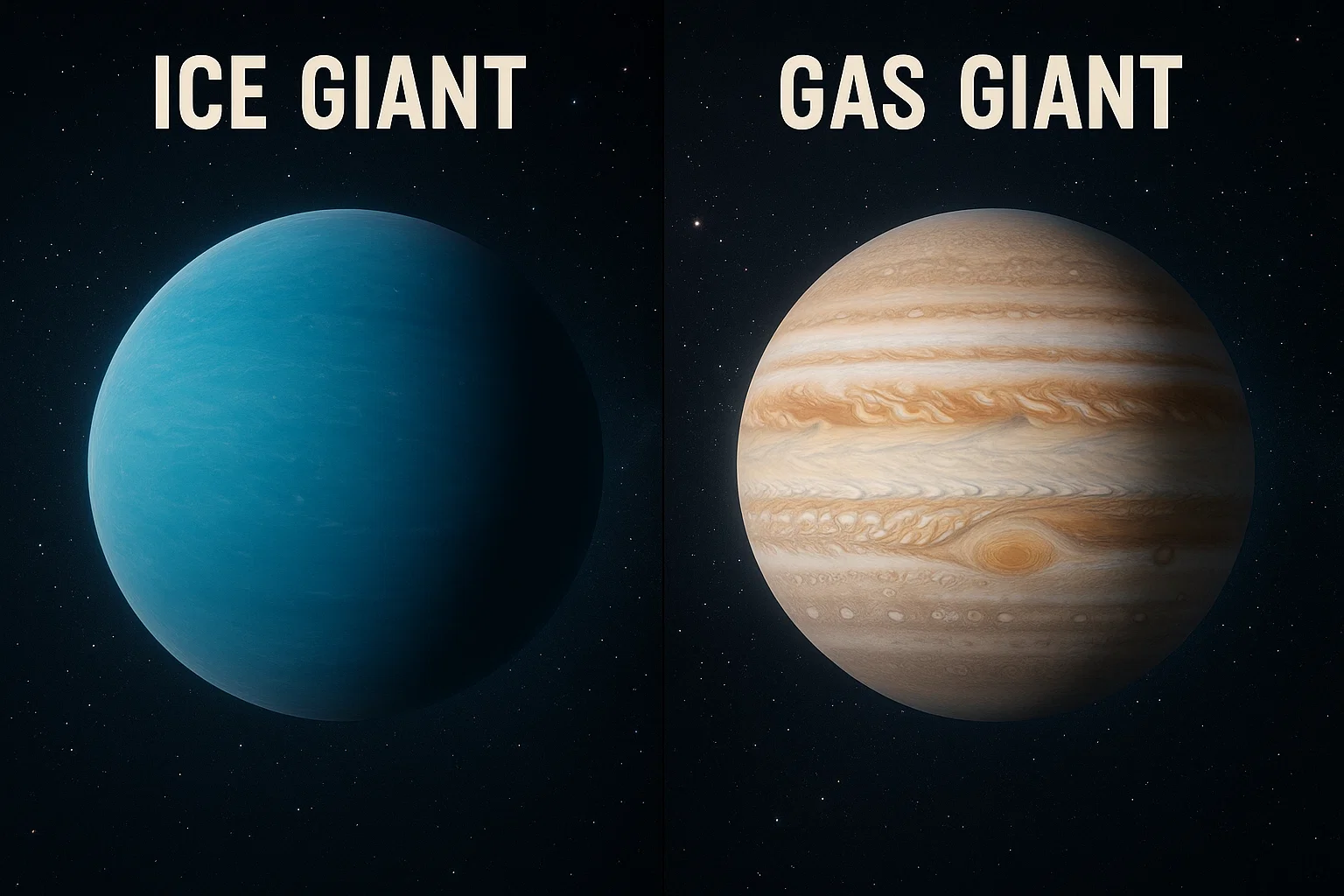
When you gaze out into the vast, dark neighborhood of our outer solar system, you find the giants. Jupiter, Saturn, Uranus, and Neptune. At a glance, they might all seem to be cut from the same cloth—massive, swirling worlds of gas, profoundly different from rocky planets like Earth or Mars.
But lumping them all together as “gas giants” is a mistake.
This common label actually hides one of the most fascinating divisions in our solar system. The truth is, Uranus and Neptune are a fundamentally different class of planet from Jupiter and Saturn. Understanding the difference between ice giant and gas giant planets doesn’t just re-categorize our solar system; it unlocks the very story of how it was born.
We’re going to explore that exact difference. This isn’t just about size or color. It’s about what’s deep inside, what they’re made of, and why they exist in the first place.
More in Celestial Objects Category
Difference Between Asterism and Constellation
Difference Between Meteoroid Meteor Meteorite
Key Takeaways
Before we dive deep, here are the essential facts you need to know about the difference between ice giants and gas giants:
- Core Composition: This is the big one. Gas giants (Jupiter, Saturn) are made almost entirely of hydrogen and helium, the same light gases that make up our Sun.
- “Icy” Ingredients: Ice giants (Uranus, Neptune) are composed of a much smaller hydrogen/helium atmosphere, but their bulk is made of heavier elements and “ices”—compounds like water (H₂O), methane (CH₄), and ammonia (NH₃).
- Formation Story: Gas giants formed faster and closer (relatively speaking), gobbling up hydrogen and helium gas before the young Sun blew it away. Ice giants formed slower and farther out, in a region rich with the “ices” that became their primary building blocks.
- Internal Structure: Gas giants are so massive they crush hydrogen into a bizarre, conductive metallic state deep inside. Ice giants lack this layer, but instead likely possess a strange, hot, slushy “mantle” of liquid ices that behaves like a planet-sized ocean.
- Magnetic Fields: This structural difference creates wildly different magnetic fields. Gas giants have fields generated in their metallic hydrogen, while ice giants’ fields are likely generated in their slushy “ice” mantles, leading to bizarre, off-center fields.
So, What Makes a Planet a “Giant” in the First Place?
This seems like a simple question, but it’s the perfect place to start. What’s the dividing line?
A “giant” planet is, quite simply, a planet that is not primarily composed of rock or other solid matter. When we look at our solar system, we see two clear families. First, there are the terrestrial (rocky) planets: Mercury, Venus, Earth, and Mars. They are dense, have solid surfaces you could (in theory) stand on, and are relatively small.
Then, you cross the asteroid belt. Everything changes.
The planets in the outer solar system are enormous, low-density worlds with no “surface” as we know it. Instead, they have atmospheres that grow thicker, denser, and hotter as you descend, eventually crushing the gases into strange liquid and even solid states. These are the giant planets. For decades, they were all just called “gas giants.” But as our telescopes and probes—like the legendary Voyager 2—got better, scientists realized the two blue worlds, Uranus and Neptune, just didn’t fit the mold.
They were something else.
Let’s Talk About the Heavyweights: What Defines a Gas Giant?
When you think “giant planet,” you’re almost certainly picturing Jupiter.
Jupiter is the king. It’s more than twice as massive as all the other planets in our solar system combined. Saturn, with its stunning rings, is no slouch either, clocking in at 95 times the mass of Earth. These two are the quintessential gas giants.
What Are Gas Giants Actually Made Of?
The name says it all. Gas.
Specifically, they are composed almost entirely of the two lightest and most common elements in the universe: hydrogen and helium. Their composition is strikingly similar to the Sun. In fact, if Jupiter had been about 80 times more massive, it would have ignited nuclear fusion and become a star itself.
Think of them as failed stars. Or, perhaps, as supremely successful planets.
Their atmospheres are a vast, deep ocean of hydrogen and helium. As you plunge into Jupiter, the pressure and temperature skyrocket. The gas just gets denser and denser, transitioning seamlessly into a liquid, with no hard surface to mark the change. This is a primary feature of a gas giant: they are vast spheres of hydrogen and helium, from their cloudy tops down to their mysterious cores.
What’s Going On Inside Jupiter and Saturn?
This is where the real magic happens. The pressure at the center of Jupiter is estimated to be over 40 million times the air pressure at sea level on Earth.
Under that unthinkable crush, the hydrogen gas is compressed so tightly that its electrons are squeezed free. The hydrogen begins to conduct electricity, behaving just like a metal. This “metallic hydrogen” layer is something we can’t truly replicate in a lab on Earth for more than a microsecond.
This layer is believed to be the engine that drives Jupiter’s and Saturn’s incredibly powerful magnetic fields. It’s a churning, spinning ocean of liquid metal, thousands of miles deep.
What’s at the very center? We still don’t know for sure. Data from NASA’s Juno mission suggests Jupiter’s core isn’t a solid, distinct ball. It may be a “fuzzy” or “dilute” core, a mix of rock, ice, and metallic hydrogen all sloshed together. Saturn’s is likely similar. This inner structure is a key point of difference we’ll return to.
What Makes Uranus and Neptune “Ice” Giants?
Now we journey further out, into the truly deep, dark, and cold reaches of the solar system. Here we find Uranus and Neptune. These twin blue planets are also giants—Neptune is 17 times Earth’s mass, and Uranus is 14.5 times. They are far, far larger than our rocky home.
But they are significantly smaller than Jupiter and Saturn. And as scientists discovered, their composition is worlds apart.
Why “Ice”? Do You Mean Like… Ice Cubes?
This is the most common point of confusion. When astronomers say “ices,” they don’t mean ice in the way you find it in your freezer.
In planetary science, “ices” are volatile compounds—molecules that have a low freezing point. The “big three” ices are:
- Water (H₂O)
- Methane (CH₄)
- Ammonia (NH₃)
In the cold, distant part of the solar system where Uranus and Neptune formed, these compounds were abundant as solid ice grains. The planets that formed there built themselves out of this icy-rocky material.
So, “ice giant” doesn’t mean the planet is a solid block of ice. It means it’s made of the ingredients that are ices in the outer solar system. In fact, the “icy” layers inside these planets are almost certainly not solid. They are likely a bizarre, hot, high-pressure fluid.
So, What’s Their Composition Then?
This is the crux of the difference between ice giant and gas giant planets.
If you were to analyze Jupiter, you’d find it’s about 90% hydrogen and helium by mass. It’s a gas planet through and through.
If you analyze Neptune or Uranus, you’d find their hydrogen/helium atmospheres are just a thin veneer, making up perhaps only 15-20% of the planet’s total mass. The other 80-85% of the planet? That’s all rock and those “ices.”
Their structure is fundamentally different.
Beneath their cloudy atmospheres, an ice giant doesn’t have a metallic hydrogen layer. Instead, it’s believed they have a massive, dense “mantle.” This mantle isn’t made of rock, like Earth’s. It’s a “supercritical fluid” ocean of water, methane, and ammonia, heated to thousands of degrees by the planet’s core, but kept in a dense, liquid-like state by the immense pressure.
It’s an ocean of hot, slushy, electrified “ice.”
At the very bottom, they likely have a more traditional core of rock and metal, perhaps about the size of Earth.
What’s the Single Biggest Difference Between Ice Giants and Gas Giants?
The single biggest difference is composition.
A gas giant is a star-like ball of hydrogen and helium with a small, questionable core. An ice giant is a large rocky-icy core wrapped in a massive mantle of “ices” and topped with a relatively thin atmosphere of gas.
Think of it this way: Jupiter and Saturn are gas planets. Uranus and Neptune are water-and-ammonia planets (with a gassy-topping). It’s a profound distinction. The universe has two completely different ways to build a giant planet, and our solar system conveniently has two of each.
How Did They Even Form So Differently?
This all comes down to location, location, location.
All planets are born from a disk of gas and dust orbiting a young star. The “core accretion” model is the leading theory for how this happens.
Step 1: Small bits of dust and ice stick together, forming planetesimals. Step 2: These planetesimals collide and grow, eventually forming a “core” with enough gravity to attract more material. Step 3: What happens next depends entirely on where you are.
Jupiter and Saturn formed in a “sweet spot.” They were far enough from the Sun for ices to be solid (beyond the “frost line”), which provided a ton of building material. They quickly grew cores of perhaps 10-15 Earth masses. Once they hit that size, their gravity was strong enough to start pulling in the gas from the disk—the hydrogen and helium. And they did this fast. They had a runaway growth spurt, hoovering up all the gas in their orbits before the young Sun’s solar wind blew it all away.
Uranus and Neptune formed much, much farther out. Out here, the disk was thinner, and orbital speeds were slower. It took them longer to build their cores. By the time their cores were big enough to start grabbing hydrogen and helium, most of that gas was already gone.
So, they were left with what they started with: a large core of rock and ice, and only a small, thin atmosphere of the gas they managed to snag at the last minute.
An ice giant isn’t a “failed” gas giant. It’s simply a planet that grew up in a different neighborhood with different ingredients and a different timeline.
What Do Their Insides Look Like? Are They Just… Fluffy?
Far from it. The interiors of these planets are some of the most extreme environments in our solar system. The difference in their composition leads to a completely different set of internal layers.
Let’s put them side-by-side.
- A Gas Giant (Jupiter/Saturn):
- Atmosphere: Clouds of ammonia, water ice, etc., in a vast ocean of hydrogen/helium gas.
- Gaseous Hydrogen: The gas just gets denser and hotter.
- Liquid Hydrogen: At 10,000 miles down, the gas is compressed into a liquid.
- Metallic Hydrogen: Deeper still, the liquid hydrogen becomes a metal. This is the “engine” of the planet.
- Core: A possible “fuzzy” core of rock, ice, and exotic fluids, dissolved into the layer above.
- An Ice Giant (Uranus/Neptune):
- Atmosphere: Clouds of methane, hydrogen sulfide, etc., in a hydrogen/helium/methane gas mix.
- Gaseous Layer: The atmosphere blends into a hot, dense mix of H₂, He, and CH₄.
- Icy Mantle: This is the bulk of the planet. A churning, supercritical “ocean” of water, methane, and ammonia. It’s hot, dark, and under extreme pressure.
- Core: A distinct, solid core of rock and ice, about the size of Earth.
That metallic hydrogen layer in gas giants is a defining feature. The lack of it in ice giants—and the presence of the icy mantle instead—is equally defining.
This isn’t just a “what if” scenario. This structural difference has massive, observable consequences.
Why Are Their Magnetic Fields So Bizarrely Different?
This is one of my favorite parts. You can “see” the difference in their guts by looking at their magnetic fields.
Jupiter and Saturn have fields that, while incredibly strong, are pretty “normal.” They are generated by their spinning, conductive metallic hydrogen layer. As a result, the fields are relatively aligned with the planet’s spin axis. Jupiter’s field is tilted by about 10 degrees, and Saturn’s is almost perfectly aligned.
Then you look at the ice giants.
Uranus’s magnetic field is a complete mess. It’s not centered on the planet; the center of the field is offset by one-third of the planet’s radius. And it’s tilted by a whopping 59 degrees from its spin axis.
Neptune’s is just as weird. It’s offset by 55% of the planet’s radius (it’s generated closer to the “surface”) and is tilted 47 degrees.
What could possibly cause this?
The answer is the structural difference. Ice giants don’t have metallic hydrogen. Their “engine” must be something else. The leading theory is that these bizarre fields are generated within the hot, slushy “icy” mantle. Because this region is a relatively thin, convective shell (compared to Jupiter’s massive metallic core), the fields it produces are not well-centered. They are “lumpy” and wildly tilted.
When we look at their magnetic fields, we are literally seeing the proof of their different interiors.
What’s the Weather Like on These Planets?
The weather on all giant planets is bananas. But the flavor of the weather is different.
Jupiter’s Great Red Spot vs. Neptune’s Great Dark Spot
The weather on gas giants is largely driven by their powerful internal heat. Jupiter radiates almost twice as much heat as it receives from the distant Sun. This heat comes from its ongoing gravitational contraction (it’s still shrinking!) and drives the planet’s famous bands and colossal storms, like the Great Red Spot—a hurricane wider than Earth that has been raging for at least 300 years.
Now let’s go to Neptune. Neptune is 30 times farther from the Sun than Earth is. Sunlight there is 900 times weaker. It should be a quiet, frozen, dead world.
It is not.
Neptune is a world of unimaginable violence. It has the fastest winds in the solar system, measured at over 1,200 mph—supersonic. It, too, has a massive internal heat engine, radiating 2.6 times the energy it gets from the Sun. This heat drives massive, dark storms, like the “Great Dark Spot” that Voyager 2 photographed (and which has since vanished, replaced by new ones).
So, what about Uranus? Here things get weird again. Uranus, for some unknown reason, has almost no internal heat. It radiates almost exactly the same amount of energy it receives from the Sun. As a result, its weather is much, much calmer. It’s a more placid, “dead” world in comparison to its twin, Neptune. This lack of heat is one of the biggest unsolved mysteries of the ice giants.
What’s With the Colors?
Why are Jupiter and Saturn beige, while Uranus and Neptune are blue?
The gas giants’ colors (yellows, oranges, browns) come from exotic clouds of ammonia ice, ammonium hydrosulfide, and other trace chemicals high in their atmospheres.
The ice giants get their beautiful cyan and azure hues from methane. Their atmospheres have a higher percentage of methane gas. This methane gas is very good at absorbing red light from the Sun, while it reflects blue light back into space.
Voila. Blue planets.
Does This “Ice Giant” vs. “Gas Giant” Thing Apply Outside Our Solar System?
Absolutely. In fact, this is why the distinction is so critically important.
When we started discovering planets around other stars (exoplanets), we found them in all shapes and sizes. We’ve found “Hot Jupiters”—gas giants orbiting scorching-hot, right next to their stars. And we’ve found thousands of planets in the size-range of Uranus and Neptune.
It turns out that “Mini-Neptunes” or “Super-Earths”—planets in that size-gap between Earth and Neptune—might be the most common type of planet in the entire galaxy. Our solar system doesn’t even have one.
By studying Uranus and Neptune, our “local” ice giants, we can understand this vast population of worlds that fills the galaxy. As you can see at NASA’s official exoplanet database, the diversity of these worlds is staggering. The difference between ice giant and gas giant isn’t just a local-solar-system-fact. It’s a fundamental branch in the family tree of planets.
Are Ice Giants Just “Failed” Gas Giants?
It’s tempting to think of them that way. As planets that “missed out” on becoming like Jupiter. But that’s the wrong way to look at it.
They aren’t failed gas giants any more than a cat is a “failed” dog.
They are a separate and distinct class of planet, born from different materials in a different environment.
The difference between an ice giant and a gas giant is the story of our solar system’s chemistry. Jupiter and Saturn tell us about the light gases, the hydrogen and helium that make up 98% of the visible universe. But Uranus and Neptune tell us about the “ices.” They tell us about the water, the methane, and the ammonia—the very molecules that, on our own little planet, combined to create life.
In the end, those two quiet, blue worlds, hanging at the edge of the darkness, may be more a reflection of our own origins than the great gas kings who hog the spotlight.
FAQ – Difference Between Ice Giant and Gas Giant
What is the main difference in composition between gas giants and ice giants?
Gas giants, such as Jupiter and Saturn, are composed mainly of hydrogen and helium, while ice giants like Uranus and Neptune have a smaller hydrogen/helium atmosphere and are primarily made of heavier elements and “ices” like water, methane, and ammonia.
How does the internal structure differ between gas giants and ice giants?
Gas giants have a metallic hydrogen layer deep inside that drives their magnetic fields, whereas ice giants lack this layer and instead likely have a hot, slushy mantle of water, methane, and ammonia, with a solid core of rock and ice at the center.
Why do Uranus and Neptune have such unusual magnetic fields?
Their strange magnetic fields are believed to be generated within their slushy, icy mantles, which are convective shells different from the metallic hydrogen layer in gas giants, resulting in off-center and highly tilted magnetic fields.
What distinguishes a planet as a ‘giant’ in our solar system?
A giant planet is primarily composed of gases or ices rather than solid rock, with outer planets like Jupiter, Saturn, Uranus, and Neptune being enormous and low-density, lacking a solid surface.
Do ice giants exist outside our solar system, and how are they relevant to exoplanet studies?
Yes, many exoplanets are in the size range of Uranus and Neptune, known as “Mini-Neptunes” or “Super-Earths,” and studying ice giants helps us understand the diversity of worlds in the galaxy and the fundamental nature of planet formation.