
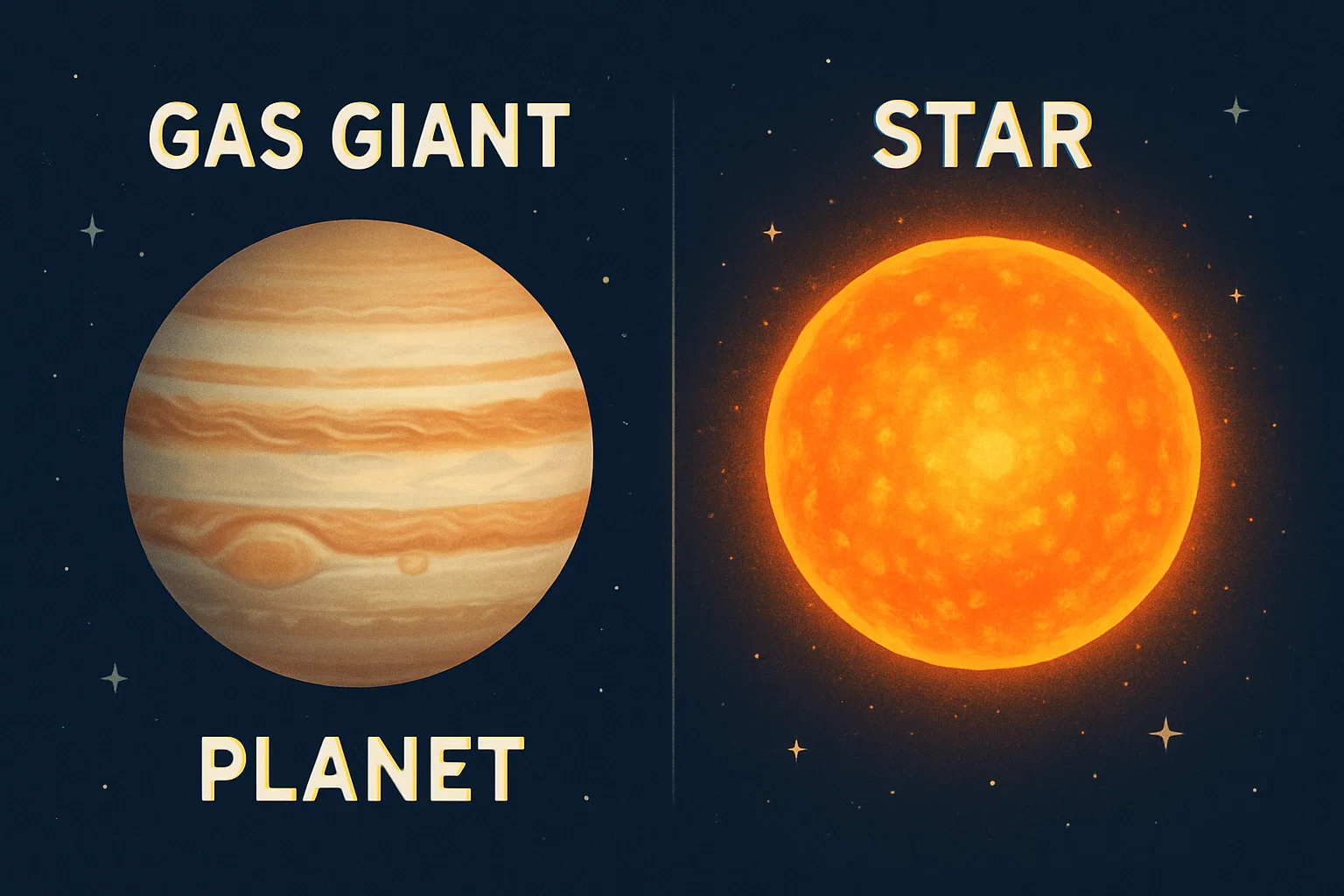
When you look up at the night sky, you see points of light. Some are stars, blazing suns billions of miles away. Others are planets, like Jupiter or Saturn, which can shine so bright they look like stars. To the naked eye, they’re all just… lights.
But they’re not. The cosmos is split into two very different teams: the furnaces and the leftovers.
Our solar system has a perfect example of each. We have the Sun (a star) and Jupiter (a gas giant). They’re both colossal spheres. They’re both made of the same stuff—hydrogen and helium. So why is one a life-giving inferno and the other a cold, dark ball of clouds?
The profound difference between gas giant and star isn’t about their ingredients. It’s about their destiny. And that destiny is decided by one thing: nuclear fusion.
This one concept is the dividing line. It’s the story of what happens when you have enough stuff… versus when you just don’t.
More in Celestial Objects Category
Difference Between Asterism and Constellation
Difference Between Meteoroid Meteor Meteorite
Key Takeaways
- The Big Divide: The fundamental difference between a gas giant and a star is that a star is massive enough to ignite and sustain nuclear fusion in its core. A gas giant is not.
- It’s All About Weight: A star’s crushing mass provides the gravitational pressure needed to heat its core to about 10 million Kelvin (18 million °F), the “ignition temperature” for fusing hydrogen into helium.
- Jupiter: The ‘Failed Star’: Gas giants like Jupiter are often called “failed stars.” They are made of the right material (hydrogen and helium) but lack the 80-or-so Jupiter masses required to start that fusion fire.
- The ‘Missing Link’: Brown Dwarfs: Brown dwarfs are the “in-between” objects. They’re bigger than Jupiter but smaller than stars. They’re just massive enough to briefly fuse a “heavy” type of hydrogen (deuterium) but can’t sustain the main show.
- Making Light vs. Reflecting It: Stars create their own light. Gas giants only reflect the light of their parent star. They’re cosmic mirrors, not cosmic lightbulbs.
So, What Does “Gas Giant” Actually Mean?
Let’s stick with what we know: our own backyard. A “gas giant” is a planet that is, well, giant, and made mostly of gas. Jupiter and Saturn are the poster children.
You’ll also hear about “ice giants” like Uranus and Neptune. They’re still giants, but they have a lot more “ices” (like water, methane, and ammonia) mixed in with their hydrogen and helium. For this chat, we’re lumping them all under the “giant planet” banner.
The key word here is planet.
A gas giant is born from the same swirling disk of dust and gas as its rocky siblings, like Earth and Mars. It orbits a host star. But its recipe is what causes all the confusion. If you wrote down the recipe for the Sun and the recipe for Jupiter, they’d look almost identical. 99% the same ingredients.
And that’s the right question to ask: “If Jupiter is a big ball of the same gas as the Sun, why isn’t it a star?”
The answer is that it just doesn’t have the “spark.” It can’t make its own light. The brilliant shine we see from Jupiter is just reflected sunlight bouncing off the tops of its icy ammonia clouds.
But Doesn’t Jupiter Emit Its Own Heat?
Here’s where people get tripped up. Yes. Jupiter does give off its own heat. In fact, it radiates about twice as much energy as it gets from the Sun. If you could see in infrared, Jupiter would be glowing.
So, it’s glowing. Case closed, right?
Not so fast. Why it’s glowing is the critical part. It’s not glowing because of nuclear fusion. It’s glowing because it’s still hot from its formation billions of years ago.
Think of it like a giant cast-iron skillet that was forged in fire. It’s still piping hot, but the burner is off. It’s on a one-way trip, slowly cooling down over eons. It’s shedding its primordial heat, not actively creating new heat. That’s a crucial distinction.
How Do These Giants Even Form?
Scientists have two main theories on this. The first, and most popular, is called core accretion. The idea is that a “seed” forms first, a core of rock and ice about 10 times the mass of Earth. This new, heavy core then has so much gravity that it starts vacuuming up all the light hydrogen and helium gas left in the early solar system. It “accretes” a massive, puffy atmosphere.
The second idea is gravitational instability. This model suggests the gas giant forms all at once. A massive clump of gas in the early solar disk just collapses in on itself under its own gravity, much like a star does… but on a smaller scale. This model might explain how some massive planets we see orbiting very far from their stars could have formed.
What Makes a Star a “Star”?
A star, on the other hand, is a completely different beast. A star, like our Sun, has achieved something incredible. It has become a self-sustaining nuclear reactor.
It’s a furnace. Not a cooling ember.
The definition of a star is that it shines with its own light. A light generated deep within its core from the universe’s most powerful engine: nuclear fusion. This process is what separates the givers of light from the reflectors of light.
What Is This “Nuclear Fusion” You Keep Mentioning?
This is the whole ballgame. And it’s all about gravity.
A star is born from a massive cloud of gas that collapses under its own weight. As it collapses, the stuff in the center gets squeezed. Unbelievably squeezed. This insane compression creates friction, and that friction creates heat. As more and more mass piles on, the pressure and temperature at the core just skyrocket.
Eventually, the core hits a magic number: about 10 million Kelvin (18 million °F).
At this temperature, the hydrogen atoms (which are just bare protons) are moving so fast and are packed so tightly that they overcome their natural repulsion. They slam into each other and fuse.
What’s the ‘Fuel’ for This Fire?
The specific reaction is called the Proton-Proton Chain. In short, four hydrogen atoms fuse together in a series of steps to become one helium atom.
But here’s the kicker: one helium atom weighs slightly less than the four hydrogen atoms that made it. That “lost” mass doesn’t just vanish. It explodes into a pure, titanic blast of energy. That’s Einstein’s $E=mc^2$ in action.
This energy, pushing outward, fights gravity to a perfect standstill. Gravity tries to crush the star; fusion tries to blow it apart. This perfect cosmic balancing act, called “hydrostatic equilibrium,” is what lets a star burn steadily for billions of years.
Why Can’t a Gas Giant Just… Start Fusion?
This brings us back to Jupiter. If it’s made of hydrogen, why doesn’t this happen?
The answer is almost insultingly simple: mass.
Jupiter is a giant to us. You could fit 1,300 Earths inside it. But by stellar standards, it’s a lightweight. It simply does not have enough mass. It doesn’t have enough gravity to create the core pressure needed to light the fusion fire.
The analogy of rubbing two sticks together is perfect. Jupiter’s gravity is like lazily rubbing two sticks together. It generates some heat (that leftover formation heat), but it’s not enough to ignite.
A star’s gravity is like hooking those two sticks up to a V8 engine and smashing them together. The result isn’t a spark; it’s an explosion.
What’s the Magic Number for Mass?
So, what’s the magic number? How much “stuff” do you need to graduate from planet to star?
Astronomers have it pinned down. The barrier to entry for stardom is about 80 times the mass of Jupiter.
No, that’s not a typo. Eighty.
Our solar system’s king is a mere 1/80th of what’s required. It’s not even close. This 80-Jupiter-mass line (which is about 8% of our Sun’s mass) is the celestial dividing line.
- Below this line: You’re a planet (or a gas giant). Your core will compress, it will get hot, but it will never hit that 10-million-degree ignition point. You are destined to be a cold, dark world, forever.
- Above this line: You’re a star. Your core will ignite. The fusion engine will turn on. You will spend billions of years burning hydrogen and shining your own light across the galaxy.
So What Happens to Jupiter? Is It a “Failed Star”?
You guessed it. That’s the exact nickname astronomers use: a “failed star.”
It had all the ambition. It’s made of the exact same stuff as the Sun. It collapsed from the same primordial cloud. It vacuumed up as much gas as it could. But ultimately, it just didn’t have enough.
It had the right recipe, but it showed up to the party with only one cup of hydrogen when the recipe called for 80. It’s the king of the planets, but it will never be a king of its own system.
Have We Found Anything “In Between”?
Now you’re thinking like an astronomer. If 1 Jupiter is a planet and 80 Jupiters is a star, what about… 40 Jupiters?
The universe, of course, has an answer: brown dwarfs.
These are the fascinating, murky middle-ground. They are the universe’s overachieving gas giants or its underachieving stars, depending on how you look at it.
Meet the Brown Dwarf: The “Almost-Star”
A brown dwarf is an object with a mass in that “in-between” range: roughly 13 to 80 times the mass of Jupiter.
They are more massive than Jupiter, so their cores get hotter than Jupiter’s. But they are still less massive than a true star, so their cores don’t get hot enough for sustained hydrogen fusion.
They are stuck in celestial purgatory.
But they have one last trick up their sleeve. While they can’t burn regular hydrogen, the lowest-mass brown dwarfs (starting at just 13 Jupiter masses) are big enough to ignite a different kind of fusion.
Do Brown Dwarfs Have Fusion?
Yes! But… it’s a “fusion-lite.” They can’t burn hydrogen, but they can burn deuterium.
Deuterium is a rare, “heavy” isotope of hydrogen (its nucleus has one proton and one neutron, instead of just one proton). The great thing about deuterium is that it’s “easier” to fuse. It ignites at a much lower temperature of “only” about 1 million K.
So, a young brown dwarf’s core does ignite. It fuses its limited supply of deuterium. For a brief, shining moment (a few million years), it’s a fusion-powered object.
Here’s a quick comparison:
- Star Fusion (Main Sequence): Burns regular Hydrogen. Requires 10 million K. Lasts for billions of years.
- Brown Dwarf Fusion: Burns Deuterium (“heavy” hydrogen). Requires only 1 million K. Sputters out in a few million years.
The supply of deuterium is tiny. It runs out fast. The brown dwarf “sputters” to life, has a short-lived burst of glory, and then… the fire goes out. Forever. After that, it just cools off, glowing faintly in the infrared, just like Jupiter.
L, T, and Y: The ‘Alphabet’ of Failed Stars
Because brown dwarfs just cool down over time, astronomers classify them not by their mass, but by their temperature. This gives us the “spectral types” L, T, and Y.
- L Dwarfs: These are the hottest and youngest brown dwarfs (1,300–2,200 K). They are still glowing a dull, angry red.
- T Dwarfs: These are the middle-aged ones (700–1,300 K). They’re cool enough for methane to form in their atmospheres, which dramatically changes how they look.
- Y Dwarfs: These are the coldest, oldest brown dwarfs we’ve found (less than 700 K). Some are as cold as a kitchen oven, or even “room temperature.” They are completely invisible to the naked eye and can only be found with our most powerful infrared telescopes.
How Do We Tell Them Apart from So Far Away?
Okay, so this is a real problem for astronomers. When we discover a new object orbiting a distant star, how do we know what it is? A 10-Jupiter-mass object is a “super-Jupiter” planet. A 15-Jupiter-mass object is a “brown dwarf.” They can look awfully similar from light-years away.
Is It Just About Mass?
Mass is the gold standard. If we can see the object’s gravitational pull on its host star, we can “weigh” it. If it’s 10 Jupiters, it’s a planet. If it’s 20, it’s a brown dwarf. If it’s 90, it’s a star. Box checked.
But what if we can’t get a good mass measurement? Then you have to become a cosmic detective. You look for “fingerprints” in the object’s light.
What’s a ‘Wobble’ vs. a ‘Transit’?
How do we “weigh” something light-years away? We have two main tricks.
- The ‘Wobble’ (Radial Velocity): A planet doesn’t just orbit a star; they both orbit their common center of mass. This means a massive planet causes its parent star to “wobble” slightly. We can detect this wobble by seeing the star’s light shift back and forth (redshift, blueshift). The size of the wobble tells us the planet’s mass. This is the best way to “weigh” an object.
- The ‘Transit’ (Photometry): This is when a planet passes directly in front of its star, causing a tiny, temporary dip in the star’s brightness. This tells us the planet’s physical size (its diameter), but not its mass.
Often, we need both methods to get a full picture. But if we can only see it transit, we’re stuck. We have a “big” object, but is it a puffy, lightweight planet or a small, dense brown dwarf?
The Telltale Signs: Spectrum and Temperature
This is where we separate the wannabes from the true stars. We look for chemical “fingerprints” that can only exist at certain temperatures.
- Gas Giants (Planets): Their atmospheres are cold. We see the clear signature of ammonia clouds (like Jupiter) and methane.
- Stars (even tiny Red Dwarfs): They are too hot. Their surfaces are thousands of degrees. Fragile molecules like ammonia and methane are instantly destroyed. Their absence is a huge clue.
- Brown Dwarfs: They’re the “in-between.” They are warm enough to have atmospheres full of methane and water vapor, but not so hot that they’re destroyed.
But the real smoking gun is lithium.
It’s a neat trick: A true star’s core (at 10 million K) is hot enough to burn and destroy lithium very quickly. A brown dwarf’s core, however, never gets hot enough to burn lithium.
So, astronomers have a test: if you see the fingerprint of lithium in the spectrum of a star-like object, you know it’s not a star. It must be a brown dwarf.
Does This Mean Jupiter Could Never Become a Star?
That’s exactly right. A planet cannot “grow up” or “evolve” into a star. Its mass is set at its formation. Jupiter will be a gas giant today, tomorrow, and five billion years from now when our Sun itself dies. It failed the entrance exam, and there’s no makeup test.
What If We “Fed” Jupiter?
But let’s play god for a second. What if we could change its destiny?
Theoretically… yes. If you could somehow find 79 other Jupiters and smash them, one by one, into our Jupiter, you could make a star. As the mass piled on, the core’s gravity and pressure would climb.
When that 80th-Jupiter-equivalent of mass was added, the core would flash. It would hit 10 million K.
The fusion engine would ignite. Jupiter would “wake up” and be born as a tiny, dim, red dwarf star. The solar system would be a complete wreck, as the new star’s gravity would throw all the other planets (including Earth) into chaos. But hey, we’d have a new star.
This just reinforces the central point: the difference between gas giant and star is not one of kind, but one of quantity.
Why Does This Difference Even Matter?
So, who cares? Why does this line in the sand matter?
This isn’t just cosmic trivia. This distinction—between a planet that can’t light its fire and a star that can—is the most important distinction in the entire universe. It’s the difference between creation and stagnation.
Stars Create, Planets Receive
It’s simple: stars are the creators. Planets are just… collectors.
The nuclear fusion in their cores is the engine of creation. That process, and the more complex fusion that happens when massive stars die, is what astronomers call nucleosynthesis. It is the process that creates all the heavy elements in the universe.
Every atom of carbon in your body, every atom of oxygen you breathe, every atom of iron in your blood—it was all forged in the heart of a star that lived and died billions of years ago.
Stars are the creators. Gas giants, like all planets, are just the recipients. They’re built from the “primordial” hydrogen and helium, plus a tiny sprinkling of the heavy elements made by other stars. They don’t make anything new.
The Search for Life
This distinction also guides our entire search for life. A star, by burning, creates a “habitable zone” around it—a stable, warm region where rocky planets can have liquid water on their surfaces.
A gas giant can’t do this. It has no fusion, no engine, and thus no stable habitable zone. (One fascinating exception: the moons of a gas giant, like Jupiter’s moon Europa, might be habitable. Not from the giant’s heat, but from the tidal “friction” of its immense gravity squeezing and stretching the moon).
When we scan the skies, we are looking for stars to find planets. One is the furnace, the other is the home.
So, the next time you look at bright Jupiter in the sky, remember what you’re seeing. You’re not just seeing a planet. You’re seeing a magnificent, colossal, failed star. A world of incredible storms and crushing gravity, made of all the right stuff, but destined to be a king of planets, never a king of suns.
FAQ – Difference Between Gas Giant and Star
Why does Jupiter not become a star despite being made of similar materials?
Jupiter does not have enough mass—specifically, it is about 80 times less massive than required—to generate the core pressure needed for nuclear fusion, so it cannot become a star.
What are brown dwarfs and how do they fit into the celestial spectrum between planets and stars?
Brown dwarfs are objects with masses between 13 and 80 times that of Jupiter; they are too small to sustain hydrogen fusion but can briefly fuse deuterium, placing them between gas giants and true stars in the celestial hierarchy.
What is nuclear fusion and why is it essential for stars?
Nuclear fusion is a process where atomic nuclei, such as hydrogen, fuse together under intense heat and pressure to form new elements, releasing enormous energy that powers the star’s own light and heat.
How do astronomers distinguish between planets, brown dwarfs, and stars when observing distant objects?
Astronomers use mass measurements, spectroscopic analysis, and detection of elements like lithium; stars burn lithium at their cores, whereas brown dwarfs retain it, helping to identify their true nature.