

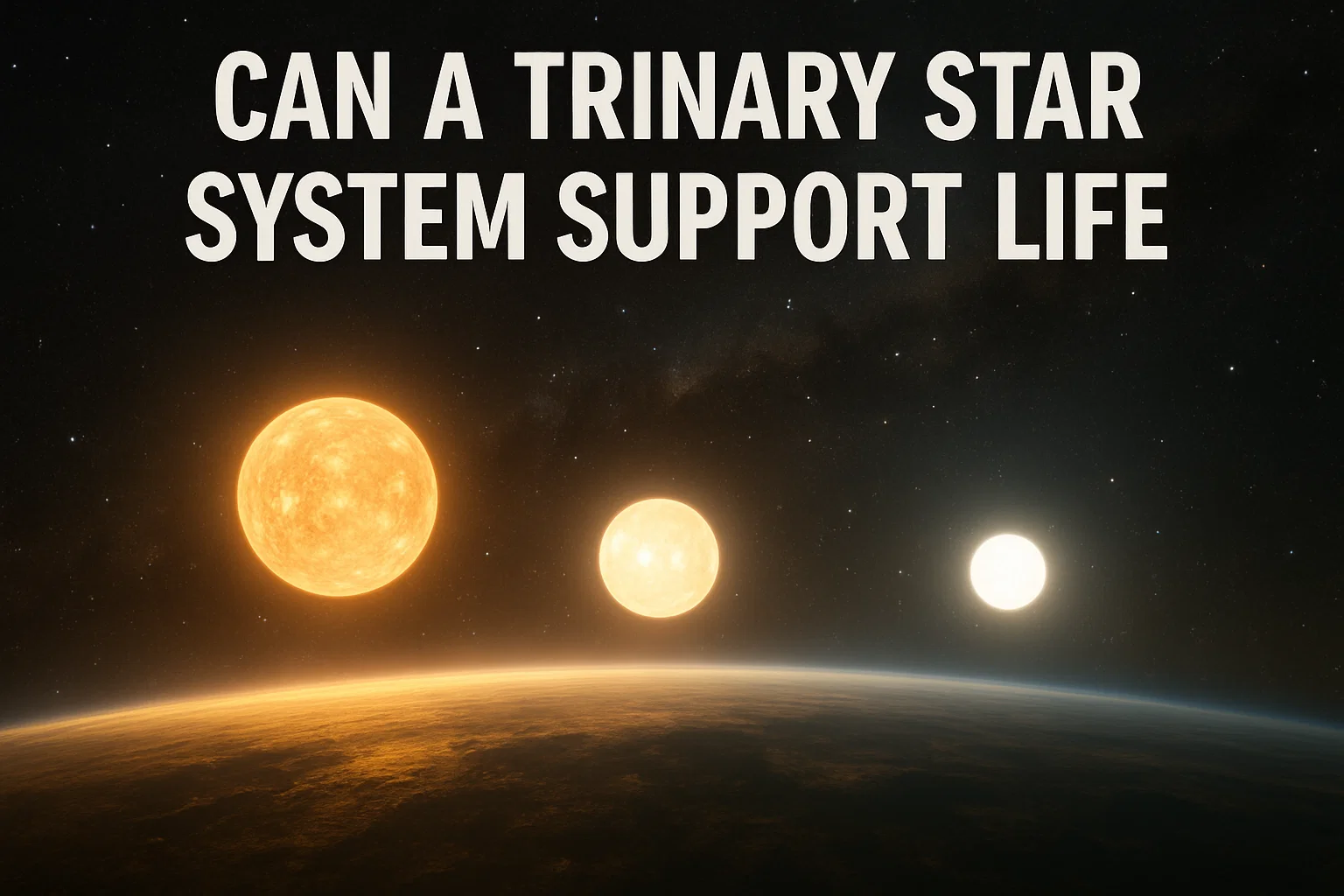
Most of us grew up watching Luke Skywalker stare wistfully at a twin sunset on Tatooine. It’s an iconic image. But frankly, science fiction writers usually take the easy way out. They give us the cool visuals without the orbital headaches. When I look at the night sky, I don’t just see pretty lights; I see gravity traps, radiation storms, and orbital chaos. So, when people ask me, can a trinary star system support life, I don’t give them a simple yes or no. The reality is messy, violent, and absolutely fascinating.
Here is the thing: our Sun is a bit of a loner. That makes us biased. We assume life needs a single, steady heat source to thrive. But the universe prefers company. A massive chunk of the stellar population hangs out in pairs or triplets. If we ignore these crowded systems, we are basically ignoring half the galaxy. I wanted to get to the bottom of this, so I dove into the orbital mechanics and atmospheric data to see if three suns spell doom, or if biology is stubborn enough to survive the madness.
More in Category:
What Happens If You Fall Into a Black Hole
Key Takeaways
- Hierarchy is non-negotiable: Chaos kills. Life only stands a chance if the stars follow a strict “hierarchical” arrangement—usually two tight partners with a distant third wheel.
- The Habitable Zone is a moving target: You don’t get a steady “summer” or “winter.” The Goldilocks zone warps and shifts, demanding that planets have thick, insulating atmospheres to survive.
- Red Dwarfs are bullies: Most trinary systems include Red Dwarfs, which are prone to violent temper tantrums (flares) that can strip a planet’s ozone layer overnight.
- We are watching Alpha Centauri: Our next-door neighbors live in a trinary system, and astronomers are hunting for biosignatures there right now.
Wait, How Common Are Three-Star Systems Anyway?
You might think three-star systems are rare freaks of nature. They aren’t. They are shockingly common. When huge clouds of gas collapse in space, they rarely make just one star. They shatter into fragments, birthing litters of stars. Astronomers estimate that somewhere around 10% to 15% of all star systems are triples. That sounds small until you realize we are talking about billions of potential worlds in the Milky Way alone.
But here is where the physics gets tricky. You rarely see three stars juggling each other in a chaotic, tight circle. That is a recipe for disaster. Gravity doesn’t like equality. If three stars of equal mass try to orbit each other closely, the system becomes unstable fast. One star usually gets kicked out of the club, flung into deep space.
Stable systems—the ones that stick around long enough for life to evolve—almost always settle into a hierarchy. You get a tight binary pair doing a rapid do-si-do in the center, and a third, lonely star orbiting them from way downtown. This setup, called a hierarchical triple, is the only way to keep gravity from tearing the whole family apart.
Does the Chaos of Gravity Make Planets Impossible?
I love the “Three-Body Problem” as a concept, but for a planet, it’s a death sentence. Gravity is a bully. In our solar system, things are calm. The Sun is the boss, and the planets fall in line. Throw two more stars into the mix, and the gravitational map looks like a turbulent ocean.
Yet, planets find pockets of calm. I’ve looked at the simulations, and stability usually comes in two flavors:
- The Satellite (S-Type) Orbit: The planet clings to one star. It effectively ignores the other two, treating them like distant, overly bright streetlights. The gravity of the primary star dominates, keeping the planet on a leash.
- The Planetary (P-Type) Orbit: This is the “circumbinary” style. The planet orbits the two central stars from far away. It doesn’t see two distinct suns; it feels the gravitational pull of a single, combined mass in the center.
If a planet tries to get cute and weave between the stars? Gone. Ejected from the system. But if it stays in its lane—either hugging one star tight or looping wide around the pair—the ground beneath your feet stays put. So, strictly speaking, gravity isn’t the dealbreaker. The real problem is the heat.
Where is the Goldilocks Zone When You Have Three Heat Sources?
This is where my optimism starts to waver. For life, you need liquid water. That means you need to be in the Habitable Zone. In our system, that zone is a nice, steady ring. In a trinary system, that zone moves.
Picture this: You are on a planet orbiting Star A. It’s a nice Tuesday. But then, Star B and Star C swing to their closest point in their orbit (periastron). Suddenly, you aren’t just getting heat from your main sun. You are getting blasted by the thermal output of two other stars. The temperature spikes. Your oceans might start to evaporate.
Then, the stars drift apart. The extra heat vanishes. The planet plunges into a deep freeze. This push-and-pull creates a “breathing” habitable zone. For a planet to survive this, it can’t be like Mars or Mercury. It needs a thick, heavy atmosphere. A dense atmosphere acts like a thermal battery, soaking up the heat when it’s intense and slowly releasing it when the stars retreat. Without that buffer, you’re looking at a world that flash-boils and flash-freezes every few years.
Could a Planet Survive the Radiation Bombardment?
Let’s talk about the stars themselves. In fiction, stars are usually yellow, like ours. In reality, the universe is infested with Red Dwarfs (M-dwarfs). These guys are small, dim, and incredibly long-lived. They are also violent.
Red Dwarfs are famous for stellar flares. We aren’t talking about the gentle aurora-causing flares we get here. We are talking about blasts thousands of times stronger. If your trinary system has a Red Dwarf component—and statistically, it probably does—any planet nearby is in the firing line.
I’ve seen models where a single flare from a Red Dwarf strips a planet’s entire atmosphere in a geological blink of an eye. No atmosphere means no pressure, which means no liquid water. Game over.
But there is a shield: a magnetosphere. If the planet spins fast and has a molten core, it generates a magnetic field. This invisible force field deflects the charged particles from the flare.
What Would Life Actually Look Like Under Three Suns?
Forget little green men. Evolution on a trinary world would produce something far stranger. The light quality would shift constantly.
If you have a system with a red star, a yellow star, and a blue star, the “color” of the day changes based on which star is in the sky. Photosynthesis on Earth is tuned to our specific yellow sun. On a trinary world, plants might be black. Why black? To absorb every scrap of light available across the entire spectrum. Or maybe they would use infrared light, appearing invisible to our eyes but glowing in thermal cameras.
Sleep patterns? Forget about it. You might have seasons where the suns never set, creating “eternal days” that last for human years. Animals wouldn’t rely on day/night cycles to sleep. They would evolve internal clocks based on exhaustion or temperature drops. Life there would be insomnia-driven and hyper-adaptable.
Is Alpha Centauri Our Best Bet for Finding Neighbors?
We don’t need to look at distant galaxies to test this. The Alpha Centauri system is right next door—just over 4 light-years away. It’s a textbook trinary system. You have Alpha Centauri A and B (the big, bright pair) and Proxima Centauri (the angry little red dwarf far out in the suburbs).
We know Proxima has a planet, Proxima b. It sits in the habitable zone. But Proxima is a flare star. It likely blasts that poor planet with radiation daily. The real hope lies with stars A and B. They are sun-like. They are calm.
Astronomers are obsessively pointing telescopes at A and B right now. If we find a rock circling those two, it would enjoy a relatively peaceful existence, with Proxima just appearing as a bright red dot in the night sky. The European Space Agency and others are digging into this data. Finding life there would change everything. It would mean the universe is teeming with life, even in the complicated neighborhoods.
Can a Trinary Star System Support Life if the Stars are Violent?
Timing is everything. Biology is slow. It took Earth billions of years to go from slime to dinosaurs. Massive stars (O and B types) live fast and die young. They burn through their fuel in a few million years and then explode as supernovae.
If you are a planet orbiting a massive blue giant in a trinary system, you are doomed. Your sun will go boom before you even grow legs. For life to stand a chance, the stars need to be boring. You want F, G, or K stars. These are the steady burners. They provide the one thing evolution needs more than anything else: time.
Do Tides Wreak Havoc on Surface Water?
We usually think of tides as the water rising and falling at the beach. But gravity pulls on rock, too. In a trinary system, the tidal forces can be immense. As the stars tug on the planet, they stretch and squash it like a stress ball.
This friction generates heat inside the planet’s core. It’s called tidal heating. It drives massive volcanic activity. While that sounds bad—nobody wants to live in a lava field—it might actually be a savior. Volcanoes pump out carbon dioxide. Carbon dioxide keeps the planet warm.
If a planet is drifting on the outer edge of the habitable zone, too far from the warmth of its suns, this internal heater could keep it alive. It keeps the core molten, which drives the magnetic field, which protects the atmosphere. It’s a beautiful, violent feedback loop.
How Does the “GW Orionis” Discovery Change Everything?
I have to mention GW Orionis. This system blew everyone’s minds recently. It’s a trinary system with a massive disk of dust and gas. But the gravity of the three stars has torn the disk apart, warping it and breaking it into misaligned rings.
Why do I care about dust rings? Because that is where planets are born. We used to think the chaotic gravity of three stars would stop planets from forming in the first place. GW Orionis proves us wrong. It shows that nature can build the foundation for planets even in a gravitational hurricane. If the planet can form, life has a stage to perform on.
Why Do Astronomers Remain Optimistic Despite the Odds?
You’d think with all the radiation, shifting orbits, and temperature swings, scientists would write these systems off. They haven’t. If anything, they are more excited than ever.
Why? Because life is stubborn. Look at Earth. We find life inside boiling acid vents, deep in the crushing dark of the ocean, and inside rocks in Antarctica. These “extremophiles” teach us that life doesn’t need paradise. It just needs a chance.
Simulations are getting better, too. We used to think stable orbits were one in a million. Now, with better computers, we are finding vast islands of stability within these complex systems. The math supports it. The biology supports it.
Conclusion
So, let’s circle back to the big question: can a trinary star system support life? The scientific answer is a gritty, qualified yes. It’s not easy. It requires a specific layout of stars, a tough-as-nails planet with a thick atmosphere, and a strong magnetic shield.
It isn’t the garden paradise of Earth. It’s a world of extremes, of triple shadows and shifting seasons. But nature seems to hate wasted space. With billions of trinary systems spinning out there in the dark, I’d bet good money that on one of them, something is looking up at three suns and wondering if they are the only ones out there.
FAQs – Can a Trinary Star System Support Life
How common are three-star systems in the universe?
Three-star systems are quite common, with estimates suggesting that around 10% to 15% of all star systems are triples, which amounts to billions of potential worlds in the Milky Way alone.
What factors make planets in a trinary system potentially stable and capable of supporting life?
Planet stability in a trinary system typically depends on orbital configurations: planets either orbit one star closely or circle the binary pair from afar, avoiding chaotic gravitational interactions that could eject them from the system.
How does the shifting habitable zone in a three-star system affect the potential for life?
The habitable zone in a trinary system is dynamic and moves with the stars’ orbits, requiring planets to have dense atmospheres to buffer temperature swings caused by the stars’ changing proximity.
What role does stellar activity, such as flares from Red Dwarfs, play in the possibility of life in three-star systems?
Flares from Red Dwarfs can strip planetary atmospheres and bombard planets with radiation, but planets with strong magnetic fields and thick atmospheres may withstand these effects, maintaining conditions suitable for life.