

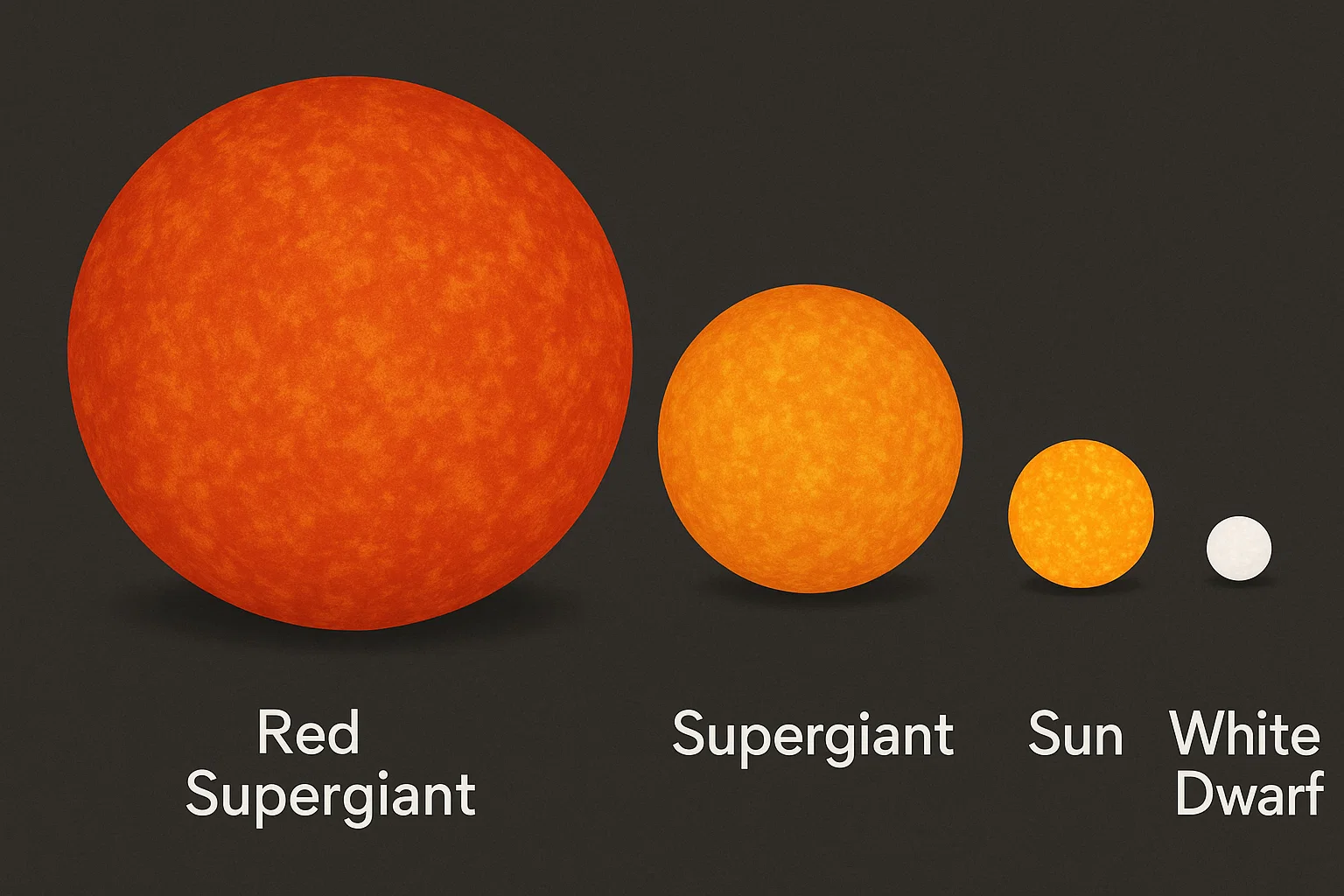
I remember the first time I actually grasped the scale of the universe. I was a kid, maybe ten years old, looking at a diagram in a library book. It showed the Sun as a tiny pea next to a basketball labeled “Betelgeuse.” That image stuck with me. It messed with my head. We walk around thinking our Sun is the ultimate power in the sky. It burns our skin from 93 million miles away. It holds the entire solar system together. But out there in the deep dark, there are monsters that make our Sun look like a spark from a dying campfire.
It forces you to ask the question, doesn’t it? If the Sun is small, just how big can supergiant stars get before physics steps in and says “enough”?
This isn’t just about numbers. It’s about trying to visualize the impossible. We are talking about objects so wide that light—the fastest thing in the universe—takes hours to cross them.
More in Celestial Objects Category
Difference Between Meteoroid Meteor Meteorite
What Is Left After a Supernova
Key Takeaways
- The Upper Limit: Physics suggests stars can’t get much larger than 2,500 times the radius of the Sun without ripping themselves apart.
- The Current King: A star named Stephenson 2-18 is the current record holder, dwarfing former champions like UY Scuti.
- Volume vs. Mass: These stars are massive in size (volume) but are actually very diffuse; their outer layers are thinner than a laboratory vacuum.
- The measurement problem: Measuring these beasts is a nightmare because they don’t have solid edges; they just fade into space.
- They are time bombs: The bigger they are, the faster they burn out and explode.
What Exactly is a Supergiant Star?
Let’s strip away the jargon. You hear terms like “red giant,” “hypergiant,” and “supergiant” thrown around. It gets confusing.
A supergiant is basically a star in its retirement phase, but it’s retiring with a bang, not a whimper. When a massive star burns through the hydrogen fuel in its core, the delicate balance between gravity (pulling in) and radiation (pushing out) breaks. The core collapses, gets hotter, and pushes the outer layers of the star outward.
And I mean way outward.
Think of it like a marshmallow in a microwave. It puffs up. It gets huge. But it’s not getting heavier; it’s just taking up more space. That’s a red supergiant. They are cool (relatively speaking), red, and incomprehensibly large. When we ask how big can supergiant stars get, we are essentially asking how much that cosmic marshmallow can expand before it pops.
How Does Our Sun Compare to the True Giants?
Comparison is the only way our brains can handle this. Raw numbers mean nothing. If I tell you a star has a radius of 1.5 billion kilometers, you’ll nod, but you won’t feel it.
Let’s try this.
Imagine you replace our Sun with the red supergiant Betelgeuse.
Mercury? Gone.
Venus? Vaporized.
Earth? swallowed whole.
Mars? Inside the star’s belly.
Betelgeuse would extend out past the asteroid belt and nearly touch Jupiter.
Now, take the current heavyweight champion, Stephenson 2-18. Drop that guy in the center of our solar system. It swallows Saturn.
Saturn is nearly a billion miles away from us. If you were flying a commercial jet at 550 mph around the equator of Stephenson 2-18, do you know how long the trip would take?
It would take you about 1,100 years.
You would die of old age forty times over before you finished one lap. That is the scale of the monsters we are dealing with.
Who Are the Reigning Heavyweights of the Galaxy?
The leaderboard for “biggest star” is messy. It changes all the time. Why? Because measuring a glowing ball of gas thousands of light-years away through a cloud of dust is incredibly hard.
Whatever Happened to UY Scuti?
For years, UY Scuti was the answer everyone gave. You’d see it in YouTube videos and science articles everywhere. Astronomers pegged it at around 1,700 times the radius of the Sun.
But science is ruthless. New data came in. It turns out, UY Scuti is closer to Earth than we originally thought. In astronomy, if a light is brighter than expected but closer, it means the object is smaller. The current estimates have downgraded UY Scuti significantly. It’s still a beast, but it’s likely not the king anymore.
Is Stephenson 2-18 the New Boss?
Right now, the title belt belongs to a star called Stephenson 2-18. It hangs out in a massive star cluster about 20,000 light-years away in the constellation Scutum.
The data puts it at roughly 2,150 solar radii. That is a volume 10 billion times greater than the Sun.
I love this star because it shouldn’t exist. It sits right on the edge of stellar theory. It is so large and so cool that it challenges our models of how stars evolve. It’s possible we are misinterpreting the data, or maybe Stephenson 2-18 is just a freak of nature.
Don’t Forget VY Canis Majoris
I have a soft spot for VY Canis Majoris. Back in the 2000s, this was the “biggest star” everyone talked about. It’s a Hypergiant. It looks like it’s exploding in slow motion. It throws off so much gas that it’s shrouded in its own nebula. It’s smaller than Stephenson 2-18, maybe around 1,420 solar radii, but it is one of the most violent and unstable objects we have ever found.
Why Can’t Stars Just Keep Growing Forever?
There has to be a limit, right? A star can’t just grow until it eats the galaxy.
Two main “cosmic police officers” stop stars from growing infinitely.
Can the Eddington Limit Be Beaten?
The first cop is the Eddington Limit. This is a battle between light and gravity.
Inside a star, fusion creates light (photons). These photons push outward. Gravity pulls inward. Usually, they agree to a truce. But if a star gets too massive and too bright, the light pushes so hard it literally blows the outer layers of the star into space.
If a star tries to get too big, it effectively strips itself naked. It sheds mass until it stabilizes. It’s a self-correcting problem.
What Is the Hayashi Track?
The second cop is the Hayashi Limit. This is a theoretical line on the the Hertzsprung-Russell diagram (the map of stellar life). It basically says there is a maximum radius for a star of a certain mass.
If a star tries to expand past this line, it can’t maintain its temperature. It becomes unstable. It cools down too much and gravity takes over, forcing it to shrink back down.
Why Is It So Hard to Measure These Things?
You might be wondering, “Why don’t we just take a picture and measure it?”
I wish it were that simple.
Here is the problem: Supergiants don’t have a surface.
When you look at the Sun, you see a sharp edge. That’s the photosphere. But red supergiants are different. Their outer layers are incredibly thin. We are talking about a density lower than the best vacuum chamber we can build on Earth.
Where does the star end and the vacuum of space begin? It’s a gradient. It’s like trying to measure the diameter of a puff of smoke. Depending on what wavelength of light you look at (infrared, radio, visible), you get a different size.
Plus, there is dust. Lots of it. These stars live in dirty neighborhoods. Dust blocks light and makes the star look dimmer or redder than it actually is. This messes up our calculations. A lot of the “record-breaking” stars turn out to be smaller once we get better telescopes that can peer through the dust.
What About the Blue Supergiants?
We’ve focused on the red ones because they are the widest. But Blue Supergiants deserve some respect.
Take Rigel in Orion. It’s a blue supergiant. It is far hotter and more energetic than Betelgeuse. But because it is so hot, it is more compact. Gravity holds it together tighter.
Blue stars are the sports cars of the galaxy: sleek, fast, and powerful. Red supergiants are the monster trucks: huge, lumbering, and taking up three lanes of traffic.
If you want mass (weight), blue stars often win. If you want size (radius), red is the only way to go.
How Do These Giants Meet Their End?
This is the tragic part of the story. Or the beautiful part, depending on how you look at it.
The price of being a supergiant is a short life. Our Sun will live for 10 billion years. A star like Stephenson 2-18 might only live a few million years. They burn the candle at both ends and in the middle.
Eventually, the core runs out of fuel. It tries to fuse iron. This is the kiss of death. You can’t get energy from fusing iron. The engine stalls.
Gravity, which has been waiting patiently for millions of years, wins instantly. The core collapses in a fraction of a second. The outer layers crash inward, bounce off the core, and… BOOM.
Supernova.
The explosion is so bright it can outshine the entire galaxy where the star lived.
Could There Be Something Bigger Out There?
Are we done? Is Stephenson 2-18 the limit?
I doubt it. The Milky Way has over 100 billion stars. We haven’t looked at all of them. And that’s just one galaxy. There are billions of other galaxies.
However, there is a theoretical concept called a “Quasi-star.”
These are hypothetical monsters from the very early universe. We’ve never seen one, but the math says they could have existed. These things would have formed around a black hole core.
If they existed, they could have been 7,000 times the size of the Sun. That’s a solar system-sized star. But they are likely all gone, dead for billions of years. For now, in the modern universe, the limit seems to be around that 2,000 to 2,500 solar radii mark.
For a deeper dive into the lifecycle that creates these monsters, check out this detailed guide on stellar evolution.
Why Should We Care About Big Stars?
It’s easy to dismiss this as just trivia. Who cares if a star is 1,000 or 2,000 times bigger than the Sun?
You should care. Because you are made of them.
I’m serious. The calcium in your teeth? The iron in your blood? The oxygen filling your lungs right now? The Big Bang didn’t make those.
Supergiant stars made them.
These stars are the cosmic forges. They spend their lives crushing atoms together to make heavy elements. Then, they explode and scatter that stuff across the universe. That dust forms new stars, new planets, and eventually, people.
Without these massive, unstable, terrifying giants, the universe would just be a boring soup of hydrogen and helium. We wouldn’t exist.
The Future of the Hunt
We are living in a golden age for this stuff. We have the James Webb Space Telescope up there right now. It looks at the universe in infrared light.
Remember how I said dust hides the true size of stars? Infrared cuts through dust like a knife.
In the next few years, JWST and the upcoming Extremely Large Telescope (yes, that’s the real name) on the ground in Chile are going to rewrite the textbooks. We might find that Stephenson 2-18 is actually smaller than we thought. Or we might find a new monster lurking behind a nebula that shatters all our records.
Conclusion: A Matter of Perspective
So, to answer the question: how big can supergiant stars get?
The answer is big enough to swallow the solar system. Big enough to make the Sun look like a grain of sand. Big enough to defy our imagination.
But the numbers don’t matter as much as the feeling they give you.
I walk outside at night and look at the red dot of Betelgeuse in Orion’s shoulder. I know it’s dying. I know it’s swelling up. I know that one day, maybe tomorrow or maybe in 100,000 years, it will explode and light up our daytime sky.
It’s a reminder that the universe is alive. It’s violent, it’s creative, and it is incredibly large. We are just tiny spectators watching the fireworks. And honestly? I’m okay with that. It makes looking up a lot more interesting.
FAQ – How Big Can Supergiant Stars Get
What is the maximum size a supergiant star can reach before physics prevents further growth?
Physics suggests that stars cannot get much larger than approximately 2,500 times the radius of the Sun without tearing themselves apart.
Which star currently holds the record for the largest known supergiant?
Stephenson 2-18 is the current record holder for the largest known supergiant star, with a radius roughly 2,150 times that of the Sun.
Why are measurements of supergiant stars so challenging?
Measuring supergiant stars is difficult because they lack a solid surface, have outer layers that fade into space, and are surrounded by dust that interferes with observations, making their true size hard to determine.
Do supergiants just keep growing forever?
No, stars are limited by phenomena such as the Eddington Limit and the Hayashi Limit, which prevent them from growing indefinitely by either shedding mass or becoming unstable.
Why are large stars important for the universe and our existence?
Large stars are essential because they forge heavy elements like calcium, iron, and oxygen that make up our bodies, and their explosions distribute these elements across space to form new stars and planets, including Earth.