

You look up on a clear night, and the sky looks peaceful. It feels permanent. That unchanging tapestry of light has guided sailors and inspired poets for millennia. But that stillness is a lie. The universe is actually a violent, chaotic engine, and the stars above us are burning through fuel at a rate that defies human comprehension. They are living things, in a sense. They are born, they fight for survival, and eventually, they die.
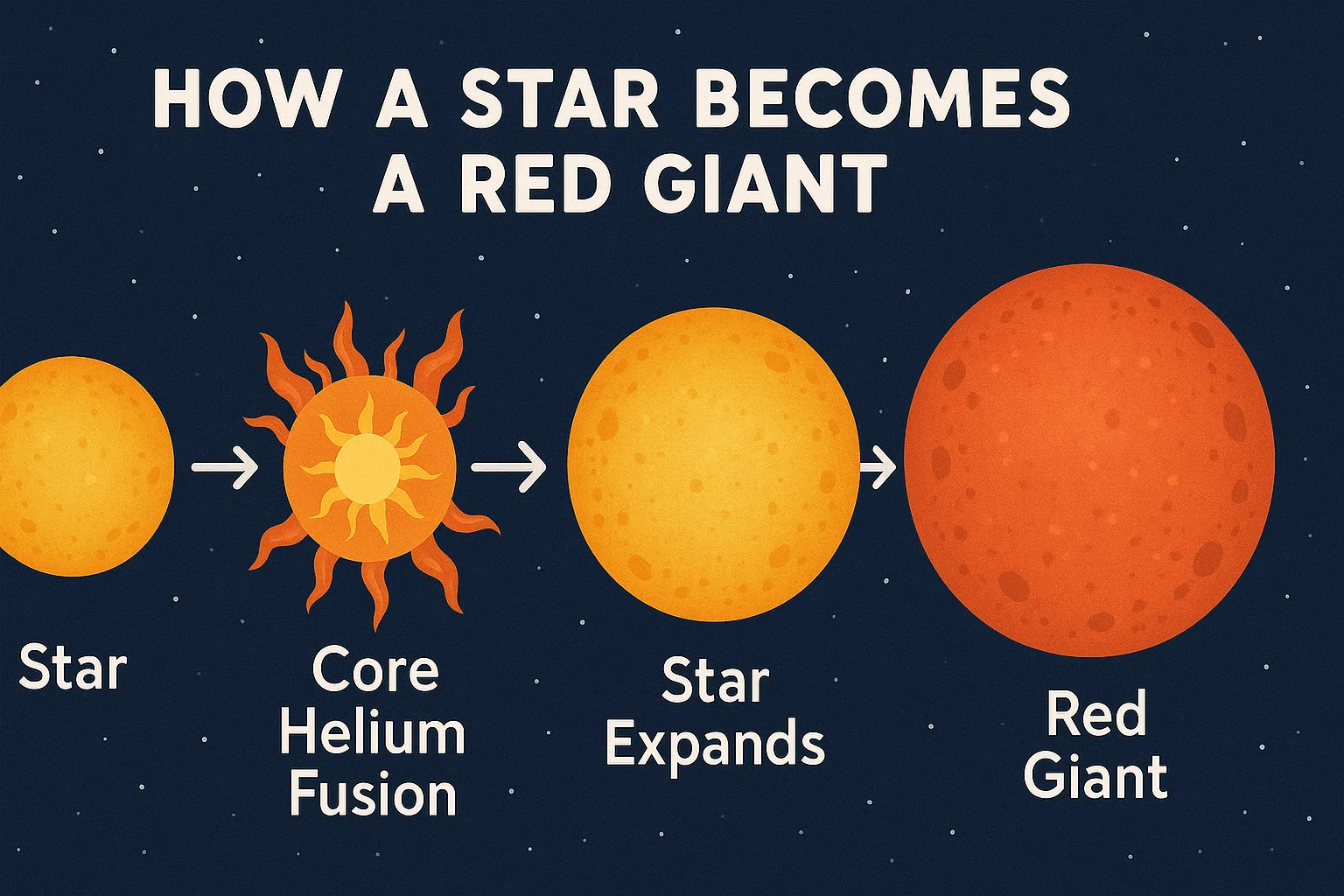
One of the most dramatic deaths belongs to stars like our own sun. They don’t just fade to black immediately. They swell up. They turn angry and red. They consume their neighbors. This is the red giant phase. It is a destiny written in the laws of nuclear physics. But how does a star become a red giant? It isn’t a simple switch that flips. It is a complex, step-by-step breakdown of the forces that hold a star together.
I’ve always found this process terrifying and beautiful in equal measure. It shows us exactly what our solar system’s future looks like. Let’s strip away the dense academic textbook language and walk through this stellar metamorphosis.
More in Celestial Objects Category
Difference Between Gas Giant and Star
Difference Between Asterism and Constellation
Key Takeaways
- The Fuel Crisis: A star only turns into a red giant when it runs out of hydrogen in its core.
- The Paradox: The core shrinks and gets hotter, but the outside expands and gets cooler.
- Shell Burning: Fresh fusion ignites in a shell around the core, driving the massive expansion.
- The Color Shift: The surface expands so much that it cools down, shifting the light spectrum to red.
- Our Destiny: The Sun will enter this phase in about 5 billion years, likely engulfing the inner planets.
What Keeps a Star Alive Before the End Begins?
To understand the death, you have to understand the life. A star is essentially a massive, continuous explosion held in place by its own weight. Right now, our Sun is in the prime of its life. Astronomers call this the “Main Sequence.”
Think of it as a wrestling match that lasts for billions of years. In the red corner, you have Gravity. Gravity wants to crush the star. It pulls every atom toward the center with incredible force. In the blue corner, you have Fusion. Deep in the core, hydrogen atoms smash together to create helium. This releases pure energy. That energy pushes outward.
For most of a star’s life, these two forces cancel each other out. Gravity pulls in; fusion pushes out. They lock into a stalemate called hydrostatic equilibrium. The star stays a consistent size. It shines steadily. It supports life on planets like ours. But this balance relies entirely on fuel. The star needs hydrogen to keep the fusion engine running. And just like a gas tank in a car, that fuel is finite.
When Does the Hydrogen Finally Run Out?
Stars are gluttons. They consume millions of tons of hydrogen every second. For a star the size of our Sun, this binge-eating phase lasts roughly 10 billion years. It sounds like an eternity, but the clock never stops ticking.
Eventually, the core converts all its hydrogen into helium. The party ends. The fusion engine sputters and dies. This is the trigger point. This is the moment the balance breaks.
Without the outward pressure of fusion to hold it back, gravity instantly takes the upper hand. It wins the wrestling match. The core, now just a ball of inert helium ash, begins to collapse under its own weight. This collapse is the first step in the answer to how does a star become a red giant. It seems counterintuitive, but the star has to shrink on the inside to grow on the outside.
Why Does a Shrinking Core Cause Expansion?
This part always trips people up. How does a collapse lead to a giant star? It comes down to heat.
When gravity crushes that helium core, it squeezes it tight. Basic thermodynamics tells us that when you compress a gas, it heats up. The core might not have fusion anymore, but it has gravitational friction. It gets hot. Really hot.
This intense heat radiates outward from the center. It hits the layers of gas sitting just outside the core. These layers still contain plenty of fresh, unburnt hydrogen. The extreme heat from the collapsing core ignites this hydrogen.
We call this Hydrogen Shell Burning.
The fusion in this shell is wild. It burns much faster and more furiously than the core fusion ever did. It produces a torrent of energy. This new surge of power blasts outward toward the surface. It hits the outer layers of the star with overwhelming force. Gravity can no longer hold the surface down. The atmosphere of the star billows outward.
How Big Does the Star Actually Get?
The expansion is not subtle. It is catastrophic. The star swells to monstrous proportions.
If you put a red giant in the center of our solar system today, it wouldn’t just fill the sky. It would swallow Mercury. Then it would swallow Venus. It would grow to nearly 100 times its original size.
Imagine inflating a beach ball until it fills a stadium. That is the scale we are talking about. The star becomes tenuous and “puffier.” The gas at the surface is so far away from the center that the gravity holding it there becomes incredibly weak. The star starts to lose its grip on its own shape.
Why Does the Color Shift to Red?
So the star is bigger, and it’s producing more energy from that aggressive shell burning. Why does it look red? In our minds, red usually means “hot” and blue means “cold.” But in astrophysics, the opposite is true. Blue stars are the hottest; red stars are the coolest.
Here is the physics of it: The star is pumping out more total energy, yes. But it has also increased its surface area by a massive amount. That energy has to spread out over a gigantic skin.
Think of it like spreading a small jar of jam over a giant loaf of bread. The layer gets very thin. The heat spreads out so much that the temperature at the surface drops. Our Sun’s surface is currently about 5,500 degrees Celsius (yellow-white). When it becomes a red giant, that surface temperature will plummet to about 3,000 degrees.
Cooler stars emit light at longer wavelengths. Longer wavelengths register to the human eye as red or orange. So, you have a giant, bright star that is actually cool to the touch—relatively speaking.
What Is the Helium Flash?
While the outside of the star is expanding and cooling, the inside is doing something terrifying. The core is still collapsing. It is getting denser and hotter by the second.
For stars like the Sun, the core eventually becomes “degenerate.” This is a strange quantum state where the electrons are packed so tightly they refuse to move. In this state, the core stops behaving like a normal gas. Normally, if you heat a gas, it expands. But degenerate matter doesn’t expand. It just gets hotter.
The temperature climbs to 100 million degrees. Suddenly, the helium atoms ignite. They fuse into carbon.
Because the core can’t expand to release the pressure, this ignition becomes a runaway nuclear explosion. Astronomers call this the Helium Flash. In a matter of minutes, the core releases as much energy as an entire galaxy.
But here is the kicker: You wouldn’t see it from the outside. All that energy is absorbed by the star’s layers. It lifts the degeneracy, the core expands, and the star settles down for a brief period of stability, burning helium.
Does This Happen to Every Star?
No. The universe loves variety. The process I am describing applies to low and intermediate-mass stars (from about 0.3 to 8 times the mass of the Sun).
- Red Dwarfs: These tiny stars sip their fuel so slowly that the universe isn’t old enough for any of them to have died yet. They won’t become red giants; they will likely just fizzle out.
- Massive Stars: The heavyweights (10+ times the mass of the Sun) don’t stop at red giant. They become Red Supergiants. They burn fuel until they create iron, and then they detonate in a Supernova.
The red giant path is the “middle class” stellar death. It is the fate of the average star.
Will the Solar Wind Destroy Earth?
As the star expands, its gravity at the surface drops. It begins to shed mass. We call this a stellar wind, but that’s a gentle name for a violent process. The star literally blows its own atmosphere into deep space.
This mass loss changes the gravity of the solar system. As the Sun loses weight, the planets drift outward. Their orbits widen.
This leads to the great debate about Earth. We know Mercury and Venus are doomed. They will be vaporized. But Earth sits right on the edge. Some models say the Sun will lose enough mass that Earth will drift to a safer orbit, escaping the flames. Other models say tidal forces will drag our planet inward, plunging it into the fiery atmosphere.
Even if the planet survives physically, life will not. The oceans will boil away long before the Sun reaches its maximum size. The atmosphere will strip away. Earth will be a cinder, a burnt piece of charcoal orbiting a dying ember.
Where Do the Elements of Life Come From?
There is a silver lining to this destruction. The red giant phase is essential for our existence.
When the star is shedding its outer layers, it isn’t just blowing out hydrogen. It is blowing out carbon, oxygen, and nitrogen. These are elements the star forged during its life. Convection currents—massive elevators of hot gas—dredge these heavy elements up from the core and dump them on the surface.
The stellar wind carries this dust into the galaxy. It mixes with interstellar clouds. Eventually, that dust collapses to form new stars, new planets, and living things. The carbon in your DNA? It likely came from a star that went through this exact red giant process billions of years ago. We are the afterlife of ancient stars.
What Remains After the Giant Dies?
The red giant phase doesn’t last forever. Eventually, the helium runs out too. The star tries to burn carbon, but it isn’t heavy enough to generate the heat required. The engine stalls for the last time.
The star shudders. It pulses. With a final heave, it ejects its outer layers completely. These layers drift away to form a Planetary Nebula—beautiful, glowing rings of gas that light up the dark.
What’s left behind? The naked core. It is a small, incredibly dense ball of carbon and oxygen about the size of Earth. We call this a White Dwarf. It produces no new energy. It just sits there, slowly cooling off over trillions of years. It is the ghost of the star that once was.
How Do Astronomers Know This Is True?
You might ask, “Nobody lives for billions of years, so how do we know this happens?”
It’s a fair question. We use a tool called the Hertzsprung-Russell (H-R) Diagram. Imagine you took a photo of a crowded city. You would see babies, teenagers, adults, and elderly people. You don’t need to watch one person grow up to understand the human life cycle. You can infer it by looking at the population.
That is what we do with stars. We look at clusters. We see stars on the Main Sequence. We see stars branching off into the Red Giant phase. We see White Dwarfs. When we run computer simulations using nuclear physics, the math matches the observations perfectly. The story checks out.
Can Anything Stop the Expansion?
If we look far into the future, could a civilization stop their sun from turning into a red giant? Theoretically, maybe. You would need to remove the helium ash from the core and replenish the hydrogen supply.
But this is engineering on a god-like scale. You would need to dismantle the star and put it back together. For all intents and purposes, the process is inevitable. Gravity always wins in the end. It waits patiently for the fuel to run out, and then it makes its move.
How Does Being in a Binary System Change Things?
Everything I just told you assumes the star is alone. But plenty of stars come in pairs. If a star has a nearby partner, the red giant phase gets messy.
As the star swells up, it can dump gas onto its neighbor. It can swallow its neighbor. Sometimes, the neighbor sucks the outer layers off the red giant before it even finishes expanding. These “vampire stars” change the evolution completely, leading to exotic explosions like Type Ia supernovae. It’s a chaotic dance, and it makes the question of “how does a star become a red giant” much more complicated for binary systems.
The Final Transformation
The transition to a red giant is the beginning of the end, but it is also a moment of creation. It is the mechanism the universe uses to recycle. It turns simple gas into complex dust.
When you see an orange-tinted star in the sky, like Aldebaran in the constellation Taurus, give it a nod. You are looking at a star in the fight of its life. It is swelling, churning, and dying. It is following the same path our Sun will walk. It is a reminder that nothing in the cosmos is static. We live in a universe of constant, violent, glorious change.
FAQ – How Does a Star Become a Red Giant
What is the initial phase that keeps a star alive before it becomes a red giant?
A star remains in the main sequence phase, where nuclear fusion in its core balances the force of gravity, until the hydrogen fuel is exhausted.
How does a star’s core change during its transition to a red giant?
The core shrinks and heats up as it runs out of hydrogen, causing it to collapse and increase in temperature, which then ignites hydrogen in a shell around the core.
Why does a star expand so dramatically into a red giant despite the core shrinking?
The collapse of the core heats the surrounding hydrogen shell, causing it to burn rapidly and produce massive outward pressure, which makes the star expand significantly.
What causes the surface of a star to turn red as it becomes a red giant?
As the star expands, its surface cools down to about 3,000 degrees Celsius, leading to emission of longer wavelengths of light that appear red to the human eye.
What is the Helium Flash and why does it happen?
The Helium Flash occurs when the core’s temperature reaches about 100 million degrees and helium ignites suddenly in a runaway nuclear explosion, especially in degenerate cores of stars like the Sun.