
When a truly massive star decides to die, it doesn’t just flicker out. It refuses to go quietly. Instead, it rages against the dying of the light with a cosmic explosion so violent it can briefly outshine its entire home galaxy.
This is a supernova. It’s the universe’s ultimate fireworks show.
But the explosion, as spectacular as it is, is just the death rattle. The grand finale. The real question, the one that points us toward the most bizarre and terrifying objects in the entire cosmos, is what is left after a supernova?
When the smoke clears, what remains at the heart of that celestial graveyard?
It’s not an empty void. It’s not a peaceful retirement. Instead, the star’s death leaves behind its own corpse: a single, hyper-condensed object. This stellar remnant is the star’s former core, a thing that has been crushed by its own gravity into a state of density that breaks all the rules.
Depending on just how big that original star was, this remnant will become one of two things: a neutron star or a black hole.
This article is our journey into that aftermath. We’re going to explore the stunning, violent physics that decides a star’s final fate.
More in Celestial Objects Category
Why Are Neutron Stars So Dense
Key Takeaways
- A supernova is the catastrophic, explosive death of a massive star. This collapse is triggered when the star’s core runs out of nuclear fuel.
- What is left after a supernova is the star’s collapsed core, which becomes either a neutron star or a black hole.
- The deciding factor is the original star’s mass. The more massive the star, the more extreme its remnant.
- Stars that start out with about 8 to 20 times the Sun’s mass will typically leave behind a neutron star.
- Truly massive stars, those over 20-25 times the Sun’s mass, will collapse completely, forming a black hole.
- Our own Sun, thankfully, is not massive enough to go supernova. It will end its life as a much quieter white dwarf.
So, What Exactly Triggers a Star to Explode?
To understand the corpse, we first have to understand the death.
A massive star—and we’re talking a real heavyweight, at least eight times the mass of our Sun—spends its entire life in a high-stakes balancing act. For millions, or even billions, of years, two colossal forces are locked in a perfect cosmic stalemate.
On one side, you have gravity. The star’s own immense mass is constantly, relentlessly trying to pull everything inward. It wants to crush the star down to a single point.
On the other side, you have the nuclear furnace at its core.
The star’s core is a fusion engine. It’s a factory that spends its life smashing lighter elements together to create heavier ones. This process, nuclear fusion, releases an enormous amount of energy in the form of light and heat. This outward-pushing energy, called radiation pressure, is the only thing fighting gravity. It shoves back against the inward crush, holding the star up.
This is a star’s life. Gravity pulls in. Fusion pushes out. A perfect, stable balance.
For a while.
Isn’t a Supernova Just a Star ‘Dying’?
“Dying” is the right word, but it’s a very specific, layered kind of death. The star’s fusion process isn’t simple. It doesn’t just burn hydrogen its whole life. It burns through its fuel in stages, from lightest to heaviest.
It starts by fusing the most basic element, hydrogen, into helium. This is what our Sun is doing right now. This stage can last for billions of years.
But eventually, the hydrogen in the core runs low. Gravity starts to win. The core squeezes. This squeeze, however, increases the temperature and pressure until it gets hot enough to ignite the next reaction: fusing helium into carbon.
This process continues, creating a series of shells inside the star, like a cosmic onion.
As the star ages, it builds up layers. A core of one element ignites, creates a new, heavier element, and then that new element becomes the fuel for the next stage.
- Hydrogen fuses into Helium.
- Helium fuses into Carbon.
- Carbon fuses into Neon.
- Neon fuses into Oxygen.
- Oxygen fuses into Silicon.
- Finally, Silicon fuses into Iron.
And iron… iron is the end of the line. It’s the final stop. Iron is ash.
For all the previous stages, the fusion process released energy. It created the outward pressure that fought gravity. But fusing iron is different. Fusing iron doesn’t release energy.
It consumes it.
The star’s core, which has been its engine for its entire life, suddenly and catastrophically becomes an energy sink. The furnace goes out.
The balance is broken. Instantly.
What Happens in the Star’s Final Seconds?
What happens next is almost unimaginably fast. It is the most violent event in the universe.
With the outward pressure gone, gravity wins. And it wins decisively.
The star’s core, which might be the size of Earth but holding more mass than our entire Sun, has nothing left to support it. It collapses in on itself. This isn’t a slow crush; it’s a catastrophic implosion. The core free-falls, collapsing at a staggering 15% to 25% the speed of light.
In less than a second, a region the size of a planet is crushed down to the size of a city.
This implosion is so violent that the very structure of matter is destroyed. The pressure becomes so extreme that atoms, the building blocks of you and me and everything, are obliterated. Protons and electrons, which normally exist as separate particles, are physically jammed together to form neutrons.
This process, called electron capture, releases a truly biblical flood of tiny, ghost-like particles called neutrinos.
The core, now made almost entirely of neutrons and packed as tightly as physically possible, suddenly stops collapsing. It becomes rigid. It’s like the universe just hit a solid wall. This new, super-dense object is the infant neutron star.
Now, picture the rest of the star. The star’s outer layers, all those massive onion shells of hydrogen, helium, and carbon, were also in free-fall. They were chasing the collapsing core.
And they slam into this new, unyielding neutron core.
They “bounce.”
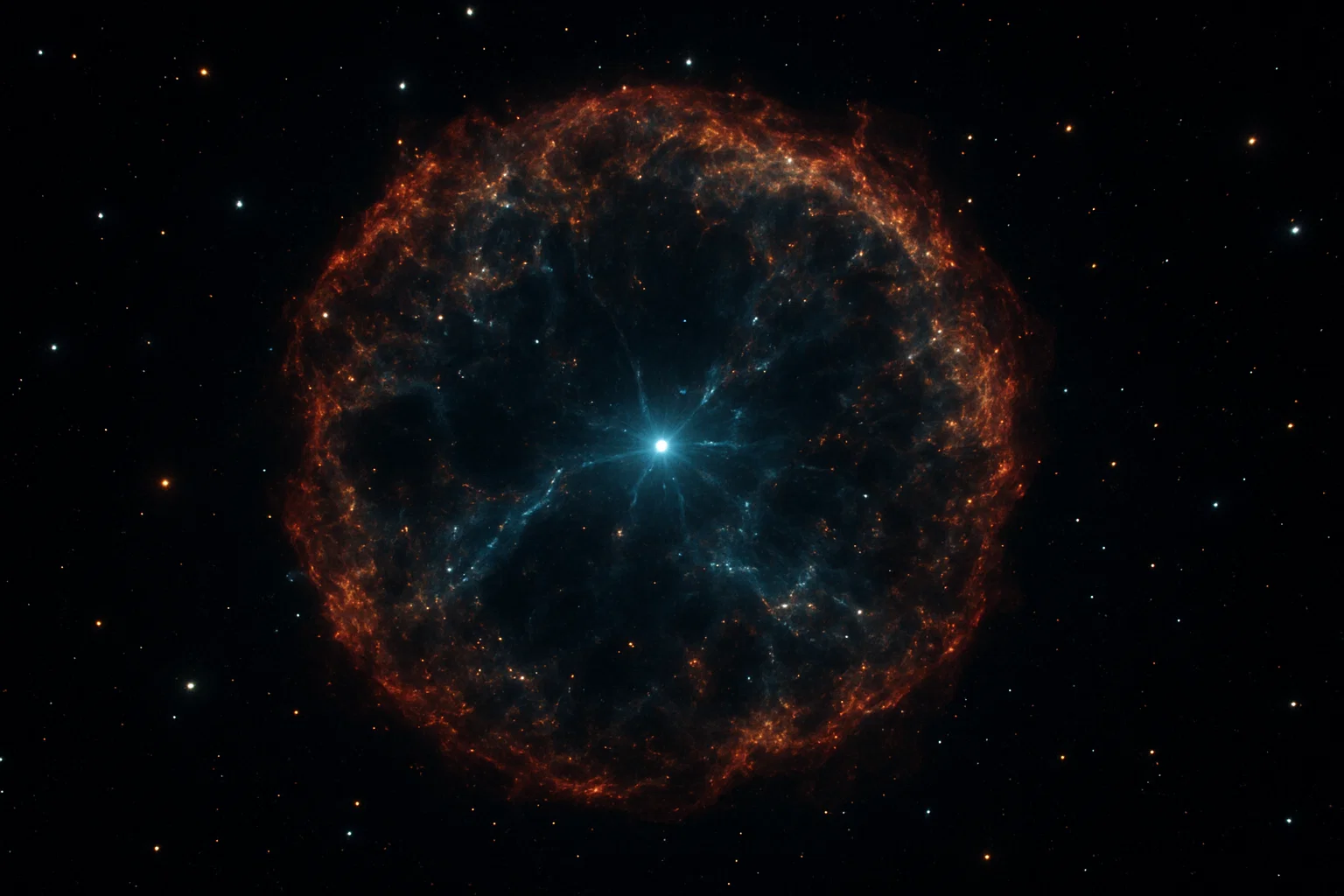
This colossal rebound, supercharged by that blast of neutrinos pushing outward, is what we see as the supernova. The outer 99% of the star is violently blown away, rocketing into interstellar space at high speed. This is the explosion.
But our question is about what’s left behind. At the center of that expanding, chaotic fireball, the battle-scarred, collapsed core remains.
Why Doesn’t Every Supernova Leave the Same Thing Behind?
This brings us to the crucial point. The explosion is the event, but the remnant is the legacy. And that legacy is determined by one single, simple factor: mass.
It’s all about how massive the original star was.
This is the great dividing line in astrophysics. The mass of the progenitor star—the star that blew up—dictates everything. It determines how it lives its life, how it dies, and what cosmic corpse it leaves behind. When astronomers try to figure out, the first and most important question they ask is, “How big was the star that blew up?”
Is It All About the Star’s Original Weight?
Yes. Precisely. We measure star masses in “solar masses,” where one solar mass (or 1 M☉) is the mass of our Sun.
As we’ve established, a star needs to start with about 8 solar masses of fuel to even trigger a supernova. But the events after the supernova are decided by how much mass is left in the core.
There is a “magic number” in physics, a speed limit for just how massive a neutron star can be. It’s called the Tolman-Oppenheimer-Volkoff (TOV) limit. We’re still refining the exact number, but it’s somewhere between 2 and 3 solar masses.
This is not the star’s original mass, but the mass of the core it leaves behind.
- If the leftover core’s mass is below this limit, it will stabilize. It will become a neutron star.
- If the leftover core’s mass is above this limit, it will… not.
What If the Star Isn’t Too Massive? (Path 1: The Neutron Star)
Let’s take the first path. A star starts its life with, say, 10 or 15 times the mass of our Sun. It lives, it burns through its fuel, and the core collapses. It goes supernova.
The explosion blasts most of the star’s mass into space, but it leaves behind a collapsed core of about 1.4 solar masses. This is comfortably below the TOV limit.
Gravity has crushed the core. Protons and electrons have merged to form neutrons. The core stabilizes, but it’s not held up by fusion anymore. It’s held up by a quantum-mechanical law called “neutron degeneracy pressure.” This is a fancy way of saying the neutrons are packed so tightly that they are physically touching. They cannot be packed any tighter. They are pushing back against gravity, establishing a new, permanent, and very, very strange equilibrium.
Welcome to the Neutron Star: The Universe’s Ultimate-Density Object
This is what’s left. A neutron star.
These objects are the definition of extreme. Imagine taking our entire Sun, with its 1.4-million-kilometer diameter, and crushing it. And crushing it. And crushing it. Until it fits into a ball roughly 20 kilometers (12 miles) across.
It’s the mass of a star in the volume of a city.
The density is staggering. A single teaspoon of neutron star material would weigh about 10 million tons on Earth. The gravity on its surface is so strong that if you dropped a marshmallow from one meter high, it would hit the surface with the force of an atomic bomb.
They are also bizarre. They spin incredibly fast. This is a rule of physics called “conservation of angular momentum”—think of an ice skater pulling their arms in to spin faster. The original star might have rotated once every few weeks, but this new tiny remnant can spin hundreds of times per second.
They also inherit the star’s magnetic field, concentrating it into a force trillions of times stronger than Earth’s. Some become magnetars, objects so magnetic they could wipe a credit card clean from the distance of the Moon.
Have We Actually Seen These Things?
Oh, yes. We have. We “see” them in a very specific way.
These rapidly spinning, highly magnetic neutron stars act like cosmic lighthouses. They shoot out intense beams of radiation (like radio waves) from their magnetic poles. These beams are not necessarily aligned with the star’s spin axis.
As the neutron star spins, its beams of radiation sweep across the cosmos. If one of these beams happens to sweep across Earth, our radio telescopes pick up a regular, repeating “pulse” of energy. Pulse… pulse… pulse…
For this reason, we call these objects Pulsars.
When pulsars were first discovered in 1967 by Jocelyn Bell Burnell, the signal was so regular, so clock-like, that the team half-jokingly labeled it “LGM-1.”
It stood for “Little Green Men.” They thought it might be an alien beacon.
The truth was, in some ways, even stranger. It was the pulse of a star’s hyper-dense corpse, a cosmic lighthouse left behind by a supernova.
What Happens When the Star is a True Behemoth? (Path 2: The Black Hole)
Now we take the second path. What if the original star was a true monster, weighing in at 25, 30, or 50 times the mass of our Sun?
The same process begins. The star lives. It burns through its fuel. It forms an iron core. The furnace goes out. The core collapses.
But this time, the core itself is just too massive.
The star goes supernova, just like before. But the core it leaves behind is heavier than the Tolman-Oppenheimer-Volkoff limit. It might be 3, 4, or 5 solar masses.
At this point, gravity is simply too powerful. The inward crush is overwhelming. Even neutron degeneracy pressure—that “un-squishable” wall of neutrons—isn’t strong enough. It fails.
When Gravity Wins… Absolutely
The neutrons are crushed. The core collapses.
And it never stops.
There is no “bounce.” There is no new equilibrium. Gravity wins, absolutely and completely. The core continues to collapse, shrinking past the size of a city, past the size of a marble, past any size, down to an infinitely small, infinitely dense point.
This is a singularity.
The star has collapsed in on itself so violently that it has effectively broken the fabric of reality at its center.
What Is a Black Hole, Really?
A black hole is not a “thing” in the way a neutron star is. You can’t land on it. It’s a region of spacetime. It’s a place.
Around the central singularity, there is an invisible boundary called the “event horizon.” This isn’t a physical surface; it’s a theoretical line, the “point of no return.” It is the distance from the singularity where the force of gravity is so strong that the escape velocity—the speed you need to go to get away—is greater than the speed of light.
Since nothing in the universe can travel faster than light, nothing that crosses the event horizon can ever get back out.
Not a spaceship. Not a planet. Not even light itself.
This is why we call it a black hole. It is a “hole” in the universe from which no light can escape. You can learn more about the incredible properties of these objects directly from NASA’s excellent guide on black holes. The remnant of the star is still there, crushed into a singularity, but it is locked away forever, hidden from the rest of the universe.
Will Our Sun Go Supernova and Leave a Black Hole?
This is a question I get all the time. After hearing about these cataclysmic fates, it’s natural to look at our own star, the one that gives us life, and wonder.
I can give you a very clear and happy answer: No.
Absolutely not.
Our Sun is a relative lightweight. It is a single-solar-mass star, which puts it well below that 8-solar-mass minimum required to go supernova. It simply doesn’t have enough gravity to create the conditions we’ve been talking about. It can’t even get hot enough to fuse carbon, let alone create an iron core.
A Different, Quieter Fate for Stars Like Ours
Our Sun has a much more peaceful, though still dramatic, end in store. In about 5 billion years, it will run out of hydrogen in its core. It will swell up into a red giant. Its outer layers will expand so much they will likely swallow Mercury, Venus, and possibly Earth.
After this red giant phase, the Sun will “puff” off its outer layers. This will create a beautiful, glowing cloud of gas called a planetary nebula.
And what will be left at the center?
The core. Just like with the massive stars, the core will be left behind. But the Sun’s core isn’t massive enough to collapse into a neutron star. Instead, it will be held up by “electron degeneracy pressure” (a less extreme version of neutron pressure).
It will become a white dwarf: a stable, non-fusing, Earth-sized ember of carbon and oxygen that will spend the next trillion years slowly cooling off, like a dying coal.
No supernova. No black hole. Just a quiet fade to black.
But What About all the Other Stuff Blasted into Space?
So far, we’ve focused entirely on the core. The thing that’s left at the center.
But when we ask “what is left after a supernova,” we can also mean the other 99% of the star. The material that was blasted into space.
This brings us to the most beautiful part of the entire story.
The massive, expanding cloud of gas and dust from the explosion is called a supernova remnant. These are some of the most stunning objects in the night sky.
Perhaps the most famous example is the Crab Nebula. It’s the remnant of a supernova that was seen on Earth in the year 1054, recorded by Chinese and Arab astronomers. It was so bright it was visible during the daytime. Today, we can look at that same spot with a telescope and see the expanding cloud of debris. And right at its heart? A pulsar, the neutron star left behind.
Why Do These Remnants Matter So Much?
These remnants aren’t just pretty clouds. They are the entire reason you and I are here to talk about them.
Remember how the star spent its life fusing heavier and heavier elements, all the way up to iron? And remember the explosion itself, that unfathomably hot and violent event?
In that fiery blast, for a few brief, chaotic seconds, the conditions are right for even heavier elements to be created. All the elements on the periodic table heavier than iron—like gold, platinum, silver, and uranium—are forged almost exclusively in the heart of a supernova.
The supernova remnant, that expanding cloud, is scattering these new, heavy elements across the galaxy. This material, this “star-stuff,” enriches the vast clouds of hydrogen gas that float between the stars.
This accomplishes two things:
- The shockwave from the supernova can compress these nearby gas clouds, triggering a new wave of star and planet formation.
- These new stars and planets will now be “polluted” with all the heavy elements from the previous generation.
This is cosmic recycling on the grandest scale. The iron in your blood, the calcium in your bones, the oxygen you are breathing… all of it was created in the core of a long-dead, massive star and flung into space by a supernova.
That star lived, it died, and it seeded the cosmos with the raw materials for the next generation. For new solar systems. For new planets.
For life.
So, a Black Hole or a Neutron Star?
The death of a massive star is a study in extremes. It is the most powerful explosion, leaving behind the most condensed objects in all of reality.
It is not an ending. It is a transformation. The answer is written in the star’s original mass. If the star was a heavyweight, but not a champion, it leaves behind a neutron star—a city-sized atomic nucleus, a cosmic lighthouse spinning hundreds of times a second.
And if the star was a true titan, a behemoth of the cosmos? Gravity wins the final battle. The star leaves behind a hole in spacetime itself—a black hole, a place where the laws of physics as we know them break down, hidden forever behind a one-way door.
The explosion clears, the dust expands, and at the center, a new and terrible object is born. And all around it, in that expanding cloud of star-stuff, are the seeds of the future.
FAQ – What Is Left After a Supernova
What remains after a supernova explosion?
After a supernova, the core of the star collapses into a highly dense object, which can become either a neutron star or a black hole, depending on the original star’s mass.
How does the mass of the original star influence its final remnant?
The mass of the original star determines its final remnant: stars with about 8 to 20 solar masses typically leave behind neutron stars, while stars over 20-25 solar masses collapse into black holes.
What is a neutron star and how is it formed?
A neutron star is an incredibly dense object formed when a star with enough mass undergoes a supernova, and its core is crushed into neutrons, stabilized by neutron degeneracy pressure.
What happens when a star’s core is too massive to become a neutron star?
If the core’s mass exceeds the Tolman-Oppenheimer-Volkoff limit (around 2 to 3 solar masses), gravity overcomes neutron degeneracy pressure, causing the core to collapse into a black hole.
Does the Sun will ever go supernova or become a black hole?
No, our Sun is not massive enough to go supernova or form a black hole; it will end its life as a white dwarf after expanding into a red giant and shedding its outer layers.